Naruto and the Real Shinobi: What 忍 (Endurance) Meant Before Ninja Became Superhuman
How Naruto reframes the real shinobi and the kanji 忍 (endurance) — the patient, hidden intelligence work of Iga and Kōga spies behind today's superhuman ninja.

Tokyo-born, 3rd-generation Edokko · writing on Japanese culture from outside Japan
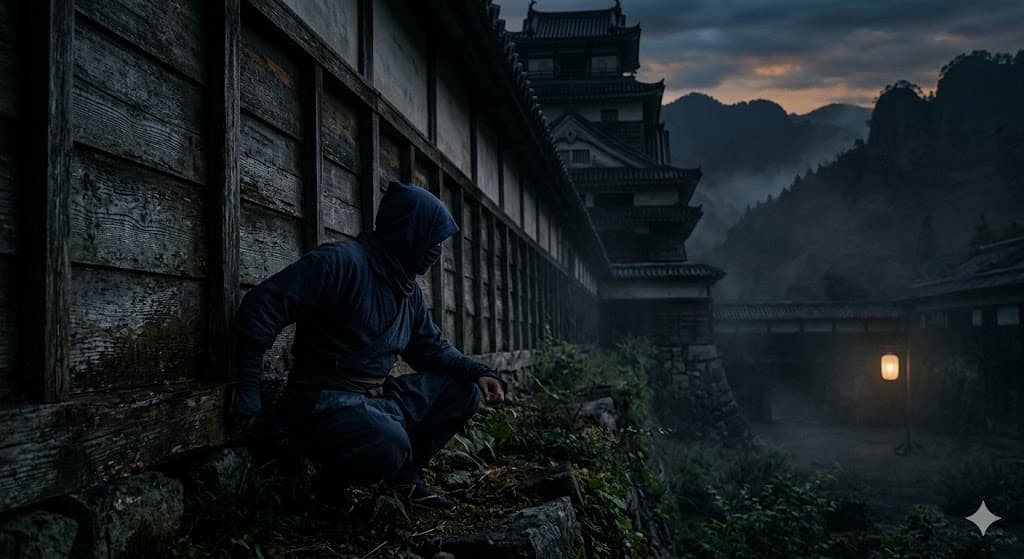
Spoiler-Free Cultural Analysis
This article looks at the real history and language behind the word "ninja" — the kanji 忍, the espionage groups of Iga and Kōga, and the gap between legend and record. It touches only on the opening premise and atmosphere of Naruto (a ninja school, graduation, the forehead protector) and reveals no plot beyond what any synopsis already states.
Key Takeaways
- The single character at the heart of "ninja," 忍, is built from a blade placed over a heart, and its oldest meanings are not stealth-magic but to conceal and, just as importantly, to endure.
- The historical shinobi of Iga and Kōga were mostly low-ranking warrior-farmers who sold their services as spies and scouts; the prized skill was being unremarkable enough to walk into a place, learn what was needed, and come home alive.
- The word "ninja" as we use it today is largely a modern, twentieth-century popularization, and the superhuman figure on screen grew out of theater and pulp novels long after the real craft had faded.
Key Terms Explained
- 忍 (Shinobu / Nin) / To Endure, To Conceal — A single character combining 刃 (ha, blade) over 心 (kokoro, heart); read shinobu as a verb and nin in compounds.
- 忍耐 (Nintai) / Endurance, Patience — The everyday word for perseverance, sharing its first character with "ninja" and carrying the sense of bearing hardship without complaint.
- 忍者 (Ninja) / Covert Agent — The Chinese-style (on'yomi) reading of 忍者; the older native reading is shinobi, short for shinobi-no-mono.
- 忍術 (Ninjutsu) / The Art of Stealth — The practical craft of disguise, infiltration, reconnaissance, and survival, not the cinematic display of supernatural powers.
- 伊賀・甲賀 (Iga / Kōga) / The Two Ninja Heartlands — Mountainous districts (today Mie and Shiga Prefectures) where networks of warrior families specialized in covert warfare during the Sengoku era.
Paper Shuriken and the Boy Who Wanted to Vanish
Long before I knew anything about history, I knew how to fold a 手裏剣(Shuriken: throwing star) out of a sheet of paper. In the back streets of downtown Tokyo where I grew up, friends and I played at being ninja almost every week. We folded shuriken from origami, cut up old plastic 下敷き(Shitajiki: pencil-case writing boards) into makeshift blades, and threw them at each other. The best part was crouching behind a wall and whispering, "a ninja erases his presence," then creeping up to startle someone. For us, the ninja was first of all a creature of hiding — of vanishing and reappearing — and only second a fighter.
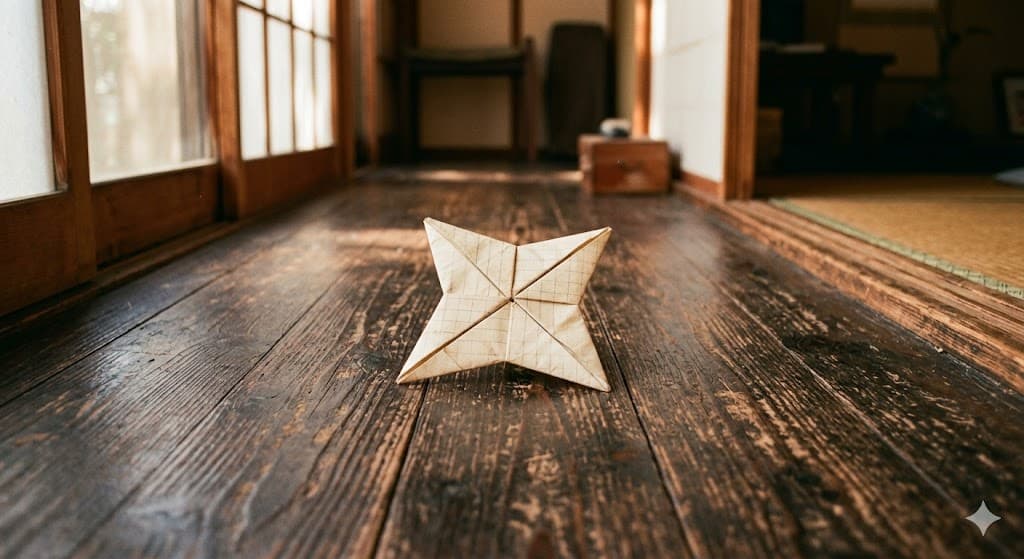 The ninja of childhood play and television was first of all a creature of hiding and spectacle.
The television and manga of my childhood pushed the figure in the opposite direction. On screen the ninja folded his hands into a sign, disappeared, split into copies of himself, and vanished in a puff of smoke. I loved every flashy moment of it. Looking back, the ninja I first carried in my head was not a person from any history book at all; it was that superhuman image, assembled from action scenes and clever tricks.
That same image is exactly where Naruto begins. The series opens inside a world that treats this fantasy as ordinary reality: there is a ninja academy, students graduate to become ninja, and the techniques they learn are called jutsu. A boy who keeps failing the graduation exam still dreams of becoming the village's greatest ninja. It is, in other words, the fully grown version of the playground I remember — the ninja as spectacle. What surprised me, much later, was how much the real word underneath all of it points somewhere quieter.
The Quiet Craft Behind the Smoke
The Word Itself: A Blade Over the Heart
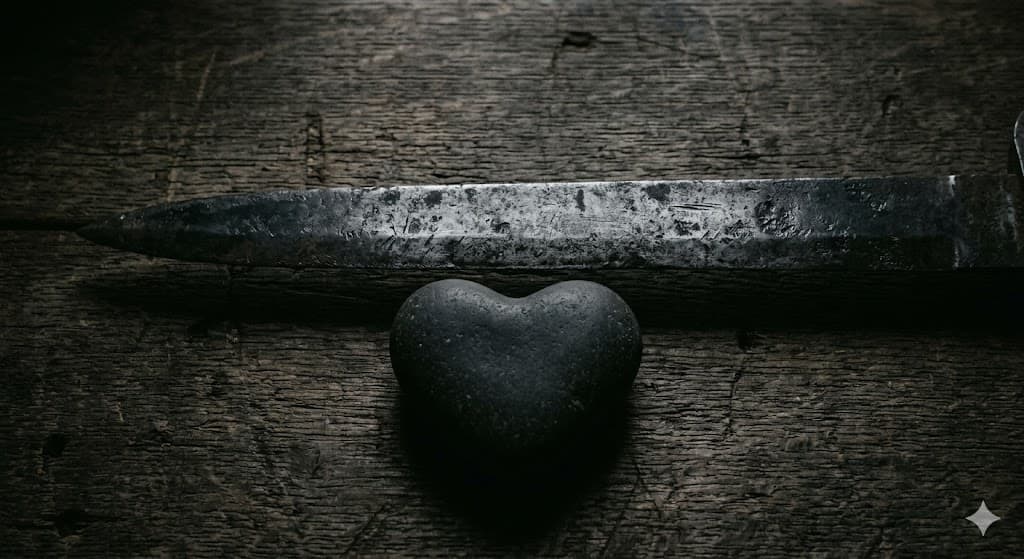 The character at the core of "ninja" encodes both concealment and endurance — a blade held over the heart.
The character 忍 is one of those kanji whose shape contains its own lesson. It places 刃(Ha: blade) directly above 心(Kokoro: heart or mind). The traditional reading of that picture is almost physical: to live with a blade pressed to your chest, holding still, refusing to let pain or emotion show. From that come both of its core meanings — to conceal, and to endure. The familiar word 忍耐(Nintai: endurance) carries the second sense into everyday Japanese, while the verb 忍ぶ(Shinobu: to conceal oneself, to bear) carries both.
This is older and broader than the action figure suggests. The word shinobi appears in Japanese writing as far back as the eighth-century poetry anthology, the 万葉集(Man'yōshū: Japan's oldest collection of poems), long before anything resembling a ninja movie existed. The historical manuals of the craft — the 萬川集海(Bansenshūkai: a 1676 compendium of shinobi knowledge) and the 正忍記(Shōninki: a 1681 manual) — did not even use the word "ninja." They wrote of shinobi, and they treated that blade-over-heart endurance as the foundation of everything else. A practitioner who could not master his own fear and greed was, in their view, no shinobi at all, however skilled his hands.
Iga and Kōga: Leagues of the Shadow
The real centers of this craft were two rugged, hard-to-reach districts near the old capital: Iga (modern Mie Prefecture) and Kōga, more properly Kōka (modern Shiga Prefecture). They were not mystical brotherhoods. They were communities of jizamurai — warrior-farmers of modest rank — who, in the long disorder of the medieval period, banded together into self-governing leagues called 一揆(Ikki: confederations for mutual defense). Protected by mountains and constant local fighting, they developed exactly the skills that chaos rewards: scouting, ambush, night raids, arson, and above all the gathering of information.
By the Sengoku era these men were in demand across many provinces, hired out as professional spies and mercenaries. Their first joint fame is recorded at the village of Magari in the late fifteenth century, where their hit-and-run tactics harried a shogun's army. The romanticized blood feud between Iga and Kōga that fiction loves appears to be largely invented; in practice they often allied. What ended their independence was overwhelming force. After an earlier humiliation of his son's troops, Oda Nobunaga crushed Iga in the campaign remembered as the 天正伊賀の乱(Tenshō Iga War) around 1581.
The aftermath is the part that always strikes me. Survivors did not vanish into legend; they found employment. Many Iga and Kōga families went on to serve Tokugawa Ieyasu, escorting him through dangerous country and later working within the new shogunate's intelligence network as guards and watchers over other lords. The shadow warriors became, in effect, civil servants of a peaceful state.
The Gap Between Fiction and Fact
Read the manuals and a very different professional appears. Espionage, not assassination, was the chief work. The shinobi's job was to slip into a place — often disguised as a monk, merchant, or farmer, blending into an accepted social role rather than dressing as a black-clad killer — observe, and bring the intelligence back. The highest expression of the art, as the Shōninki frames it, was not destruction but survival: returning alive, with what you came for, having left no memorable trace that you were ever there. The ideal was to be forgettable.
So how did we get the flying, multiplying ninja of my childhood television? Largely through the centuries after the real craft declined. Once the country was unified and at peace, the open need for such warriors dried up, and their stories migrated into 歌舞伎(Kabuki: traditional theater) and popular literature, where their abilities grew steadily more fantastic. Early-twentieth-century adventure novels made a Kōga hero with near-supernatural powers a household name, and the word "ninja" itself only became the common term in the modern era, spreading worldwide in the late twentieth century. The superhuman ninja, in short, is the descendant of the historical shinobi, not a portrait of him.
The Endurance Hidden Inside the Word
The part of all this that reaches me most is not the smoke or the shuriken. It is that buried second meaning — 忍 as endurance — because it describes a virtue I was raised inside without ever naming it.
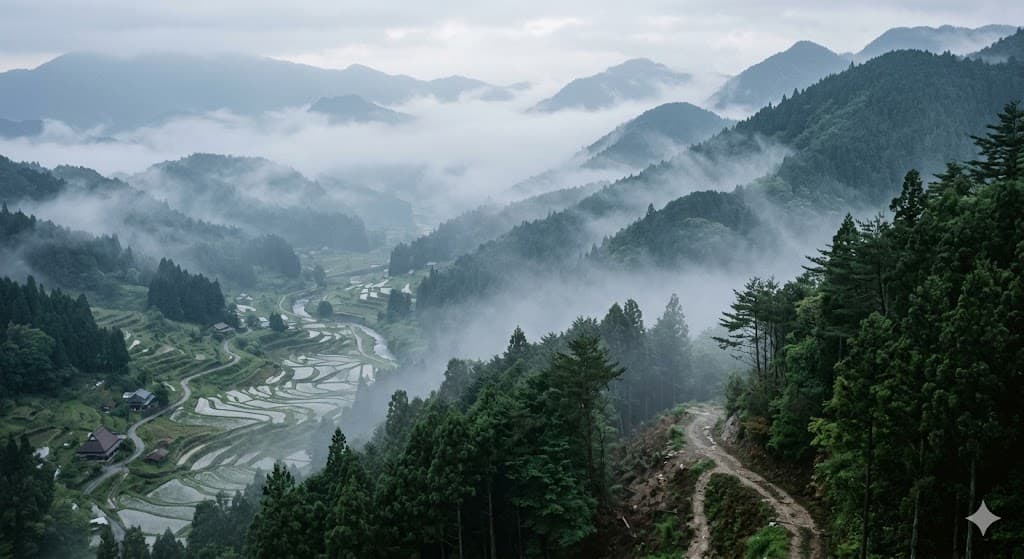 The rugged, hard-to-reach heartlands where warrior-farmers turned survival and patience into a craft.
At home I was told to be patient, that 我慢(Gaman: patient endurance) was the mark of a good child; wanting something was no reason to say so, and tears were something to swallow. At school and in club activities, simply bearing hard training was treated as meaningful in itself, and the child who endured without complaint earned respect. When I began working, in broadcasting and IT, the pattern held: the visible, glamorous part of any job was small, and the long stretches were spent quietly supporting others and putting up with deadlines and other people's schedules. None of this felt like a philosophy. It felt like air.
It was only after years of living outside Japan that I could see it from the outside. In the places I have lived, people state their wants and their displeasure on the spot, and someone who silently endures is often read as either a pushover or as having no opinion at all. The instinct to treat patient endurance as a quiet virtue, I realized, was something I had absorbed at home rather than something universal. And that realization sent me straight back to the word. The same character that fuels the flashy ninja of the screen also names the unglamorous discipline of holding still under pressure.
This is the piece I find hardest to carry across when "ninja" comes up abroad, and it comes up constantly — it is one of the most powerful single words Japan has exported, recognized across generations and borders in a way that tea ceremony or kimono are not. The costume travels. The throwing star travels. But the idea sitting inside the name — that to be a shinobi is, before anything else, to endure and to conceal what you feel — tends to stay behind. The version the world fell in love with is one slice of one fantasy. The older word is patient, watchful, and a little sad, and it was about coming home alive far more than about winning a fight.
FAQ
Q: Were real ninja actually superhuman warriors like in anime?
A: No. The historical shinobi of Iga and Kōga were mainly warrior-farmers hired for espionage, scouting, and sabotage. Their valued skill was blending in and returning alive with information, not supernatural combat. The superhuman image comes mostly from later theater, novels, and modern pop culture.
Q: Why does the kanji 忍 mean both "stealth" and "endurance"?
A: The character combines 刃 (blade) over 心 (heart). The traditional reading is that you bear a blade against your heart without flinching — concealing your feelings and enduring hardship. From that single image come both senses: to hide and to endure. The everyday word 忍耐 (nintai, endurance) shares the same character.
Q: Is "ninja" or "shinobi" the more accurate word?
A: Both point to the same figure, but shinobi (the native reading) is what the historical manuals like the Bansenshūkai actually used. "Ninja" is the Chinese-style reading of the same characters and became the common, worldwide term only in the modern era, especially the twentieth century.
Key Insights to Remember
- The most important "ninja symbol" is not the shuriken or the black hood but the character 忍 itself: a blade over a heart, encoding endurance and concealment as the discipline underneath the craft. Everything spectacular in the legend is a later addition layered on top of that quiet core.
- The real shinobi were valued for being inconspicuous, patient, and survivable — closer to intelligence agents than to assassins. Reframing them this way turns the question from "how did they fight?" into "how did they avoid being seen at all and make it home?", which is a more honest and more interesting question.
- A word can preserve a culture's values even after its surface meaning has been rewritten by entertainment. "Ninja" carries, hidden in its first syllable, the same ethic of gaman that quietly shapes daily life in Japan — a connection that is easy to miss precisely because the costume and the smoke are so loud.
Sources
- Ninja — Wikipedia
- Iga–Kōka alliance — Wikipedia
- Japan's Shadow Warriors: The Legend of Ninja — JAPAN HOUSE Los Angeles
- Shinobi Meaning: What Japan's Real Ninja Were Actually Called — Shinobi-Arts
- The Spirit of Ninja (忍者の精神) — Iga-ryu Ninja Museum
About the author

Spoiler-free cultural deep-dives into anime, manga & live-action Japanese drama
- ●Tokyo-born, 3rd-generation Edokko (江戸っ子)
- ●Lifelong manga reader & anime viewer since the kaiju era
- ●Writes from outside Japan — distance as a cultural lens
- ●Spoiler-free · sourced · Kanji + Romaji + English
A Tokyo-born, 3rd-generation Edokko writer who has spent years living outside Japan. I use the anime, manga, and live-action Japanese drama you already love as a doorway into the folklore, language, religion, and everyday history behind them — written so even first-time fans can follow along, with sources for every claim.
Enjoy this article?
Get the next spoiler-free cultural deep-dive straight to your inbox.
Related Articles
Your Name and Kumihimo: The Real Japanese Craft Behind Mitsuha's Braided Cord
How Your Name dramatizes kumihimo as a picture of musubi, and the real braided-cord craft behind it, from samurai armor to the modern kimono obijime.
10/12/2026

Touch and the Alps Stand of Koshien: Why Japan Unbolts Stadium Seats for a School Brass Band
How Touch's high-school baseball world leads to Koshien's Alps Stand, named by a cartoonist, and why seats are removed each August for school brass bands.
8/14/2026

Summer Wars and Hanafuda: The Flower Cards That Built Nintendo Before Video Games
How Summer Wars puts a deck designed to survive a gambling ban on the table, and why Nintendo spent its first 86 years making those flower cards by hand.
8/13/2026

In This Corner of the World and Japan's Noon Silence on August 15: The Minute a Whole Country Stops
How In This Corner of the World, set in wartime Kure, connects to Japan's mokutō, the noon silence each August 15 timed to the 1945 surrender broadcast.
8/12/2026

Sailor Moon and the Sailor Fuku: Why Japan Put a Skirt on a British Naval Uniform
How the sailor uniform behind Sailor Moon reached Japan — a British naval design adopted in 1920 so girls could do gymnastics, and the school that first paired the top with a skirt.
8/6/2026

Silver Spoon and Japan's Agricultural High Schools: The Real Nōgyō Kōkō Behind Ooezo
How Silver Spoon draws on Japan's real agricultural high schools — around 300 of them — and why their student farming clubs were deliberately modelled on an American organisation after the war.
8/5/2026