The Apothecary Diaries and the Eunuchs Japan Never Adopted
How The Apothecary Diaries dramatizes the eunuch-run rear palace, and why Japan never adopted China's castrati, relying on the walled Ōoku instead.

Tokyo-born, 3rd-generation Edokko · writing on Japanese culture from outside Japan
Spoiler-Free Cultural Analysis
This article explores the real comparative history behind the world of The Apothecary Diaries — the eunuch system of imperial China and the very different way Japan secured its own royal succession. It deals only with setting, atmosphere, and the history that the series draws on, and reveals nothing about the plot beyond the opening narration of the first episode.
Key Takeaways
- The eunuch-staffed rear palace that anchors The Apothecary Diaries was a real continental institution: China, Korea, and Vietnam all relied on castrated court officials to guarantee that every child born to a ruler was unmistakably his.
- Japan imported almost the entire Chinese court package — writing, law codes, Buddhism, ranks, even the idea of a sealed harem — yet it is the one country in the Chinese cultural sphere that never adopted the eunuch system.
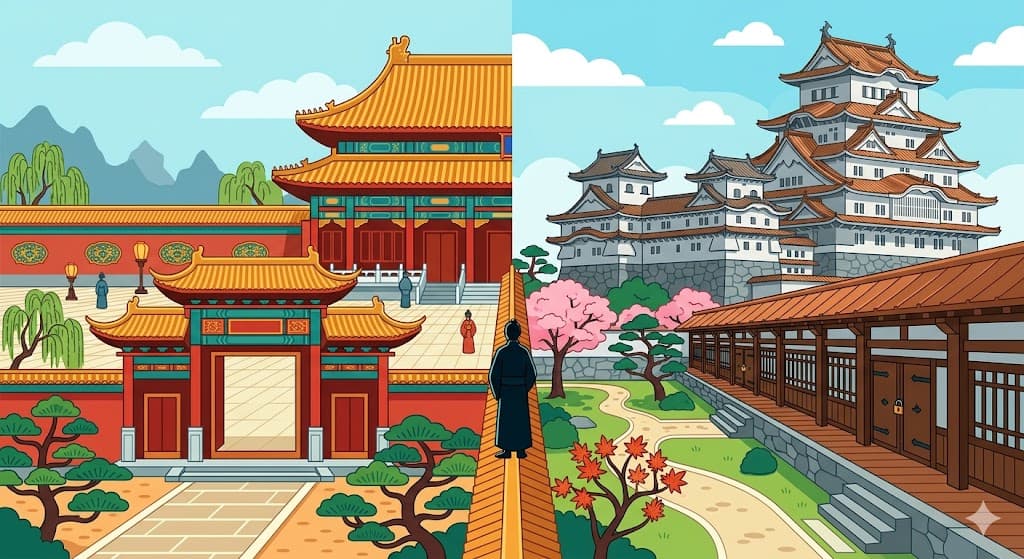
- Faced with the same problem, Japan reached a different answer: not a knife, but architecture. The Ōoku of Edo Castle sealed the women's quarters behind copper walls and a single locked corridor that only the shōgun could cross.
Key Terms Explained
- 宦官 (Kangan) / Eunuch — A man castrated so he could serve inside the imperial women's quarters without any possibility of fathering a child there. The defining staff of the continental inner court.
- 後宮 (Kōkyū) / Rear Palace — The walled inner quarters where an emperor's consorts and serving women lived. The setting of The Apothecary Diaries and the place Maomao is sold into.
- 律令 (Ritsuryō) / Penal and Administrative Codes — The Tang-modeled legal system Japan adopted in the seventh and eighth centuries, one of the clearest signs of how thoroughly Japan copied China's state machinery.
- 大奥 (Ōoku) / The Inner Chambers — The women's quarters of Edo Castle under the Tokugawa shoguns, sealed off from the rest of the castle and from the outside world.
- 御鈴廊下 (Osuzu Rōka) / Bell Corridor — The single locked passage connecting the Ōoku to the rest of Edo Castle, named for the bells rung to announce the shōgun's approach.
A Bystander to the Ōoku Dramas, Curious About the Walls
I grew up on television period drama, but never on the kind set inside the women's quarters. The staples I loved were 水戸黄門(Mito Kōmon: a long-running travelling-magistrate samurai series) and 暴れん坊将軍(Abarenbō Shōgun: a samurai series built around a sword-swinging shōgun) — stories of men moving through the open world, righting wrongs. The lavish Ōoku dramas, all rivalries and poison among the shōgun's ladies, never quite pulled me in. I knew the word, I knew the genre existed, but I watched from a distance. What did interest me, even as a boy, was the machinery underneath: how the shogunal house was actually structured, how Edo-period power was wired together.
There was also, I'll admit, the ordinary childhood pull of the forbidden room. A place only certain people may enter is a magnet for curiosity; the harder a door is locked, the more you want to know what shape the world takes on the other side. The Ōoku was exactly that kind of sealed interior, and the part of me that wanted to understand the walls always outweighed the part that wanted the gossip behind them.
It was only years later, watching the eunuchs glide through the corridors of The Apothecary Diaries, that the two halves of that old curiosity snapped together. The series opens by laying out a rule with almost clinical calm: the inner court is a women's world, men are forbidden, and the only males who may pass the gate are high nobles by blood and the eunuchs — men who have given up the parts that make them men. Hearing it stated so plainly, I finally understood that the Ōoku I had half-ignored as a child was Japan's answer to the very problem those eunuchs existed to solve. China reached for the knife. Japan reached for a wall. And that difference, it turns out, runs much deeper than a single palace.
Related: Ōoku: The Inner Chambers and the Real Ōoku of Edo Castle: The Sealed World Only One Person Could Enter explains this in detail.
One Problem, Two Continents, Two Answers
The anxiety every dynasty shared
 The castrated court official was the continent's answer to a universal dynastic problem: keeping men inside the inner court while removing any threat to the bloodline.
Strip away the silk and the intrigue and every hereditary monarchy faced the same blunt question: how do you guarantee that the child a consort bears is genuinely the ruler's? A throne passed by blood cannot afford doubt about whose blood it is. The inner court — the rear palace — existed to remove that doubt by removing every other man from the space where the heirs were conceived and raised.
In The Apothecary Diaries, you can see the engineering of that certainty in the background of almost every scene. The rear palace is a small city ringed by high walls on all four sides, each gate watched by eunuchs on the inside and soldiers on the outside, with a moat and a drawbridge for good measure. Roughly two thousand women live there, served by around a thousand eunuchs. It is a beautiful place, and it is a machine for controlling lineage.
Related: The Apothecary Diaries and the Art of Playing Dumb: Why Maomao Hides Her Brilliance explains this in detail.
China's answer: the knife
China's solution was to keep men in the inner court but make them incapable of fathering children there. A castrated official could carry, guard, lift, and administer; what he could not do was compromise the imperial bloodline. Some men entered this life through poverty or ambition, trading their bodies for proximity to power. Others arrived through the courts: castration, known as 宮刑(Kyūkei: castration imposed as a judicial punishment), was one of the gravest penalties in the Chinese legal repertoire, and it supplied the palace as a side effect of the law.
This was not a Chinese eccentricity that stopped at the border. Korea built its Joseon court around eunuch officials, and the courts of Vietnam employed them as well. Across the Chinese cultural sphere, the castrated court servant was simply part of how a serious monarchy was assembled. Which is exactly what makes Japan so strange.
What Japan borrowed — and the one thing it left at the gate
From roughly the seventh century onward, Japan studied China the way a determined apprentice studies a master. It took 漢字(Kanji: Chinese characters) and built its writing on them. It imported the ritsuryō codes and reorganized the state around them. It received 仏教(Bukkyō: Buddhism) and let it reshape the spiritual life of the court. It adopted Tang-style ranks, ceremonies, city planning, even the concept of an emperor's sealed harem.
And yet, out of that vast act of borrowing, Japan quietly left one piece on the shelf. It never adopted the eunuch. There is no native tradition of kangan, no Japanese Sima Qian, no caste of castrated officials accumulating power behind the throne. A country that copied China's court almost to the brushstroke declined to copy the men who staffed its inner sanctum.
Why the refusal? The theories
No single explanation is settled, and Japanese historians have argued the point for over a century. A few threads recur. One, often raised and just as often doubted, points to Buddhism's reverence for the body and its prohibition on mutilation — though China was just as Buddhist and kept its eunuchs, so the argument only goes so far.
A more striking theory comes from the cultural anthropologist 石田英一郎(Ishida Eiichirō: a Japanese cultural anthropologist), who treated castration first and foremost as a livestock technology. Castration spread among pastoral, meat-eating peoples who routinely gelded their animals; the technique, and the cultural comfort with it, traveled from the herd to the court. Japan was a rice-growing society with almost no tradition of animal husbandry — Japanese horses, famously, went un-gelded well into the modern era. If a culture never learned to castrate its livestock, the argument runs, it had neither the surgical know-how nor the everyday acceptance to start castrating men. Alongside this sits a simpler legal fact: castration was never adopted as a judicial punishment in Japan, so the court never had that grim, steady supply line that fed the Chinese palace.
A Wall Instead of a Knife: The Ōoku Solution
If Japan refused the eunuch, it still had the original problem to solve. Its answer was the Ōoku, the women's quarters built deep inside Edo Castle under the Tokugawa shoguns. Where China removed the masculinity from the men inside, Japan removed the men.
 Japan sealed the Ōoku behind copper walls and the locked Osuzu Rōka, a single corridor opened only when bells announced the shōgun's approach.
The architecture did the work that surgery did on the continent. The Ōoku was walled off from the rest of the castle by copper-plated barriers and connected to it by the Osuzu Rōka, a corridor that was kept locked and opened only when a bell announced the shōgun. By a law passed early in the seventeenth century, the women inside could not leave the castle without permission, and no adult man could set foot on the floor of the Ōoku except the shōgun himself. A handful of others — doctors, carpenters, certain officials — could enter only on tightly supervised business, never freely. One man, and one man only, had the run of the inner world.
The parallel to The Apothecary Diaries is almost uncanny, even though the series wears Chinese dress. Both are sealed cities of women, both ring their boundaries with guards and a single controlled point of passage, both exist to make a ruler's succession unquestionable. The difference is the human cost at the threshold. The continental rear palace is staffed by men who paid for entry with their bodies. The Ōoku simply let no man past the bell.
I should add a note of honesty here, because it bears on how these sealed worlds actually behaved. When I went out for my teaching practicum as a student, a senior teacher warned me that the world of schoolteachers carried strong 学閥(Gakubatsu: cliques based on one's alma mater), invisible from outside and very real once you were in. Later, founding a company and helping start an industry body, I met the same truth again: closed worlds grow their own hidden hierarchies. Both the eunuch court and the Ōoku prove the rule. Seal a space tightly enough and it will not stay quiet — it fills with its own factions, its own ranks, its own quiet wars. The Apothecary Diaries understands this perfectly; the poison is never only in the powder.
The View From Outside the Wall
Living outside Japan for many years has rearranged how I see all of this. When you stay inside one country, its way of doing things feels not like a solution but like the solution — the obviously correct shape of the world. It was only by leaving that I learned, again and again, to watch other people solve a problem I thought I already knew the answer to, and solve it completely differently. The problem was the same; the answer was just one of several, and mine had never been the only one.
 Continent and islands faced the same anxiety about royal blood and chose differently — one a permanent alteration of the body, the other a wall and a bell.
The eunuch question is that lesson written across a thousand years. The continent and the islands faced an identical anxiety about royal blood. One reached for a permanent alteration of the body; the other reached for a corridor and a bell. Neither was inevitable. Neither was the single right answer. They were two cultures choosing differently at the same fork.
There is something else worth sitting with. Japan's genius has always been described as borrowing — absorbing kanji, Buddhism, law, and a hundred other imports and making them its own. But the eunuch story shows the quieter, harder half of that talent: knowing what not to take. A culture that swallowed almost everything China offered still drew a line at this one thing and held it. Selective refusal is its own kind of cultural confidence, and it rarely gets the credit that borrowing does. Watching Maomao move through her perfumed, lethal rear palace, I find myself grateful, in a way I can't fully explain, that the country I come from looked at that particular door and decided to build a wall instead.
FAQ
Q: Were there really no eunuchs in Japan at all?
A: Essentially none in the Chinese sense. Japan never developed a class of castrated court officials, and historians treat it as the one country in the Chinese cultural sphere that declined the institution entirely, despite copying so much else from the continent.
Q: Is the rear palace in The Apothecary Diaries based on real Chinese history?
A: It is set in a fictional empire that is clearly modeled on imperial China rather than any exact dynasty. The eunuchs, the ranked consorts, the food tasters, and the walled inner court all reflect genuine features of the Chinese imperial harem, filtered through fiction.
Q: How is the Ōoku different from a Chinese rear palace?
A: Both sealed women away to protect the succession, but the Chinese court kept men inside by castrating them, while the Ōoku kept nearly all men out by law and architecture — copper walls, a locked bell corridor, and a rule that only the shōgun could enter.
Key Insights to Remember
- The eunuch is not a piece of exotic cruelty bolted onto a story; it is a solution to a real and universal problem of hereditary rule. The Apothecary Diaries shows that machinery working in the background of every scene, which is part of why its world feels so solid.
- Japan's refusal of the eunuch is more revealing than its many borrowings. A culture that took kanji, law, and Buddhism from China and still said no to this one institution was exercising judgment, not just imitation — and that judgment is a side of "tradition" we rarely examine.
- The deepest lesson sits at the level of method. The same human problem can have radically different cultural answers, none of them the single correct one. Seen side by side, the castrated official and the walled inner chamber are two reasonable people solving the same puzzle with the tools their world handed them.
Sources
- Ōoku — Wikipedia (https://en.wikipedia.org/wiki/%C5%8Coku)
- Palace Rendezvous: Rigid Rules Governed Sex Lives of Tokugawa Shōguns — Nippon.com (https://www.nippon.com/en/japan-topics/c10808/)
- Ōoku: Women of Power in Edo Castle — Tokyo Art Beat / Tokyo National Museum (https://www.tokyoartbeat.com/en/events/-/Ooku-Women-of-Power-in-Edo-Castle/1-DC-8-EF-86/2025-07-19)
- The Absence of Castration of Humans and Other Animals in Japan — Academia.edu (https://www.academia.edu/44821999/The_Absence_of_Castration_of_Humans_and_Other_Animals_in_Japan)
- Rear Palace — The Apothecary Diaries Wiki, Fandom (https://kusuriya.fandom.com/wiki/Rear_Palace)
- The Apothecary Diaries (Literature) — TV Tropes (https://tvtropes.org/pmwiki/pmwiki.php/Literature/TheApothecaryDiaries)
- O-oku — Japanese Wiki Corpus (https://www.japanesewiki.com/history/O-oku.html)
About the author

Spoiler-free cultural deep-dives into anime, manga & live-action Japanese drama
- ●Tokyo-born, 3rd-generation Edokko (江戸っ子)
- ●Lifelong manga reader & anime viewer since the kaiju era
- ●Writes from outside Japan — distance as a cultural lens
- ●Spoiler-free · sourced · Kanji + Romaji + English
A Tokyo-born, 3rd-generation Edokko writer who has spent years living outside Japan. I use the anime, manga, and live-action Japanese drama you already love as a doorway into the folklore, language, religion, and everyday history behind them — written so even first-time fans can follow along, with sources for every claim.
Enjoy this article?
Get the next spoiler-free cultural deep-dive straight to your inbox.
Related Articles
Your Name and Kumihimo: The Real Japanese Craft Behind Mitsuha's Braided Cord
How Your Name dramatizes kumihimo as a picture of musubi, and the real braided-cord craft behind it, from samurai armor to the modern kimono obijime.
10/12/2026

Touch and the Alps Stand of Koshien: Why Japan Unbolts Stadium Seats for a School Brass Band
How Touch's high-school baseball world leads to Koshien's Alps Stand, named by a cartoonist, and why seats are removed each August for school brass bands.
8/14/2026

Summer Wars and Hanafuda: The Flower Cards That Built Nintendo Before Video Games
How Summer Wars puts a deck designed to survive a gambling ban on the table, and why Nintendo spent its first 86 years making those flower cards by hand.
8/13/2026

In This Corner of the World and Japan's Noon Silence on August 15: The Minute a Whole Country Stops
How In This Corner of the World, set in wartime Kure, connects to Japan's mokutō, the noon silence each August 15 timed to the 1945 surrender broadcast.
8/12/2026

Sailor Moon and the Sailor Fuku: Why Japan Put a Skirt on a British Naval Uniform
How the sailor uniform behind Sailor Moon reached Japan — a British naval design adopted in 1920 so girls could do gymnastics, and the school that first paired the top with a skirt.
8/6/2026

Silver Spoon and Japan's Agricultural High Schools: The Real Nōgyō Kōkō Behind Ooezo
How Silver Spoon draws on Japan's real agricultural high schools — around 300 of them — and why their student farming clubs were deliberately modelled on an American organisation after the war.
8/5/2026