The Apothecary Diaries and the World of the Yūkaku: The Glamour and Cruelty Behind Maomao's Verdigris House
How The Apothecary Diaries opens a door onto Japan's yūkaku — the Edo pleasure quarters where the oiran's glamour and harsh debt bondage shared one address.

Tokyo-born, 3rd-generation Edokko · writing on Japanese culture from outside Japan
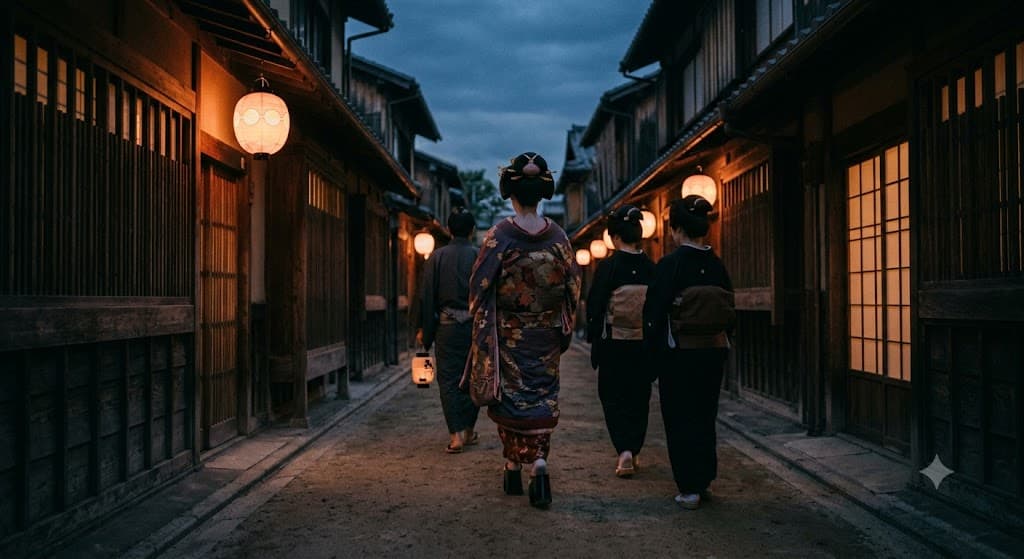
Spoiler-Free Cultural Analysis
This article explores the real history behind the pleasure-quarter world that frames The Apothecary Diaries, drawing only on the show's opening premise and publicly known setting — Maomao's upbringing in a brothel — to open a door onto Japan's own licensed pleasure districts. It discusses atmosphere, history, and cultural context only, with no plot revelations.
Key Takeaways
- The pleasure quarter that raised the heroine of The Apothecary Diaries is a fictional one, but it maps closely onto a real institution in Japanese history: the walled, licensed 遊郭(Yūkaku: a government-sanctioned pleasure quarter), of which Edo's Yoshiwara was the most famous.
- The top courtesans were not simply sex workers; they were ranked, branded, and trained celebrities whose education in poetry, music, and conversation could rival that of noblewomen — yet most had been sold into the trade and could not freely leave.
- The dazzling public procession of a star courtesan and the debt bondage that trapped her were two faces of the same system. Understanding that doubleness is the key to reading any pleasure-quarter story, on screen or in history.
Key Terms Explained
- 遊郭 (Yūkaku) / Licensed Pleasure Quarter — A walled, government-regulated district where prostitution was legally confined during the Edo period; Edo's Yoshiwara was the most renowned.
- 花魁 (Oiran) / High-Ranking Courtesan — The elite courtesans of Edo's Yoshiwara, celebrated for beauty and artistic training. The word pairs 花 ("flower") with 魁 ("leader").
- 太夫 (Tayū) / Top-Rank Courtesan — The highest, most cultured rank in the early quarters; priced out of Yoshiwara by the mid-1700s but preserved in Kyoto.
- 花魁道中 (Oiran Dōchū) / Courtesan's Procession — The slow, theatrical public parade in which a star courtesan walked to a teahouse to meet a client, surrounded by attendants.
- 身請け (Miuke) / Buying Out — Paying off a courtesan's remaining debt to the house so she could leave the quarter; for a famous oiran the sum could be ruinous.
A Glittering Procession on a Childhood Screen
The first time the pleasure-quarter world entered my imagination, it was through a television screen. As a child I watched 時代劇(Jidaigeki: Japanese period dramas) and films in which a 花魁(Oiran: a high-ranking courtesan of Edo's pleasure quarters) walked slowly down a street in layered, gorgeous kimono, dozens of hairpins fanned out around her head, a whole retinue trailing behind her. I had no words for what I was watching. I only thought, what a beautiful person, and let the image wash over me. To a child, the oiran was glamour itself — radiant, untouchable, the center of every eye. Nothing existed behind that picture, as far as I knew.
 The image of the glamorous oiran, radiant and untouchable, that first reached many viewers through period dramas and films.
That is why The Apothecary Diaries feels so familiar in its opening minutes, even though its story unfolds in a fictional empire modeled on imperial China rather than Japan. The heroine, Maomao, was raised in a brothel — the 緑青館(Ryokuseikan: the Verdigris House, the pleasure-house where she grew up) — and one of its star courtesans, one of the so-called Three Princesses, is treated by the street like a sight you are not allowed to look at without paying. That single early scene carries an entire institution inside it. The show's red-light district is invented, but the logic of it — ranked women on display, glamour sold by the glimpse, a child apprentice running medicine between the rooms — is the same logic that organized Japan's real pleasure quarters for more than two centuries. The anime simply gives a Japanese audience a doorway back into their own history.
What makes Maomao such a sharp narrator of that world is that she grew up inside it without being romanced by it. She learned about poison because she watched courtesans ruin themselves with lead-based white face powder, trading their health for the pale skin that drew customers. That is the perspective I lacked as a child in front of the screen — and the one this topic lets me finally look at directly.
The Architecture of a Walled Floating World
To understand why a pleasure quarter could produce both a celebrity and a prisoner in the same body, it helps to see how the real districts were built — physically and socially.
A District Built Behind Walls
吉原(Yoshiwara: the licensed pleasure quarter of Edo, in present-day Tokyo) was established in 1617 when the 徳川幕府(Tokugawa Bakufu: the shogunate that ruled Japan through the Edo period) decided to gather and regulate the city's brothels in one controlled place. After the 明暦の大火(Meireki no Taika: the Great Fire of Meireki) destroyed much of Edo in 1657, the quarter was rebuilt on marshy ground north of 浅草(Asakusa: a historic downtown district of Tokyo), behind the great temple 浅草寺(Sensō-ji: the temple at the heart of Asakusa), and became known as New Yoshiwara. It sat inside what is now 台東区(Taitō-ku: a central Tokyo ward).
 Yoshiwara was a self-contained, walled town near Asakusa — a glittering pocket of the floating world that doubled as a cage.
The crucial detail is the design. The quarter was surrounded by a moat and walls, with controlled gates. Those barriers were framed as keeping order, but they also kept the women in. Yoshiwara was a self-contained town with its own main street, its own teahouses, its own fashions and slang — a glittering pocket of 浮世(Ukiyo: the "floating world" of fleeting Edo pleasures) that fed the era's prints, novels, and theater. It was also a cage with beautiful bars. Both things were true at once, by design.
The Ranks Above the Lattice
Inside the walls, women were sorted into a strict, visible hierarchy — and the hierarchy was itself a marketing tool. In the early decades, the summit belonged to the 太夫(Tayū: the highest and most cultured rank of courtesan). A tayū was among the most educated women of her age, trained in classical literature, calligraphy, tea ceremony, poetry, the 三味線(Shamisen: a three-stringed plucked instrument), and even the strategy board game 囲碁(Igo: a game of territory played with black and white stones). At a banquet she sat in the seat of honor, above the client rather than beneath him, and she could refuse a patron she did not want. Just below her stood the 格子(Kōshi: a high rank of courtesan placed in the front row of the latticed display windows).
By the mid-1700s the economics shifted. The samurai who could afford a tayū were sliding into debt, and the rank was priced out of existence; the last Yoshiwara tayū retired in 1761. The word 花魁(Oiran) — thought to come from a phrase meaning roughly "the elder sister of our house" — spread as the general term for the top courtesans, with the 呼出し(Yobidashi: the highest oiran rank that replaced the tayū) at the peak. A yobidashi never sat in a window for passersby to inspect. A client had to summon her by name through a teahouse, and she would arrive in full procession. Below these elites ran a long ladder of lesser ranks, down to women soliciting from cramped doorways at the quarter's edge for a tiny fraction of an oiran's fee.
The Procession as Moving Advertisement
The most spectacular expression of that hierarchy was the 花魁道中(Oiran Dōchū: the courtesan's stately public procession). Clients did not walk into a brothel and point. They went first to a teahouse to negotiate, and then the lavishly dressed oiran came out to meet them, parading slowly through the quarter.
 The oiran dōchū was a moving advertisement: beauty, wealth, and rank turned into a slow public spectacle.
Everything about it was theater. Her hair was built into a towering arrangement studded with dozens of tortoiseshell hairpins. She wore layers of opulent kimono that could weigh well over twenty kilograms, her 帯(Obi: the wide sash that fastens a kimono) tied in front rather than behind, balanced on tall, three-pronged black-lacquered clogs. And she walked in a unique step called the 外八文字(Soto-hachimonji: the outward figure-eight gait), each foot sweeping out in a wide arc before planting forward. It was slow, hypnotic, and physically punishing. She was framed by attendants: lantern-bearers carrying her painted name, child attendants called 禿(Kamuro: young girl attendants in training), apprentice courtesans, and watchmen rattling iron staves to clear the way. Fox masks sometimes opened the parade, a nod to 稲荷(Inari: the deity of rice and foxes), the patron deity associated with the quarter. The whole display said one thing to the street: this is the finest we have, and you cannot afford to look without paying. It is exactly the energy of that early Verdigris House scene — beauty turned into a paid spectacle.
The Only Way Out
The glamour rested on a debt. Most courtesans had been sold into the quarter by impoverished families, or taken by men who traveled the countryside collecting girls, and the cost of their food, clothing, and training was charged against them as a debt they were expected to work off. Freedom of movement was severely limited. Disease, especially 梅毒(Baidoku: syphilis, literally "plum poison"), cut many lives short, and some women died young.
There was essentially one escape: 身請け(Miuke: paying off a courtesan's remaining debt to release her from the house). A wealthy patron could either settle directly with the brothel or route the money through her family. For a famous oiran the figure was staggering — sums that could reach the equivalent of hundreds of millions of yen today, so large that authorities at one point tried to cap them. Miuke is the quiet engine humming under every pleasure-quarter romance: the dream of being bought out, and the brutal arithmetic that made it a fantasy for almost everyone. When a story like The Apothecary Diaries lingers on which courtesan is prized and which is expendable, this economy is what it is pointing at.
What the Spring Processions Leave Out
I am an 江戸っ子(Edokko: a true-born Tokyoite) of the third generation, raised in the old downtown. I know the name Yoshiwara and I know where it is. And yet I have never once set foot in the former quarter. I have walked the nearby streets of Asakusa and 三ノ輪(Minowa: a neighborhood in Taitō Ward near the old Yoshiwara) many times — that slightly worn, low-rise downtown air is still in my body — but the old pleasure ground itself I have always, somehow, left alone. When I write about Yoshiwara for readers outside Japan, I want to keep that honest distance: I am not someone who was born there or carries its memory in my blood. I only know the air of the neighborhood next door.
What changed for me was not the place but the picture. As an adult I learned what sat behind the glamour I had admired on screen, and my view of the oiran was overwritten in a single stroke. The radiant women I had taken for free artists were, for the most part, people sold against a debt, unable to walk out the gate on their own. The exquisite kimono and hairpins were, in large part, a shop display meant to pull in customers, not a wardrobe chosen for pleasure. The brightness and the suffering, I realized, were not two separate things. They lived at the same address.
That doubleness is easy to lose today. Each spring, towns across Japan stage reenacted oiran processions — most famously in the old Yoshiwara backstreets behind Sensō-ji — and they are beautiful, family-friendly affairs, the figure-eight walk preserved like a dance. The pageantry survives; the debt does not march in the parade. Living far from Japan for many years has made me notice how comfortably a culture can keep the gorgeous half of a memory and quietly set down the painful half. There is nothing wrong with preserving the costume. But a show like The Apothecary Diaries does something the spring festivals cannot: it puts a girl who grew up backstage at the center, and lets her see the whole machine.
FAQ
Q: Were oiran the same as geisha?
A: No. Oiran were high-ranking courtesans of the licensed pleasure quarters whose role included prostitution, ranked within a strict hierarchy. Geisha were professional entertainers of music, dance, and conversation. A quick visual tell from the processions: an oiran wore her obi tied in front and walked barefoot on tall clogs, while a geisha wore a more subdued kimono with the obi tied at the back.
Q: Does the Verdigris House in The Apothecary Diaries depict the real Yoshiwara?
A: Not literally. The series is set in a fictional empire inspired by imperial China, so its pleasure district is invented. But the structure it shows — ranked courtesans, star "princesses," a controlled quarter, children raised inside it — closely echoes the real logic of Japan's yūkaku, which is why it reads as familiar to Japanese audiences.
Q: Can you still see an oiran procession today?
A: Yes, as reenactments rather than living practice. Prostitution was outlawed in Japan in 1957, ending the courtesan profession. Today, festivals such as the spring procession in the historic Yoshiwara area of Asakusa stage the oiran dōchū with full costume and the figure-eight walk, as cultural preservation.
Key Insights to Remember
- The pleasure quarter was engineered so that visibility itself was the product. Ranks, latticed windows, and the slow procession were not incidental decoration but a pricing system made visible — which is why the same display that elevated a courtesan to celebrity also marked her as merchandise.
- Cultural refinement and human captivity were not opposites in this world; they were bundled together. A tayū's mastery of poetry and a girl's sale against a debt belonged to one institution, and any honest account has to hold both at once rather than choosing the prettier half.
- Stories told from inside the quarter, like Maomao's, are valuable precisely because they refuse the tourist's gaze. A narrator who learned about poison from watching courtesans damage themselves sees the machinery the procession was built to hide — and that backstage vantage is the difference between admiring a costume and understanding a system.
Sources
- The Courtesans of Yoshiwara — Nippon.com
- Oiran — Wikipedia
- Yoshiwara — Wikipedia
- What is Oiran? Characteristics and Differences Between Tayū/Geisha — Japaniche
- Oiran: Japan's Courtesans — Yoshiwara History & Geisha Divide — Miyakodori
- Oiran: The Glamorous and Wretched Life of a High Courtesan — Uncanny Japan
About the author

Spoiler-free cultural deep-dives into anime, manga & live-action Japanese drama
- ●Tokyo-born, 3rd-generation Edokko (江戸っ子)
- ●Lifelong manga reader & anime viewer since the kaiju era
- ●Writes from outside Japan — distance as a cultural lens
- ●Spoiler-free · sourced · Kanji + Romaji + English
A Tokyo-born, 3rd-generation Edokko writer who has spent years living outside Japan. I use the anime, manga, and live-action Japanese drama you already love as a doorway into the folklore, language, religion, and everyday history behind them — written so even first-time fans can follow along, with sources for every claim.
Enjoy this article?
Get the next spoiler-free cultural deep-dive straight to your inbox.
Related Articles
Your Name and Kumihimo: The Real Japanese Craft Behind Mitsuha's Braided Cord
How Your Name dramatizes kumihimo as a picture of musubi, and the real braided-cord craft behind it, from samurai armor to the modern kimono obijime.
10/12/2026

Touch and the Alps Stand of Koshien: Why Japan Unbolts Stadium Seats for a School Brass Band
How Touch's high-school baseball world leads to Koshien's Alps Stand, named by a cartoonist, and why seats are removed each August for school brass bands.
8/14/2026

Summer Wars and Hanafuda: The Flower Cards That Built Nintendo Before Video Games
How Summer Wars puts a deck designed to survive a gambling ban on the table, and why Nintendo spent its first 86 years making those flower cards by hand.
8/13/2026

In This Corner of the World and Japan's Noon Silence on August 15: The Minute a Whole Country Stops
How In This Corner of the World, set in wartime Kure, connects to Japan's mokutō, the noon silence each August 15 timed to the 1945 surrender broadcast.
8/12/2026

Sailor Moon and the Sailor Fuku: Why Japan Put a Skirt on a British Naval Uniform
How the sailor uniform behind Sailor Moon reached Japan — a British naval design adopted in 1920 so girls could do gymnastics, and the school that first paired the top with a skirt.
8/6/2026

Silver Spoon and Japan's Agricultural High Schools: The Real Nōgyō Kōkō Behind Ooezo
How Silver Spoon draws on Japan's real agricultural high schools — around 300 of them — and why their student farming clubs were deliberately modelled on an American organisation after the war.
8/5/2026