The Apothecary Diaries and the Dokumiyaku: Inside Japan's Real History of Poison Tasting
How The Apothecary Diaries turns the poison taster into a quiet drama of power and risk, and what Japan's real 毒見役 system reveals about life near the throne.

Tokyo-born, 3rd-generation Edokko · writing on Japanese culture from outside Japan
Spoiler-Free Cultural Analysis
This article explores the real historical practice behind the "special task" given to the heroine in The Apothecary Diaries — the role of the poison taster in Japanese court and warrior society. It discusses institutions, atmosphere, and folk belief only, with no plot revelations beyond the setting an official synopsis already establishes.
Key Takeaways
- The poison taster, or 毒見役 (Dokumiyaku), was a real and dangerous post in Japan, not just a dramatic flourish — those who held it lived alongside the constant risk of paralysis or death.
- The Tokugawa shogunate built an elaborate, multi-stage tasting routine in which a single meal passed through many hands before reaching the ruler, the same "handled by several people" logic the drama dramatizes.
- The idea that 銀 (Gin: silver) blackens in the presence of poison is rooted in a genuine chemical reaction to sulfur, but it was never the all-purpose detector that fiction often suggests.
Key Terms Explained
- 毒見役 (Dokumiyaku) / Poison Taster — A person who ate a portion of a meal before a ruler to confirm it was free of poison, judging safety with their own body.
- お毒見 (Odokumi) / Honorific Poison Tasting — The ceremonial term for the tasting ritual performed for shoguns and high-ranking figures.
- 御膳奉行 (Zen-bugyō) / Magistrate of the Table — The Tokugawa official responsible for overseeing the shogun's meals and the tasting process.
- 砒素 (Hiso) / Arsenic — A favored historical poison, colorless and nearly tasteless, whose impure forms could darken silver.
- 硫化銀 (Ryūka-gin) / Silver Sulfide — The black compound formed when silver reacts with sulfur, the science behind the "silver detects poison" belief.
The Retainer Who Tasted First
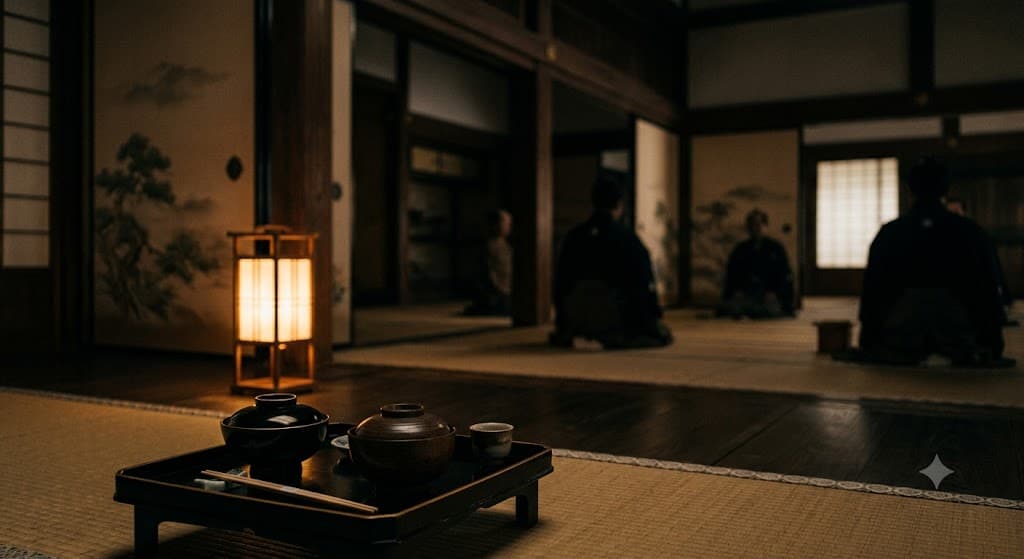
The first time I understood what a poison taster was, I was a child watching 時代劇 (Jidaigeki: period dramas) and 大河ドラマ (Taiga Drama: NHK's year-long historical series) on television. There was a recurring image I never questioned: before a lord lifted his chopsticks, a retainer would take the same tray, eat first, and wait. As a boy I filed it away as one of the genre's fixed set pieces, like the magistrate revealing his seal at the climax. It looked like staging, not history.
 The recurring jidaigeki image of a retainer tasting a lord's meal first — the screen version of the dokumiyaku that opens this story.
It was only as an adult that I learned the 毒見役 (Dokumiyaku: poison taster) was a genuine office, and that tasting first was not theater but a job carried out beside the real possibility of collapsing on the spot. That shift in understanding is exactly what The Apothecary Diaries reaches for in its second episode. The protagonist's "special task" inside the rear palace is presented first as a small mystery, then revealed as this very role — and the other attendants' looks of pity make sense only once you know what the role costs. The drama is doing quietly what took me years to grasp: peeling back a familiar screen image to show the danger underneath.
What struck me watching the episode is how the story frames the meal as something that passes through many hands before it arrives. That detail is not invented for atmosphere. It maps almost exactly onto how the real system worked.
Related: The Apothecary Diaries and the Eunuchs Japan Refused: How the One Land That Copied China's Court Rejected Its Castrati explains this in detail.
How Japan Built a Wall of Tasters Around Power
Heian Nobles and the Old Fear
 The Tokugawa court multiplied a single meal into many identical trays, layering taster after taster so no one could know which one the shogun would eat.
The fear of poisoned food in Japan reaches back well before the warrior age. In the aristocratic world of the 平安時代 (Heian Jidai: the Heian period, 794–1185), court life ran on rank, rivalry, and proximity to the throne, and the same intrigues that drove political maneuvering also made what one ate a matter of trust. A meal prepared and carried by others was, by its nature, a point of vulnerability. The rear palace setting of The Apothecary Diaries — a fictional realm clearly modeled on this kind of court — inherits that anxiety directly. When a favored concubine's life is described as always being at risk, the food on her tray is one of the quiet front lines.
Sengoku Warlords and Calculated Suspicion
By the 戦国時代 (Sengoku Jidai: the Warring States period, roughly 1467–1600), suspicion had hardened into method. Warlords who could be felled on the battlefield could just as easily be removed at the dinner table, and poisoning was a recognized tool of elimination. One documented case from a slightly later domain conflict, the 伊達騒動 (Date Sōdō: the Date house disturbance), involved an attempt to poison a young heir; the plot failed, and the domain quietly recorded the matter as food poisoning to keep it from reaching the shogunate. The detail tells you everything about the era's logic: poison was real, and its political fallout was so dangerous that even a foiled attempt had to be buried.
The Tokugawa Machine of Tasting
It was under the 徳川 (Tokugawa) shoguns that poison tasting became a full bureaucratic system, and this is where the drama's "handled by several people" image finds its closest real-world match. The process was deliberately, almost obsessively layered.
Cooks prepared not one portion but around ten identical servings, so that no one could know in advance which tray the shogun would actually receive — a way of spreading out the risk of tampering. Oversight fell to the 御膳奉行 (Zen-bugyō: the magistrate of the table), and the food then moved through stage after stage of checking and tasting. An early tasting was performed, the dishes waited while any sign of trouble would have time to appear, the trays were escorted down long corridors under watch so nothing could be added, the cooled food was reheated over charcoal, and tasting happened again. At the very end, in the shogun's own presence, attendants called 小姓 (Koshō: pages) performed a final taste before the ruler lifted his chopsticks.
The whole sequence could take around two hours, which meant the most powerful man in the realm ate his meals cold every single day. There is a grim irony there that the drama understands well: all this protection, and almost no pleasure in the eating.
There is one wrinkle worth keeping in mind. In the late-Edo reality, the formal "poison taster" was often less a person whose job was to taste than an official whose job was to make others taste — the cooks and carriers themselves became the body that proved the food. The romantic image of a single noble taster is, in that sense, partly a fiction. But the human cost the drama dwells on — the earlier taster left with lasting nerve damage — is true to the spirit of the thing. Tasting first was never safe.
The Silver That Turns Black
The Apothecary Diaries also touches the old belief that 銀 (Gin: silver) vessels react to poison, and it is worth handling this one carefully, because it sits exactly on the line between science and folklore.
 Silver darkens when it meets sulfur — the half-true chemistry behind the old belief that a blackening silver vessel could betray a poisoned meal.
There is real chemistry here. Silver reacts readily with sulfur, forming black 硫化銀 (Ryūka-gin: silver sulfide) on its surface. Historically, a common poison was 砒素 (Hiso: arsenic), which is itself colorless and nearly tasteless — but in earlier centuries the refining was crude, so arsenic preparations often carried sulfur impurities. Those impurities could darken silver, and so a blackening silver dish or pin could, sometimes, betray a tainted meal. The same logic made silver tableware prized among the elite across Eurasia, and silver needles were used as poison tests in continental court practice.
The honest caveat is that this was never a reliable detector. Pure arsenic does not react with silver at all, and with cleaner refining the trick stops working entirely. Silver darkens on its own simply from the trace sulfur in ordinary air. So the "silver reveals poison" idea is best understood as half science, half folk belief — a genuine reaction that real people leaned on, dressed up over time into something more certain than it ever was. When the drama lets a character note that silver would have been the safer choice of bowl, it is invoking exactly this layered, semi-superstitious knowledge.
What Stays With Me, Living Far From a Country Where the Tap Is Trusted
For most of my life in Japan, I never thought about whether food or water was safe. You drank from the tap. You ate what was set in front of you. That baseline of trust was so total that it was invisible, the way the painted sky behind steam is invisible when you grow up seeing it every day.
Living outside Japan for many years has rearranged that. In the place I now call home, you cannot drink straight from the tap; bottled water is sold everywhere, and there is a whole small economy of delivering drinking water to people's doors. I boil tap water before I drink it. Even so, I have had my share of stomach trouble from food and water that looked perfectly fine. None of this is dramatic. It is just ordinary life in much of the world — and it taught me that the Japanese assumption I once took as natural, that what you are served can be eaten without a second thought, is actually a rare and expensive privilege.
That is the lens through which the 毒見役 (Dokumiyaku) stops feeling like a museum piece. The instinct to confirm that something is safe before you put it in your body is not exotic at all once safety is no longer guaranteed. The historical poison taster was the most extreme expression of an impulse that, in milder forms, I now recognize in my own kitchen. The institution is gone, but the underlying human caution it grew from is still very much alive — it simply moved from the palace to the water cooler.
There is also a quieter point worth noticing. In modern Japanese, 毒見 (Dokumi) has become a faintly archaic, even joking word. When my family wants to check whether a dish tastes right, we say 味見 (Ajimi: a taste-check), never 毒見. The poison taster survives in the language mostly as a relic of period drama, a fossil of a time when the worry behind it was literal. That fading of a word is its own kind of record — proof of how thoroughly the danger receded, at least at home.
FAQ
Q: Was the poison taster a real job in Japan, or just something from dramas?
A: It was real. Poison tasting, known as 毒見 (Dokumi) or お毒見 (Odokumi), was practiced for shoguns, domain lords, and other high-ranking figures, and the Tokugawa shogunate organized it into a formal, multi-stage routine overseen by a dedicated official. Period dramas dramatize it, but the institution itself existed.
Q: Did silver vessels actually detect poison the way fiction shows?
A: Only partly. Silver reacts with sulfur to form black silver sulfide, and historical arsenic preparations often contained sulfur impurities, so silver could sometimes darken near a tainted dish. But pure arsenic does not react with silver, and silver tarnishes on its own from ordinary air, so it was never a dependable test — more a mix of real chemistry and folk belief.
Q: Why did the shogun's meals involve so many people?
A: The layering was a deliberate security measure. Cooks made multiple identical servings so no one knew which tray the shogun would get, the food was tasted and watched at several stages, and pages performed a final taste in his presence. Spreading the meal across many hands made tampering far harder — the same logic The Apothecary Diaries dramatizes.
Key Insights to Remember
- The poison taster shows how political power in old Japan was paid for in other people's bodies. The ruler's safety was manufactured through a chain of subordinates who absorbed the risk, and the drama's image of pitying glances toward the new taster captures the real social weight of that arrangement.
- The "silver detects poison" motif is a clean example of how folk knowledge forms. A real but limited chemical reaction gets generalized, over generations, into a confident rule — and fiction inherits the confident version, not the cautious truth. Reading the motif well means holding both the science and the superstition at once.
- Distance has a way of making the invisible visible. The casual trust that lets you eat anything set before you is not a universal human condition but a fragile, historically built one. The poison taster sits at the far, institutional end of a caution that ordinary life in much of the world still quietly demands.
Sources & References
About the author

Spoiler-free cultural deep-dives into anime, manga & live-action Japanese drama
- ●Tokyo-born, 3rd-generation Edokko (江戸っ子)
- ●Lifelong manga reader & anime viewer since the kaiju era
- ●Writes from outside Japan — distance as a cultural lens
- ●Spoiler-free · sourced · Kanji + Romaji + English
A Tokyo-born, 3rd-generation Edokko writer who has spent years living outside Japan. I use the anime, manga, and live-action Japanese drama you already love as a doorway into the folklore, language, religion, and everyday history behind them — written so even first-time fans can follow along, with sources for every claim.
Enjoy this article?
Get the next spoiler-free cultural deep-dive straight to your inbox.
Related Articles
Your Name and Kumihimo: The Real Japanese Craft Behind Mitsuha's Braided Cord
How Your Name dramatizes kumihimo as a picture of musubi, and the real braided-cord craft behind it, from samurai armor to the modern kimono obijime.
10/12/2026

Touch and the Alps Stand of Koshien: Why Japan Unbolts Stadium Seats for a School Brass Band
How Touch's high-school baseball world leads to Koshien's Alps Stand, named by a cartoonist, and why seats are removed each August for school brass bands.
8/14/2026

Summer Wars and Hanafuda: The Flower Cards That Built Nintendo Before Video Games
How Summer Wars puts a deck designed to survive a gambling ban on the table, and why Nintendo spent its first 86 years making those flower cards by hand.
8/13/2026

In This Corner of the World and Japan's Noon Silence on August 15: The Minute a Whole Country Stops
How In This Corner of the World, set in wartime Kure, connects to Japan's mokutō, the noon silence each August 15 timed to the 1945 surrender broadcast.
8/12/2026

Sailor Moon and the Sailor Fuku: Why Japan Put a Skirt on a British Naval Uniform
How the sailor uniform behind Sailor Moon reached Japan — a British naval design adopted in 1920 so girls could do gymnastics, and the school that first paired the top with a skirt.
8/6/2026

Silver Spoon and Japan's Agricultural High Schools: The Real Nōgyō Kōkō Behind Ooezo
How Silver Spoon draws on Japan's real agricultural high schools — around 300 of them — and why their student farming clubs were deliberately modelled on an American organisation after the war.
8/5/2026