Naruto and Yakuwarigo: The Real Meaning of Dattebayo and Why Translators Invented Believe It!
How Naruto's famous verbal tic dattebayo opens the door to yakuwarigo, Japan's role language system, and why English translators had to invent Believe it!

Tokyo-born, 3rd-generation Edokko · writing on Japanese culture from outside Japan
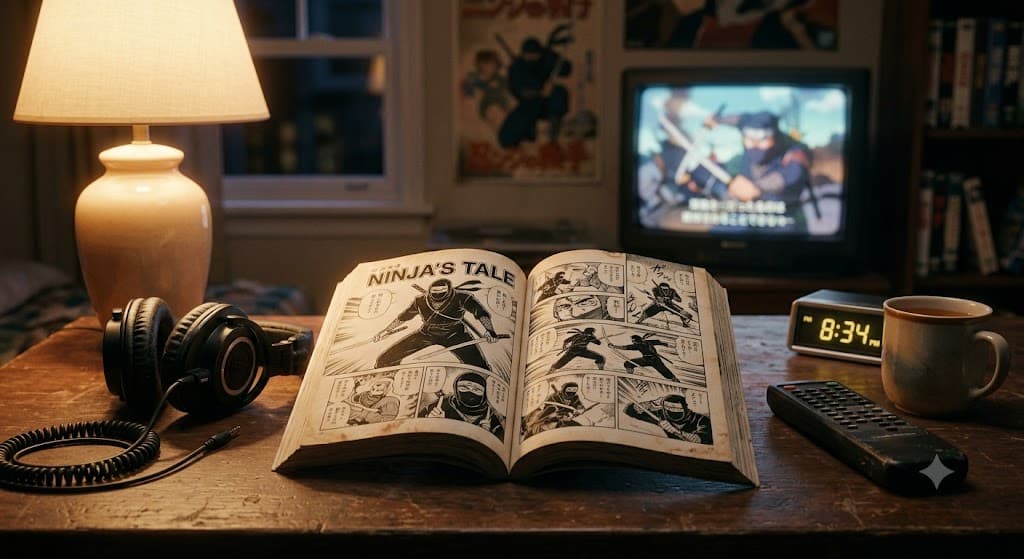
Spoiler-Free Cultural Analysis
This article explores the real linguistic and cultural background behind Naruto's famous catchphrase — Japanese role language, sentence endings, and translation choices. It contains no plot spoilers beyond what appears in the very first episode.
Key Takeaways
- "Dattebayo" has no dictionary meaning. It is not a word you can look up; it is an emphatic verbal tic built from ordinary Japanese particles, designed to make a character's voice instantly recognizable.
- Japanese fiction assigns each character type a distinct way of ending sentences — a system linguists call yakuwarigo, or role language. A single sentence-final syllable can tell you a character's age, gender, class, and personality before you see their face.
- "Believe it!" was invented by English translators because English has no grammatical slot for character-marking sentence endings. It translates the function of "dattebayo" — loud, insistent, begging to be acknowledged — rather than its nonexistent meaning.
Key Terms Explained
- 役割語 (Yakuwarigo) / Role Language — A set of speech patterns (word choice, sentence endings, pronouns) that Japanese speakers instantly associate with a character type: the old man, the samurai, the refined young lady. Coined as an academic term in 2003 by the linguist 金水敏 (Kinsui Satoshi).
- 語尾 (Gobi) / Sentence Ending — The final syllables of a Japanese sentence, where particles and copula forms carry emotion, attitude, and — in fiction — character identity.
- だってばよ (Dattebayo) / Naruto's Verbal Tic — An emphatic, semantically empty ending unique to Naruto, roughly carrying the force of "I'm telling you!" without meaning anything concrete.
- 一人称 (Ichininshō) / First-Person Pronoun — The word for "I." Japanese offers many — 僕 (boku), 俺 (ore), 私 (watashi), わし (washi), and more — and the choice itself signals identity.
- キャラ語尾 (Kyara-gobi) / Character Sentence Ending — An invented ending attached to one specific character, of which "dattebayo" is perhaps the most famous example in the world.
The Afternoon I Talked Like Bakabon's Papa
Long before I had any vocabulary for linguistics, I understood in my body that a few syllables at the end of a sentence could turn you into someone else.
 Borrowing a character's sentence ending was all it took — for a few seconds, we became the character.
As a kid in Tokyo, I spent whole afternoons imitating catchphrases from anime and TV heroes. The one I wore out completely was from 天才バカボン(Tensai Bakabon: a classic gag manga and anime), whose father figure ends his declarations with これでいいのだ(Kore de ii no da: "This is fine as it is"). Half my class said it too. Add the obligatory 変身!(Henshin!: "Transform!") pose from 仮面ライダー(Kamen Rider: a classic tokusatsu hero series), and that was our playground repertoire. What strikes me now is how little effort transformation required. We didn't need costumes. We didn't need to act. We just borrowed the character's sentence ending, and for a few seconds we were the character.
Decades later, watching the English version of 『NARUTO -ナルト-』(Naruto: Masashi Kishimoto's ninja manga and its anime adaptation), I hit the mirror image of that playground magic. The hero's constant だってばよ(dattebayo: his signature emphatic tic) had become "Believe it!" — a phrase with clear meaning, where the original had none. I remember genuinely being surprised. Something that defined the character so completely in Japanese simply could not travel in its original form. That surprise is the doorway into one of the most Japanese features of the Japanese language.
Related: Ocean Waves and the Tosa Dialect: Why a Real Japanese Accent Sounds Like a Period Drama explains this in detail.
The Hidden Grammar of Japanese Character Speech
A Language Where the Sentence Ending Does the Acting
English builds a speaker's identity mostly through vocabulary and accent. Japanese has an additional, extraordinarily efficient channel: the end of the sentence. The same statement — "It's raining" — can end in だ(da: the plain copula), です(desu: the polite copula), だよ(da yo: a casual assertive ending), じゃ(ja: an archaic copula assigned to fictional elders), でござる(de gozaru: an archaic copula associated with samurai), ですわ(desu wa: a refined feminine ending), or a dozen other forms, and each one paints a different speaker. The information load carried by those final syllables is enormous: politeness, gender coding, age, region, class, mood.
Fiction exploits this channel relentlessly. In the first episode of Naruto, before any backstory lands, Japanese viewers already know from speech alone that Naruto is a brash, childish boy, that イルカ(Iruka: Naruto's academy teacher) is a firm but caring adult, and that the 火影(Hokage: the ninja village's leader) speaks with the gravity of an elder. The subtitles you read in English carry the plot; the sentence endings carry the casting.
Yakuwarigo: The Name for What Every Japanese Reader Already Knows
In 2003, the linguist Kinsui Satoshi gave this phenomenon a name: 役割語(yakuwarigo: role language). His observation was deceptively simple. Every Japanese speaker can identify the speaker behind lines like わしは知っておるじゃ(washi wa shitteoru ja: "I know it," in stereotypical old-man speech, using わし washi, an elderly "I"), そうですわ(sō desu wa: "That's right," in refined young-lady speech), or 拙者は侍でござる(sessha wa samurai de gozaru: "I am a samurai," in stock samurai speech) — even though almost nobody in real life talks that way. Role language is a shared fictional code, learned in childhood from manga, anime, and picture books, and maintained almost entirely inside fiction.
 Role language: speech styles every Japanese reader recognizes instantly, though almost no one speaks them in real life.
What fascinates me most is where these codes come from. The stereotypical old-man speech — washi with the ending ja — is generally traced to the speech of the 京都(Kyoto: Japan's old imperial capital)–大阪(Osaka: the great merchant city of western Japan) region as it sounded centuries ago to the ears of 江戸(Edo: the former name of Tokyo): in the popular theater of the day, older, learned characters spoke in the older western style while young protagonists spoke fresh Edo Japanese. The association fossilized, and it still runs today. When a wise elder in a 2020s anime says "ja," he is unknowingly performing a linguistic fossil of the 江戸時代(Edo jidai: the Edo period, 1603–1868). Samurai speech, young-lady speech, country speech — each is a costume sewn from real historical fabric, then preserved in the wardrobe of fiction long after real speakers stopped wearing it.
Taking Apart "Dattebayo"
So what is "dattebayo," linguistically? It decomposes into three ordinary pieces: だ(da: the plain copula, "is"), ってば(tteba: an emphatic particle meaning roughly "I'm telling you," the tone of a child insisting after being ignored), and よ(yo: a final particle asserting information at the listener). Stacked together, the pieces are all real Japanese — but no actual person stacks them as a fixed tic on the end of nearly every sentence.
That is exactly the point. "Dattebayo" is not slang; it is a キャラ語尾(kyara-gobi: character sentence ending) — an ending invented for one character, functioning like an audio signature. Its childish insistence fits a boy who craves acknowledgment: every sentence he speaks grammatically demands to be heard. The tic characterizes him even when the content of his words does not. This is role language pushed to its logical extreme — not a social type's costume, but a single individual's fingerprint.
Why "Believe It!" Had to Be Invented
Now put yourself in the translator's chair. English sentences do not have a slot for a semantically empty, character-marking final particle. You cannot end every English sentence with a meaningless syllable cluster and have it read as characterization; it reads as a typo. Leaving "dattebayo" untranslated would mean deleting the character's most distinctive trait for the majority of viewers.
 With no English slot for a character-marking sentence ending, translators replaced the form with a phrase that does the same job.
The English adaptation's solution was functional translation: replace the untranslatable form with a phrase that does the same job. "Believe it!" is loud, repetitive, slightly annoying, and pleads for acknowledgment — a close functional match for the tic's emotional payload, and short enough to fit the animated mouth movements in the dub. Later official translations experimented with softer solutions such as "ya know," which trades punch for naturalness. Neither is "correct," because there is no correct answer; the source expression has form and function but no meaning to be faithful to. Once I understood that, my old surprise turned into respect. Inventing "Believe it!" was not a liberty taken with the text — it was an honest answer to a structural gap between two languages.
A Language I Only Hear in Fiction
Here is the part that took me years living outside Japan to see clearly.
I have lived in Tokyo among real speakers, and I am a third-generation 江戸っ子(Edokko: a true Tokyoite). Yet I have almost never met an actual elderly person who says "washi... ja," or a real young woman who ends sentences with "desu wa." Even the famously brash べらんめえ調(beranmee-chō: rough-and-ready old Edo working-class speech) that fiction assigns to people like my own family — I barely heard it at home. My household spoke plain standard Japanese. The vivid character voices I grew up "hearing" lived almost entirely on the page and on the screen. Role language is a Japanese that every Japanese person understands and almost no Japanese person speaks.
And yet it is not fake, exactly. It is more like a shared national theater that everyone joined as a child. I did it myself in miniature: at some point in my youth, my first-person pronoun shifted from boku, the boyish "I," to ore, the rougher masculine "I," and as an adult I switch to watashi, the neutral formal "I," in business settings. I cannot tell you the day it happened, but the shift was real, and it changed how I positioned myself in every conversation. Real Japanese speakers do perform identity through pronouns and endings — just on a subtler dial than fiction turns it.
Living for many years in a place where daily life runs in English has sharpened the contrast. English gives me exactly one "I," and my sentences end where the information ends. It is efficient, and something is missing. When I watch anime with English subtitles now, I can see the invisible layer draining away in real time: the plot arrives intact, while the casting encoded in the sentence endings quietly evaporates. "Believe it!" was one translator's attempt to bottle a little of that evaporating layer. Knowing what it stands in for makes the original — and the translation — both more interesting to watch.
FAQ
Q: What does "dattebayo" actually mean?
A: Nothing, in the dictionary sense. It combines the plain copula da, the emphatic particle tteba ("I'm telling you"), and the assertive particle yo into a signature verbal tic. It conveys insistence and a craving to be acknowledged, but it has no translatable content — which is precisely why translators had to invent a functional substitute.
Q: Is "Believe it!" an accurate translation?
A: It is a functional one. Since English has no grammatical slot for character-marking sentence endings, the English adaptation chose a short, punchy phrase that reproduces the tic's effect — loud, repetitive, attention-demanding — and fits the dub's mouth movements. Later translations tried alternatives such as "ya know." None is literally accurate, because there is no literal meaning to be accurate to.
Q: Do real Japanese people talk like anime characters?
A: Almost never. Role language — old-man speech, samurai speech, refined-lady speech — is a fictional code that all Japanese speakers learn to recognize from childhood media but rarely use in real life. Real speakers do express identity through pronoun choice and sentence endings, only far more subtly than fiction does.
Key Insights to Remember
- Japanese outsources characterization to grammar. Where English fiction must show identity through vocabulary, accent, and description, Japanese can encode age, gender, class, and personality directly into sentence endings. This makes Japanese dialogue astonishingly economical — and makes a layer of every anime effectively invisible in translation.
- Role language is history preserved in fiction. The "old man's ja" descends from Edo-period impressions of western-Japan speech; samurai speech and other codes are similar fossils. Japanese fiction functions as a museum of dead and dying speech styles that every viewer can still read fluently, even though no one speaks them anymore.
- "Believe it!" is a lesson in what translation really is. The best translation of a meaningless expression cannot be a meaning; it must be a function. The phrase's invention shows translators grappling honestly with a structural gap between languages — and understanding that gap makes both the Japanese original and the English version richer to watch.
Sources
About the author

Spoiler-free cultural deep-dives into anime, manga & live-action Japanese drama
- ●Tokyo-born, 3rd-generation Edokko (江戸っ子)
- ●Lifelong manga reader & anime viewer since the kaiju era
- ●Writes from outside Japan — distance as a cultural lens
- ●Spoiler-free · sourced · Kanji + Romaji + English
A Tokyo-born, 3rd-generation Edokko writer who has spent years living outside Japan. I use the anime, manga, and live-action Japanese drama you already love as a doorway into the folklore, language, religion, and everyday history behind them — written so even first-time fans can follow along, with sources for every claim.
Enjoy this article?
Get the next spoiler-free cultural deep-dive straight to your inbox.
Related Articles
Chihayafuru and the World of Competitive Karuta: The Speed, Silence, and Poetry Behind Japan's Fiercest Card Game
How Chihayafuru reveals competitive karuta, where poems from the 13th-century Hyakunin Isshu meet athletic reflexes and matches turn on hundredths of a second.
7/28/2026

Chainsaw Man and Why Every Japanese Dog Is Named Pochi: The Hidden History Behind Pochita
How Chainsaw Man's Pochita carries the history of Pochi, the Meiji-era nickname that became Japan's default dog name — and what that says about loyalty.
7/11/2026

Evangelion's Angels and Japan's Decorative Christianity
How Neon Genesis Evangelion's enemies are 使徒 (apostle) in Japanese but Angel in English — and how Japan wears Christianity as aesthetic, not faith.
7/3/2026

Solo Leveling and Te-ate: Why the Japanese Word for Treatment Means Placing the Hand
How Solo Leveling's healing magic opens onto te-ate, the Japanese word for treatment whose root is the simple act of placing a hand on a wound.
6/26/2026
Detective Conan and the -kun You Didn't Expect: How Japanese Honorifics Really Work
How Detective Conan reveals that the honorific -kun is not male-only — an inspector calls teenage Ran 'Ran-kun', a hierarchy English subtitles quietly drop.
6/11/2026

Witch Hat Atelier and Japan's 'Thanks for Your Thanks' Loop
How the 'thanks for your thanks' exchange in Witch Hat Atelier opens a window onto Japan's habit of not letting gratitude end on the first reply.
5/26/2026