Solo Leveling and Te-ate: Why the Japanese Word for Treatment Means Placing the Hand
How Solo Leveling's healing magic opens onto te-ate, the Japanese word for treatment whose root is the simple act of placing a hand on a wound.

Tokyo-born, 3rd-generation Edokko · writing on Japanese culture from outside Japan
Spoiler-Free Cultural Analysis
This article uses the opening battle of the Solo Leveling anime only as a doorway into a real point of Japanese language and folk medicine. There are no plot revelations beyond the first episode's basic setup — just the cultural and linguistic history behind a single everyday word.
Key Takeaways
- The ordinary Japanese word for medical treatment, 手当て(Te-ate), is written with the characters for "hand" and "apply," and the most widely told account of its origin is the literal act of laying a hand on a wound.
- That hand-on-the-wound story is beloved but is treated by language scholars as a folk etymology; the older sense of the word points instead to "allotting" effort to a task, which is also why the same word can mean a salary "allowance."
- The gesture the folk etymology describes is real and cross-cultural — from a mother rubbing a child's stomach to the globally exported Japanese healing practice now known abroad as Reiki — which is why the literal reading refuses to die.
Key Terms Explained
- 手当て (Te-ate) / Medical Treatment, First Aid — The everyday Japanese word for treating injury or illness, written with the characters "hand" + "apply/allot."
- 手かざし (Tekazashi) / Holding the Hand Over — A non-contact healing gesture in which the palm is held just above the body rather than touching it.
- 霊気・レイキ (Reiki) / Spiritual Energy, Hands-On Healing — An early-1920s Japanese hands-on healing system, later carried overseas and re-imported under the romanized name "Reiki."
- 撫でる (Naderu) / To Stroke — The soothing stroking motion, as when an adult rubs a child's sore belly or scraped knee.
- 痛いの痛いの飛んでいけ (Itai no itai no tonde ike) / "Pain, pain, fly away" — A folk incantation spoken while touching a child's hurt, half charm and half comfort.
A Warm Palm on an Aching Stomach
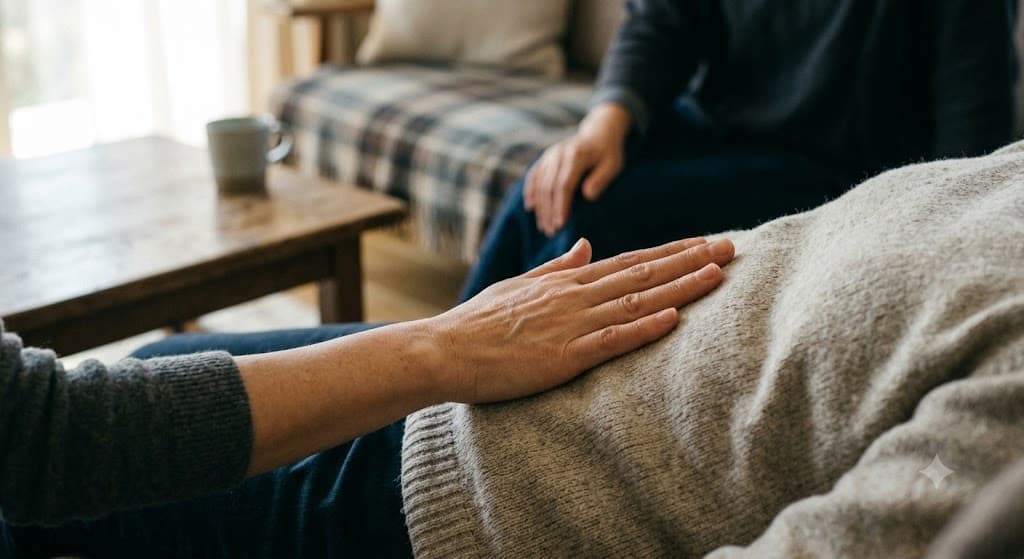
When my stomach hurt as a child, my mother did not reach for medicine first. She placed her open palm on my belly and rubbed it slowly. She belonged to the school of thought that you use as little medicine as possible and let the body settle on its own, so her instinct, whenever something was wrong, was to put a hand on it. I can still remember how that warmth alone was enough to calm me down, long before anything else happened.
 The original te-ate: a warm palm placed on the body long before any medicine is reached for.
The other memory is sharper. I had fallen and scraped my knee, and she stroked the spot while saying the old line every Japanese child hears: 痛いの痛いの飛んでいけ(Itai no itai no tonde ike: "pain, pain, fly away"). I took it at face value, then complained to her, with a child's honesty, that the pain was not flying away in the slightest. Only much later did I understand that the words were never the point. The point was the hand — the stroking, the contact, the small ritual of being attended to. That is where this whole article actually begins, because the most ordinary Japanese word for medical care carries that same hand inside it.
The Hand Hidden Inside the Word for "Treatment"
In Solo Leveling, the first episode throws its weakest hunter into a collapsing raid, and a wound that should be serious closes in an instant under a healer's magic. Joohee, introduced as a B-rank healer, makes a quiet promise to mend the hero no matter what. The image is about as universal as fantasy gets: a wounded body, a hand extended, light, recovery. What is interesting is not the magic itself but the word a Japanese viewer would reach for to describe it. To heal those wounds is, in plain Japanese, to do 手当て(Te-ate) — and the characters that spell it are simply 手(te: hand) and 当て(ate: to apply or place against).
 手当て pairs the character for "hand" with "apply" — the gesture and the word for treatment share the same root.
The Folk Etymology Everyone Believes
Ask almost anyone in Japan where the word comes from, and you will hear the same satisfying story: in an age before modern medicine, when someone was hurt or unwell, people pressed a hand directly to the painful spot to try to ease it, and from that gesture the word for "treatment" was born. One common explanation holds that long ago, people treated injury and illness by laying a hand on the affected area, which is said to be the origin of the word te-ate. The account feels right partly because we still do it without thinking. When something hurts, we instinctively put a hand to it — a hand on the head for a headache, a hand on the stomach for a stomachache. A warm palm even works a little like a light compress, holding heat and moisture against the skin.
This is the reading the topic itself points to, and it is genuinely lovely: a culture whose daily word for "to treat" is, on its face, "to place the hand." But honesty matters more than a tidy story, and the tidy story is not the whole truth.
The Scholar's Correction — "Hand" as Effort, "Ate" as Allotment
Language specialists tend to file the hand-on-the-wound origin under 俗説(zokusetsu: a popular but mistaken belief). In the stricter reading, the 手 in 手当て is not the physical hand on a wound at all but "hand" in the sense of manpower or labor — the same "hand" as in the English "we're short-handed." The 当て is "allotment," assigning resources where they are needed. By that account, 手当て first meant something closer to "making arrangements" or "handling a matter" by directing effort to it, and the medical meaning grew out of that broader sense of "handling." The same logic explains a fact that surprises learners: the identical word, written 手当, also means a salary allowance — overtime pay, a housing allowance — because that, too, is "allotting" something where it is due, a usage dated to the late Edo period.
So which is true? Both, in a way that is more interesting than either alone. The literal "placing the hand" tale is, strictly, a back-formation. Yet it has become the 通説(tsūsetsu: the prevailing popular account) precisely because the gesture it describes is so deeply human that the word feels like it must mean that. A folk etymology survives when it tells a truth the dictionary misses — and the truth here is that hands really do comfort.
From Belly-Rubbing to Laying On Hands
That truth runs from the kitchen to the temple. The gentlest end is 撫でる(naderu: to stroke), the same motion as my mother's hand on my stomach; slow, skin-speed stroking triggers the release of oxytocin, the so-called bonding hormone, which is a sober way of saying the old charm was doing something after all. At the more ritual end sits 手かざし(tekazashi: holding the palm over the body without touching), a posture that appears across the world — Christian laying on of hands in prayer, Indian traditions of channeling life-energy through the palm. Hands-on healing, in other words, is not uniquely Japanese; what is striking is that Japanese folded the gesture into the very word for medical care.
The clearest modern descendant is 霊気(reiki: spiritual energy), the hands-on practice founded by Usui Mikao in the early 1920s as a healing method, later carried to Hawaii and the American mainland and eventually re-imported to Japan under the romanized name "Reiki." In its early-twentieth-century context, "reiki" was a widely used term for healing energy radiated from the palms, and such techniques were known by names like "hands-on" and "hands-over" treatment.
I have a personal stake in this end of the spectrum. As an adult I trained in Reiki and eventually reached the teaching level, which means I have spent real time placing my hands on and over other people with the explicit intent to settle them. What stays with me is not any claim about energy but the plain tactile fact that the act of placing a hand has a steadying effect you can feel under your palm. The first thing a teacher of mine ever told me, when I tried to memorize the practice with my head, was to stop thinking and let the hands learn — and when I work with people now, the line I reach for is the simplest possible instruction to feel rather than analyze. My childhood memory of my mother's hand and my adult practice of placing hands on others sit, for me, on a single continuous thread. The word 手当て is the thread made into language.
It is worth adding that I did not arrive at hands only through the mystical door. Studying physical education at Nippon Sport Science University, I learned the unglamorous basics of first aid — stopping bleeding, cooling an injury — and later sat through emergency-care instruction at a driving school as well. That, too, is 手当て: hands pressed to a body to keep harm from spreading. The word stretches from a folk charm over a scraped knee all the way to a pressure bandage, and it never once stops being about the hand.
A World That Reaches for the Pill Bottle First
Living outside Japan for a long stretch of years has changed how I notice all this. Where I have lived, the reflex when something hurts is to reach for medicine or head to a clinic, quickly and sensibly. The older move — placing a hand on the sore spot first, stroking it, letting the contact do its quiet work before anything else — is simply not the default; you rarely see it. I do not romanticize this into a verdict about which culture is wiser. Modern medicine treats things a warm palm never could, and my mother herself, for all her hand-rubbing, would have taken a serious wound to a hospital.
 From belly-rubbing to hands-over healing, the steadying contact survives even as everyday habits thin.
What the distance reveals instead is how much a single word can carry, and how easily that cargo slips away. In Japanese, the everyday verb for "to treat" still whispers "place the hand," so the gesture is quietly encoded in the language whether or not anyone performs it. The habit it names, though, is genuinely thinning — even inside Japan, the open palm on the stomach competes now with the medicine cabinet. The interesting irony is that the practice traveled best when it left home in disguise: hands-on healing went out as a Japanese craft and came back as the global brand "Reiki," loved abroad as a relaxation method while the plain domestic version, a mother's hand on a child, asks for nothing and gets less attention. A healer's instant magic in an anime is fantasy. The unglamorous truth underneath it is that the hand was always the original treatment, and Japanese, almost uniquely, never let the language forget it.
FAQ
Q: Does "te-ate" really come from placing a hand on a wound?
A: That is the most popular explanation and the one most people in Japan believe, but language scholars generally classify it as a folk etymology. The stricter account reads the "hand" as "manpower" and the second part as "allotment," giving an original sense closer to "handling a matter by assigning effort to it," from which the medical meaning later grew.
Q: Is Reiki the same thing as everyday "te-ate"?
A: They are relatives, not twins. Everyday te-ate covers ordinary care, from a mother rubbing a stomach to applying a bandage. Reiki is a specific hands-on practice founded in Japan in the early 1920s, exported to the West, and re-imported under its romanized name. Both share the underlying gesture of placing the hand, which is why Reiki is often described in Japanese as a form of "hands-on" treatment.
Q: Why does the same Japanese word mean both "treatment" and "allowance"?
A: Because both come from the sense of "allotting" something where it is needed. Directing care to an injury and directing money to an employee are, etymologically, the same act of assignment. The salary sense, written 手当, has been used since the late Edo period.
Key Insights to Remember
- A folk etymology is not simply an error to be corrected; it is a window into what a culture feels a word should mean. The persistence of the "placing the hand" story for te-ate, even against the scholarly account, tells us how strongly Japanese ties care to touch — the gesture is so intuitive that the language is read backwards to fit it.
- The same root that gives Japanese its word for medical treatment also gives it the word for a salary allowance, because both are acts of "allotment." Holding those two meanings in one word is a small reminder that "treatment" in Japanese was never only about wounds — it was about directing what is needed to where it is needed, whether that is a hand or a stipend.
- Practices migrate more easily than the words that hold them. Hands-on healing left Japan and returned as a celebrated foreign-sounding brand, while the homely version it grew from — an open palm on an aching belly — quietly fades. The word te-ate is a kind of fossil, preserving the gesture in plain sight long after the daily habit has begun to thin.
Sources & References
- 手当て、由来とは — Matsumura Hari Massage (https://matsumura-hari-massage.com/blog/%E6%89%8B%E5%BD%93%E3%81%A6%E3%80%81%E7%94%B1%E6%9D%A5%E3%81%A8%E3%81%AF%E3%80%81%E3%80%81)
- 日本語探訪(番外3)教育のことば「手当て」 — 教育逍遙 (https://yosh-k.hatenablog.com/entry/2021/11/17/083504)
- 心を癒やし、絆を深める「手当て」の不思議な力! — サワイ健康推進課 (https://kenko.sawai.co.jp/prevention/202009.html)
- 手当て療法 — Wikipedia (https://ja.wikipedia.org/wiki/%E6%89%8B%E5%BD%93%E3%81%A6%E7%99%82%E6%B3%95)
- レイキ — Wikipedia (https://ja.wikipedia.org/wiki/%E3%83%AC%E3%82%A4%E3%82%AD)
- レイキ[各種施術・療法 - 一般] — 厚生労働省eJIM (https://www.ejim.mhlw.go.jp/public/overseas/c02/10.html)
- 「手当て」とは?意味や例文や読み方や由来について解説! — コトバスタ (https://kotobasta.com/21059/)
About the author
Spoiler-free cultural deep-dives into anime, manga & live-action Japanese drama
- ●Tokyo-born, 3rd-generation Edokko (江戸っ子)
- ●Lifelong manga reader & anime viewer since the kaiju era
- ●Writes from outside Japan — distance as a cultural lens
- ●Spoiler-free · sourced · Kanji + Romaji + English
A Tokyo-born, 3rd-generation Edokko writer who has spent years living outside Japan. I use the anime, manga, and live-action Japanese drama you already love as a doorway into the folklore, language, religion, and everyday history behind them — written so even first-time fans can follow along, with sources for every claim.
Enjoy this article?
Get the next spoiler-free cultural deep-dive straight to your inbox.
Related Articles
Chihayafuru and the World of Competitive Karuta: The Speed, Silence, and Poetry Behind Japan's Fiercest Card Game
How Chihayafuru reveals competitive karuta, where poems from the 13th-century Hyakunin Isshu meet athletic reflexes and matches turn on hundredths of a second.
7/28/2026
Chainsaw Man and Why Every Japanese Dog Is Named Pochi: The Hidden History Behind Pochita
How Chainsaw Man's Pochita carries the history of Pochi, the Meiji-era nickname that became Japan's default dog name — and what that says about loyalty.
7/11/2026
Naruto and Yakuwarigo: The Real Meaning of Dattebayo and Why Translators Invented Believe It!
How Naruto's famous verbal tic dattebayo opens the door to yakuwarigo, Japan's role language system, and why English translators had to invent Believe it!
7/4/2026

Evangelion's Angels and Japan's Decorative Christianity
How Neon Genesis Evangelion's enemies are 使徒 (apostle) in Japanese but Angel in English — and how Japan wears Christianity as aesthetic, not faith.
7/3/2026
Detective Conan and the -kun You Didn't Expect: How Japanese Honorifics Really Work
How Detective Conan reveals that the honorific -kun is not male-only — an inspector calls teenage Ran 'Ran-kun', a hierarchy English subtitles quietly drop.
6/11/2026
Witch Hat Atelier and Japan's 'Thanks for Your Thanks' Loop
How the 'thanks for your thanks' exchange in Witch Hat Atelier opens a window onto Japan's habit of not letting gratitude end on the first reply.
5/26/2026