Chihayafuru and the World of Competitive Karuta: The Speed, Silence, and Poetry Behind Japan's Fiercest Card Game
How Chihayafuru reveals competitive karuta, where poems from the 13th-century Hyakunin Isshu meet athletic reflexes and matches turn on hundredths of a second.

Tokyo-born, 3rd-generation Edokko · writing on Japanese culture from outside Japan
Spoiler-Free Cultural Analysis
This article explores the real world of 競技かるた (kyōgi karuta: competitive karuta) and the 百人一首 (Hyakunin Isshu) poems behind Chihayafuru — the history, the rules, and the culture. No plot spoilers, only the real tradition the anime is built on.
Key Takeaways
- 競技かるた (kyōgi karuta: competitive karuta) is a genuine sport in Japan, demanding an athlete's reflexes alongside a scholar's memory — the pairing at the heart of Chihayafuru is not dramatic license but the real nature of the game.
- The game is built on the 百人一首 (Hyakunin Isshu), a 13th-century anthology of one hundred classical poems; players win by memorizing all of them and reacting to the opening syllables before a poem is even fully read.
- What looks from the outside like a quiet card game is in truth a contest decided in hundredths of a second — a distinctly Japanese fusion of classical literature, ritual stillness, and explosive physical speed.
Key Terms Explained
- 百人一首 (Hyakunin Isshu) / One Hundred Poets, One Poem Each — A famous anthology of 100 classical waka poems, compiled in the 13th century and known in nearly every Japanese household.
- 競技かるた (Kyōgi Karuta) / Competitive Karuta — The formal, competitive sport version of the card game, governed by strict rules and national tournaments.
- 決まり字 (Kimariji) / The Deciding Syllables — The minimum opening syllables that uniquely identify a poem, letting a player grab the card before the full line is read.
- 詠手 (Yomite) / The Reader — The person who chants the poems aloud; players react to their voice.
The Skill of Hearing a Whole World in One Sound
There is a way of listening that I only recognized as distinctly Japanese after I had lived abroad for many years. Growing up, a single sound could place you completely — the first two notes of a festival flute, the particular clatter of a neighbor's gate, the opening syllable of a familiar phrase. You did not wait for the whole thing. The beginning was enough; the rest arrived in your mind before it arrived in the air.
That is precisely the sense competitive karuta lives on, and it is why Chihayafuru struck me so deeply. The sport is not really about cards. It is about sound — about hearing the first fragment of a poem and knowing, before your conscious mind can catch up, exactly which card your hand must strike. Watching the anime from abroad, I recognized that listening immediately. It is the quiet skill Japan trained into me without my noticing: the whole meaning of a thing, delivered and understood in its opening note.
A 13th-Century Anthology That Became a Sport
The Poems Everyone Half-Knows
At the center of it all sits the 百人一首 (Hyakunin Isshu: One Hundred Poets, One Poem Each), an anthology of one hundred 和歌 (waka: classical short poems) traditionally associated with the poet 藤原定家 (Fujiwara no Teika) in the 13th century. These are not obscure verses. They are woven into Japanese life — encountered in school, printed on New Year's playing cards, half-remembered by nearly everyone. The poems speak of love, longing, autumn leaves, the moon, the impermanence of things. To play karuta is to hold a piece of the classical canon in your hands and your muscle memory at once.
How the Game Is Actually Won
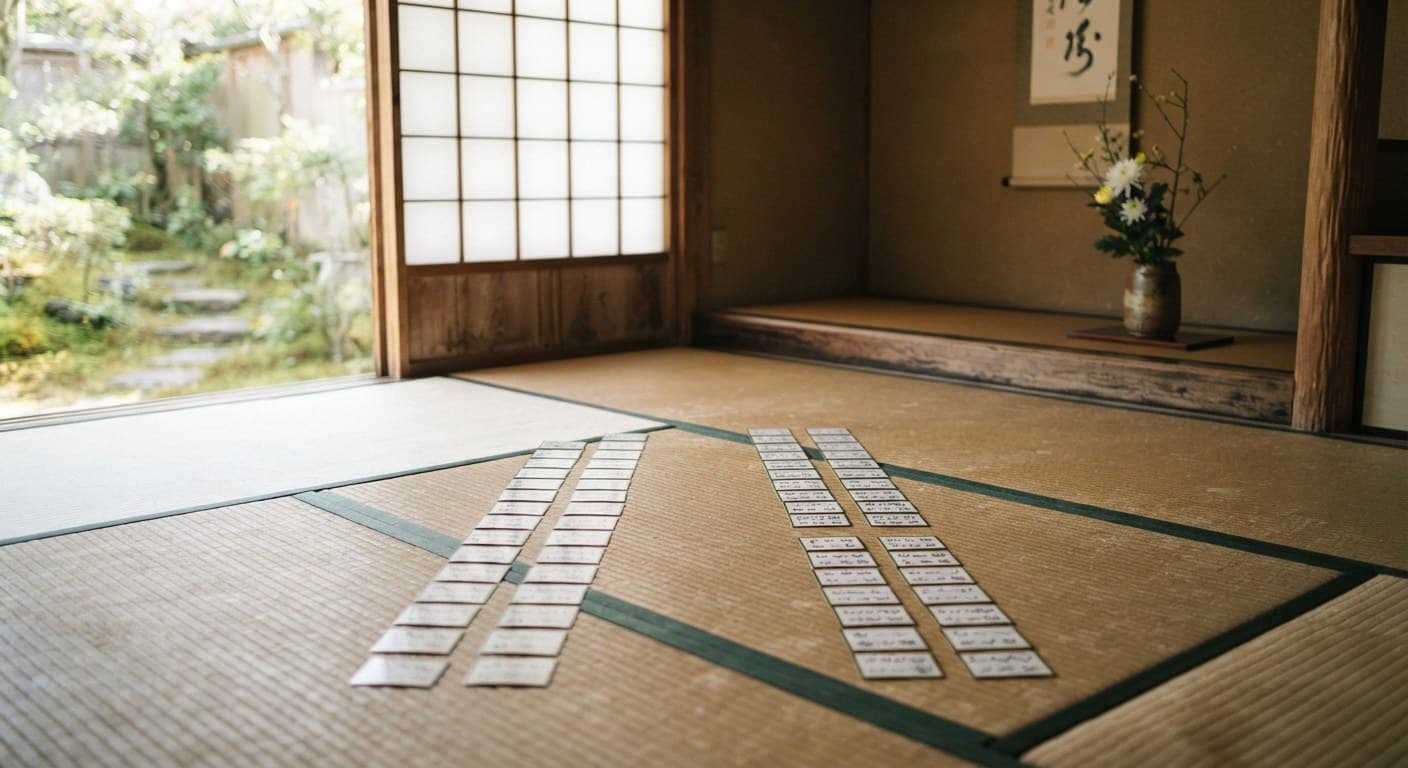
Here is the part outsiders rarely grasp. In 競技かるた (kyōgi karuta), fifty cards bearing only the second halves of poems are spread out, twenty-five per player. The 詠手 (yomite: reader) chants each poem, and players race to touch or sweep away the matching card. But the decisive skill is the 決まり字 (kimariji: the deciding syllables) — the exact minimum number of opening sounds that make a poem unique. Some poems are identifiable after a single syllable; others only after several. Elite players have every kimariji memorized, so they move the instant a poem becomes unmistakable — often a fraction of a second into the reading. Matches are decided in hundredths of a second, and the sound of a champion's hand striking a card can be startlingly sharp.
Stillness Wrapped Around Speed
What I find most Japanese about the sport is its shape: a shell of near-total stillness around a core of explosive motion. Players kneel in silence, bow, compose themselves, and wait with absolute quiet — and then, for an instant, a hand moves faster than the eye can follow, and the room is still again. It is the same aesthetic as 弓道 (kyūdō: Japanese archery) or the tea ceremony, where the decisive action is brief and everything around it is calm ceremony. The drama lives not in noise but in the charged quiet before and after.
Why a Card Game Deserves the Word "Sport"
Chihayafuru's real achievement, from a cultural standpoint, is that it made a generation take karuta seriously as an athletic pursuit — because it genuinely is one. Top players train their reflexes, stamina, and positional memory as rigorously as any athlete. A full match can last hours and leaves competitors physically drained. Calling it "just a card game" misses that it demands the reflexes of a fencer and the memory of a literature scholar, at the same time.
Having lived outside Japan for many years now, I have watched people abroad discover competitive karuta through Chihayafuru with a kind of delighted disbelief — that a nearly-immobile game built on 800-year-old poetry could be this fast, this fierce, this moving. It is the same thing I have felt about my own culture from a distance: certain deep, ordinary treasures only reveal how remarkable they are once you view them from outside. In an anthology memorized by children and a game decided in milliseconds, Japan found a way to keep its oldest poems not on a museum shelf but in the flashing hands of teenagers. The poems survive because they are still, literally, in play.
FAQ
Q: Do you need to understand classical Japanese to play competitive karuta? A: Not fully. Elite players memorize the sounds and the deciding syllables (kimariji) more than they parse the classical grammar in real time. Understanding the poems deepens appreciation, but the competitive skill is fundamentally about sound recognition and speed.
Q: Is competitive karuta really recognized as a sport in Japan? A: Yes. It has a national governing body, ranked players, and major tournaments, and its physical and mental demands are taken seriously. The pairing of athletic reflex and literary memory shown in Chihayafuru reflects how the game is actually played.
Q: What is the Hyakunin Isshu, exactly? A: It is a 13th-century anthology of one hundred classical waka poems, one each from a hundred poets. It is deeply familiar in Japanese culture — encountered in schools and played as a New Year's card game — which is why competitive karuta can draw on something nearly everyone half-knows.
Key Insights to Remember
- Competitive karuta collapses a divide most cultures keep separate: the athlete and the scholar. To win, one must hold centuries of poetry in memory and react faster than conscious thought — proof that in Japan, physical mastery and literary depth were never treated as opposites.
- The deciding syllables (kimariji) reveal the game's true nature. Victory hinges on recognizing a poem from its opening sounds alone, making karuta an art of listening — the same art by which a single sound can place you within a whole world.
- Chihayafuru matters culturally because it kept the Hyakunin Isshu alive as living practice, not museum text. The oldest poems endure precisely because they remain in play, struck from the tatami by the hands of the young.
Sources
About the author

Spoiler-free cultural deep-dives into anime, manga & live-action Japanese drama
- ●Tokyo-born, 3rd-generation Edokko (江戸っ子)
- ●Lifelong manga reader & anime viewer since the kaiju era
- ●Writes from outside Japan — distance as a cultural lens
- ●Spoiler-free · sourced · Kanji + Romaji + English
A Tokyo-born, 3rd-generation Edokko writer who has spent years living outside Japan. I use the anime, manga, and live-action Japanese drama you already love as a doorway into the folklore, language, religion, and everyday history behind them — written so even first-time fans can follow along, with sources for every claim.
Enjoy this article?
Get the next spoiler-free cultural deep-dive straight to your inbox.
Related Articles
Chainsaw Man and Why Every Japanese Dog Is Named Pochi: The Hidden History Behind Pochita
How Chainsaw Man's Pochita carries the history of Pochi, the Meiji-era nickname that became Japan's default dog name — and what that says about loyalty.
7/11/2026
Naruto and Yakuwarigo: The Real Meaning of Dattebayo and Why Translators Invented Believe It!
How Naruto's famous verbal tic dattebayo opens the door to yakuwarigo, Japan's role language system, and why English translators had to invent Believe it!
7/4/2026

Evangelion's Angels and Japan's Decorative Christianity
How Neon Genesis Evangelion's enemies are 使徒 (apostle) in Japanese but Angel in English — and how Japan wears Christianity as aesthetic, not faith.
7/3/2026

Solo Leveling and Te-ate: Why the Japanese Word for Treatment Means Placing the Hand
How Solo Leveling's healing magic opens onto te-ate, the Japanese word for treatment whose root is the simple act of placing a hand on a wound.
6/26/2026
Detective Conan and the -kun You Didn't Expect: How Japanese Honorifics Really Work
How Detective Conan reveals that the honorific -kun is not male-only — an inspector calls teenage Ran 'Ran-kun', a hierarchy English subtitles quietly drop.
6/11/2026
Witch Hat Atelier and Japan's 'Thanks for Your Thanks' Loop
How the 'thanks for your thanks' exchange in Witch Hat Atelier opens a window onto Japan's habit of not letting gratitude end on the first reply.
5/26/2026