Ocean Waves and the Tosa Dialect: Why a Real Japanese Accent Sounds Like a Period Drama
How Ocean Waves dramatizes the collision between 土佐弁 (Tosa-ben) and Tokyo standard speech — and why old-fashioned Japanese still defines our sense of the past.

Tokyo-born, 3rd-generation Edokko · writing on Japanese culture from outside Japan
Spoiler-Free Cultural Analysis
This article explores the linguistic and cultural texture behind 海がきこえる (Umi ga Kikoeru: Ocean Waves), focusing on the collision between 土佐弁 (Tosa-ben: the dialect of Kōchi Prefecture) and Tokyo standard speech. No plot points are revealed — only the atmosphere of language, regional identity, and why certain Japanese sounds carry the weight of another era.
Key Takeaways
- The friction between 土佐弁 (Tosa-ben) and Tokyo 標準語 (Hyōjungo: standard Japanese) in Ocean Waves is not a comedy device — it is a precise sociolinguistic snapshot of how regional Japan and the capital actually rub against each other, with each side hearing the other as either "old-fashioned" or "picking a fight."
- Period dramas in Japan use a stylized old-language register that overlaps with surviving regional dialects in pitch contour and sentence-ending particles, which is why a teenage girl from Tokyo can sincerely tell a Kōchi boy his everyday speech sounds like a 時代劇 (Jidaigeki: historical drama).
- Standard Japanese was not "always there." It was deliberately constructed in the Meiji era from a specific Tokyo register, and dialects like Tosa-ben preserve linguistic layers — pitch patterns, copulas, sentence-final particles — that the capital itself has shed.
Key Terms Explained
- 土佐弁 (Tosa-ben) / The Tosa Dialect — The dialect spoken in Kōchi Prefecture (former Tosa Province) on Shikoku island, known for sentence-final particles like ぜよ, き, ちゅう, and a pitch accent pattern noticeably different from Tokyo speech.
- 標準語 (Hyōjungo) / Standard Japanese — The codified national standard based on educated Tokyo speech, formalized in the Meiji era through schools, the military, and broadcasting.
- 時代劇 (Jidaigeki) / Period Drama — Japanese historical drama, typically set in the Edo period or earlier, featuring a stylized old-fashioned speech register that does not correspond to any single real dialect.
- 方言 (Hōgen) / Regional Dialect — Any non-standard regional variety of Japanese; the term itself carries a historically loaded contrast with "the proper national language."
- 役割語 (Yakuwarigo) / Role Language — The Japanese linguistic concept of stylized speech patterns instantly associating a speaker with a stereotype (samurai, old professor, country girl), independent of how anyone actually talks.
A Tokyo Boy Who Only Heard Dialect Through a Television Screen
I grew up in Tokyo as a 江戸っ子 (Edokko: a third-generation Tokyoite), in a 下町 (Shitamachi: working-class downtown) part of the city. My everyday speech was standard Japanese — not because anyone taught me to "speak properly," but because the dialect of the place I lived in had quietly become the dialect of national broadcasting. Standard Japanese is, at its root, an idealized version of the Tokyo register my grandparents and great-grandparents already spoke.
 For a Tokyo child of the Shōwa era, regional dialects often arrived first through television — filtered through samurai dramas and variety-show comedy bits.
So for most of my childhood, dialects were something that arrived through a screen. The Tōhoku 訛り (Namari: accent) of a comedy bit, the rolling cadence of Ōsaka-ben on a variety show, the soft musical drift of Hakata-ben, and — through 時代劇 (Jidaigeki) like 水戸黄門 (Mito Kōmon) and 暴れん坊将軍 (Abarenbō Shōgun) — that very particular "old Japan" speech full of ござる (gozaru) and ぬし (nushi: you). I had no built-in instinct for the difference between a real living dialect and the theatrical old-speech of a samurai drama. To my Tokyo ear, anything that wasn't standard was simply "somewhere else."
Then I read 司馬遼太郎 (Shiba Ryōtarō)'s 竜馬がゆく (Ryōma ga Yuku), the long novel about 坂本龍馬 (Sakamoto Ryōma), the Tosa-born samurai who became a key figure in the Meiji Restoration. The book is dense with 土佐弁 (Tosa-ben). Page after page, characters end their sentences with き, ちゅう, ぜよ. And here is what stayed with me: my brain heard those endings as 時代劇 (Jidaigeki) speech. They felt antique. They felt like swords and topknots. Only later did I understand that I was reading a faithful transcription of how people in Kōchi actually still talked.
That gap — between a living regional dialect and a Tokyo outsider's instinct to file it under "the past" — is exactly the gap Ocean Waves places at the center of its story.
How Tokyo Standard Speech Was Built, and What It Edited Out
To understand why Tosa-ben sounds "old" to a Tokyo ear, you have to understand that 標準語 (Hyōjungo: standard Japanese) is not a neutral default. It is a Meiji-era construction.
The Meiji Manufacture of a National Voice
Before the Meiji Restoration of 1868, "Japanese" was a federation of mutually challenging regional speech communities. A samurai from Satsuma and a samurai from Tōhoku, dropped into the same room, would often fall back on writing — because the spoken languages were that far apart. Modern nation-states need a single shared voice for schooling, conscription, courts, and newspapers, and the Meiji state set about manufacturing one. The base was the speech of the educated 山の手 (Yamanote: the uptown side of Tokyo), refined further by 国語 (Kokugo: national language) policy in schools and, later, by NHK radio broadcasting.
 Meiji-era schools were the central machinery that turned an educated Tokyo register into the codified national standard known as Hyōjungo.
What this process discarded, dialect by dialect, was substantial. Each region had its own pitch accent system, its own copulas (the Tosa じゃ where Tokyo says だ), its own sentence-final particles carrying tone and stance. The Meiji standard preserved one of these systems and quietly demoted the others to 方言 (Hōgen: dialect) — a word whose entire force comes from the implied contrast with "proper" speech.
Why Tosa-ben in Particular Lands on the Ear as "Old"
Tosa-ben preserves several features that the standard language has lost or transformed. The copula じゃ (ja) instead of だ (da) is one of them — and じゃ is also the copula heard constantly in period dramas, where old samurai gruffly say そうじゃ instead of そうだ. The sentence-final ぞ has survived in standard Japanese only as an emphatic, slightly rough particle, but in Tosa-ben it appears in ordinary, polite-enough utterances like 大事ながぜよ (daiji na ga ze yo: it matters). To a Tokyo ear trained on television samurai, that ぜよ is the audio signature of an Edo-period swordsman.
Then there is the pitch accent. Tokyo Japanese has a relatively flat, falling pitch profile. Tosa-ben uses a different pitch system entirely, with rises and falls placed in positions that, to a Tokyo speaker, sound like a recitation rather than a conversation. Combine the archaic-feeling copulas and particles with the unfamiliar pitch contour, and a teenager from Tokyo — meeting Tosa-ben for the first time — will reach for the nearest comparison her ear knows. That comparison is 時代劇 (Jidaigeki).
And Why Tokyo Speech Sounds Like a Picked Fight in Reverse
Ocean Waves does something subtler than a one-way joke about country accents. It shows the friction running both directions. To a Kōchi ear, Tokyo standard speech — clipped, fast, with its falling sentence endings — can sound abrupt, aggressive, almost confrontational. Where Tosa-ben softens directness with trailing particles like き or がぞね, Tokyo's bare だ・じゃない・でしょ feels like a verbal jab.
This is not exotic. Every place with a strong regional voice hears the capital this way. The capital, in turn, hears the regions as quaint. What is unusual is for a piece of animation to put both sides of that hearing into the same scene, without picking a winner.
The Concept of 役割語 (Yakuwarigo: Role Language)
There is one more layer worth naming. The linguist 金水敏 (Kinsui Satoshi) coined the term 役割語 (Yakuwarigo: role language) for the stylized speech patterns that Japanese audiences immediately associate with a stereotype. The "old professor" who ends sentences with じゃ. The "samurai" who uses ござる. The "country girl" who uses だべ or やん. Almost none of these patterns correspond to how the real people they represent actually speak today. They are a shared code between writers and audiences, a shorthand for character.
The trouble for Tosa-ben is that some of its real, living features (the じゃ copula, the ぜよ ending) overlap with the 役割語 (Yakuwarigo) vocabulary for samurai and Edo-period speech. So when a real Kōchi teenager opens his mouth, a Tokyo teenager's brain doesn't hear a regional dialect. It hears costume drama. The misperception is not random — it is the predictable outcome of a national language system that taught everyone to associate certain sounds with the past.
What an Outsider's Ear Notices Years Later
I have lived outside Japan for over a decade now, and that distance has done something strange to my sense of Japanese itself. When I hear Tokyo standard speech in a news clip, I notice for the first time how flat and businesslike it sounds. When I hear Ōsaka-ben in a podcast, I notice how much texture the standard language has shed.
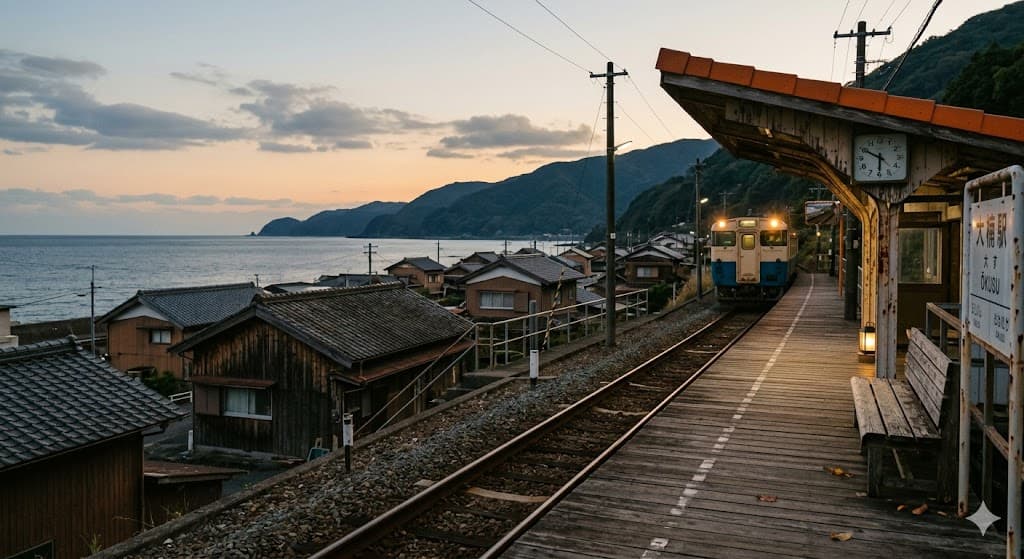
 The coastal towns of Kōchi still carry the cadence of Tosa-ben, but each generation speaks slightly less of the local register and slightly more of the standard.
In a globalized world, the standard language is the practical winner. It is the language of business, of schooling, of broadcasting, of anyone who needs to be understood across the archipelago. But there is a cost. Each generation that grows up in the regions speaks slightly less of the local register and slightly more of the standard. The copulas thin out. The pitch patterns flatten. The sentence-final particles drop away. The 役割語 (Yakuwarigo) stays vivid in fiction precisely because the real thing is fading from daily life.
Ocean Waves was made in 1993. The film is already a kind of time capsule — a 1990s Tokyo girl encountering a still-vigorous Kōchi dialect among teenagers. I am not sure the same scene could be filmed today with the same density of dialect among high school students. That is not a complaint, just an observation from someone who hears Japanese now mostly across distance. A common language is convenient. Local voices, like everything that grows in a single soil, carry warmth that no national standard ever quite reproduces.
FAQ
Q: Is Tosa-ben actually difficult for other Japanese people to understand?
A: Most Japanese people from outside Shikoku can follow the general meaning of Tosa-ben in context, but specific sentence-final particles (ぜよ, き, ちゅう) and the unfamiliar pitch accent often require a few minutes of adjustment. The grammar core is the same; the surface texture is what creates the initial friction.
Q: Why do period dramas use a language that no real period actually spoke?
A: 時代劇 (Jidaigeki) speech is a theatrical convention, not a reconstruction. Real Edo-period Japanese varied enormously by region and class and would be largely unintelligible to a modern viewer. The stylized "samurai speech" is a shared code between writers and audiences — what linguists call 役割語 (Yakuwarigo: role language) — designed to signal "the past" rather than to reproduce it.
Q: Is standard Japanese the same as Tokyo dialect?
A: They overlap heavily but are not identical. Standard Japanese is based on the educated Yamanote (uptown) speech of Meiji-era Tokyo, refined further through schools and broadcasting. The downtown Tokyo dialect, 下町言葉 (Shitamachi-kotoba), has its own features (rougher consonants, distinctive intonation) that the codified standard quietly excludes.
Key Insights to Remember
- The "old-fashioned" feel of a real living dialect is a fingerprint left by national language policy. Standard Japanese was built by selecting one regional register and demoting the others; the dialects that survived preserved sounds and grammar the capital itself shed, which is precisely why those surviving features now ring with the echo of the past.
- Linguistic friction in Ocean Waves runs both directions, and that is its honesty. Tosa-ben sounds like a period drama to a Tokyo ear; Tokyo speech sounds like a picked fight to a Kōchi ear. Neither hearing is wrong. Each is the predictable result of an ear shaped by one variety encountering another.
- Role language — the stylized speech of fiction — is so pervasive in Japanese media that it has begun to overwrite real perception. When a Tokyo teenager hears a Kōchi teenager say そうじゃ and reaches for "samurai" as the nearest reference, she is not being naive. She is showing how thoroughly the codes of 時代劇 (Jidaigeki) have replaced direct experience of regional Japan as the source of "what the past sounds like."
Sources
- Kinsui Satoshi, Virtual Japanese: Enigmas of Role Language — Osaka University Press
- Tosa-ben overview — Wikipedia
- Hyōjungo (Standard Japanese) — History and Formation — Wikipedia
- Ocean Waves (Umi ga Kikoeru) — Studio Ghibli — Studio Ghibli Official
- Sakamoto Ryōma and the Tosa Domain — Encyclopædia Britannica
About the author

Spoiler-free cultural deep-dives into anime, manga & live-action Japanese drama
- ●Tokyo-born, 3rd-generation Edokko (江戸っ子)
- ●Lifelong manga reader & anime viewer since the kaiju era
- ●Writes from outside Japan — distance as a cultural lens
- ●Spoiler-free · sourced · Kanji + Romaji + English
A Tokyo-born, 3rd-generation Edokko writer who has spent years living outside Japan. I use the anime, manga, and live-action Japanese drama you already love as a doorway into the folklore, language, religion, and everyday history behind them — written so even first-time fans can follow along, with sources for every claim.
Enjoy this article?
Get the next spoiler-free cultural deep-dive straight to your inbox.
Related Articles
Chihayafuru and the World of Competitive Karuta: The Speed, Silence, and Poetry Behind Japan's Fiercest Card Game
How Chihayafuru reveals competitive karuta, where poems from the 13th-century Hyakunin Isshu meet athletic reflexes and matches turn on hundredths of a second.
7/28/2026

Chainsaw Man and Why Every Japanese Dog Is Named Pochi: The Hidden History Behind Pochita
How Chainsaw Man's Pochita carries the history of Pochi, the Meiji-era nickname that became Japan's default dog name — and what that says about loyalty.
7/11/2026

Naruto and Yakuwarigo: The Real Meaning of Dattebayo and Why Translators Invented Believe It!
How Naruto's famous verbal tic dattebayo opens the door to yakuwarigo, Japan's role language system, and why English translators had to invent Believe it!
7/4/2026

Evangelion's Angels and Japan's Decorative Christianity
How Neon Genesis Evangelion's enemies are 使徒 (apostle) in Japanese but Angel in English — and how Japan wears Christianity as aesthetic, not faith.
7/3/2026

Solo Leveling and Te-ate: Why the Japanese Word for Treatment Means Placing the Hand
How Solo Leveling's healing magic opens onto te-ate, the Japanese word for treatment whose root is the simple act of placing a hand on a wound.
6/26/2026
Detective Conan and the -kun You Didn't Expect: How Japanese Honorifics Really Work
How Detective Conan reveals that the honorific -kun is not male-only — an inspector calls teenage Ran 'Ran-kun', a hierarchy English subtitles quietly drop.
6/11/2026