One Piece and the Straw Hat: Why Luffy's Crown Is a Japanese Summer Memory
Why Luffy's straw hat carries the weight of a Japanese childhood summer — the mugiwara bōshi as a Shōwa-era image of boyhood that anime quietly preserves.

Tokyo-born, 3rd-generation Edokko · writing on Japanese culture from outside Japan
Spoiler-Free Cultural Analysis
This article explores the cultural and emotional weight that the 麦わら帽子(Mugiwara Bōshi: straw hat) carries in Japanese memory, and why Monkey D. Luffy's choice of headwear resonates so deeply with Japanese readers. No plot points are revealed beyond what is already public knowledge from the opening episode's premise.
Key Takeaways
- The straw hat in Japan is not merely a piece of sun gear — it is a cultural shorthand for 夏休み(Natsuyasumi: summer vacation), boyhood, and a rural innocence that most modern Japanese people, including urban 下町(Shitamachi: old downtown) children, absorbed mostly through postwar manga and anime rather than lived farm life.
- Luffy's straw hat works on Japanese audiences partly because it layers a tender, earthbound symbol of 少年時代(Shōnen Jidai: boyhood) onto a genre — 海賊(Kaizoku: pirate) adventure — that would otherwise be pure spectacle. The hat is the emotional anchor that keeps him a boy.
- The image of a boy in a straw hat carrying a 虫取り網(Mushitori Ami: bug-catching net) is itself a mediated memory. It belongs less to real Japanese geography than to 昭和(Shōwa: the Shōwa era, 1926–1989) visual culture, which quietly passed the image down to generations who never actually lived it.
Key Terms Explained
- 麦わら帽子 (Mugiwara Bōshi) / Straw Hat — A woven straw sun hat historically worn by farmers and fishermen; in postwar popular culture it became the visual badge of a carefree summer boy.
- 夏休み (Natsuyasumi) / Summer Vacation — The long school break from mid-July to late August, culturally saturated with cicadas, shrines, fireworks, and the expectation of a slower, freer self.
- 下町 (Shitamachi) / Old Downtown — The low-lying, working-class districts of Tokyo — Adachi, Arakawa, Sumida, Taitō — associated with dense wooden housing, public baths, and a direct, unfussy social texture.
- 判官贔屓 (Hōgan Biiki) / Sympathy for the Underdog — A deeply rooted Japanese emotional habit of cheering for the weaker side, which shapes how Japanese audiences relate to shōnen heroes who start from nothing.
- 少年時代 (Shōnen Jidai) / Boyhood — A cultural idea more than a biographical phase; the sanctified, half-imagined territory of pre-adolescent summers that Japanese storytelling returns to again and again.
The Cicadas I Could Not Catch and a Summer That Never Quite Happened
When I try to summon my own childhood 夏休み(Natsuyasumi: summer vacation), the image that arrives first is not a rice paddy and a straw hat. It is the back garden of the house next door in 足立区(Adachi-ku: a working-class ward in northeastern Tokyo). It was huge — by 下町 standards — and full of trees, and from morning until dusk through August the cicadas roared in it. I wanted to catch them. Net in hand, I would stand on the alley side of the fence and listen. The garden was not ours, the fence was high, and 下町 blocks were too dense for a boy with a 虫取り網(Mushitori Ami: a long-handled bug-catching net) to actually run anywhere. Catching one cicada cost an hour of strategy, asking permission, and usually came to nothing.
The other 夏休み image my body remembers is the public pool. About 100 yen for entry, and a line that wrapped around the block in the merciless midday sun. By the time I was inside, my shoulders had already burned through whatever the entrance fee bought. That sun, that line, that hot concrete underfoot — I remember it more clearly than the swimming itself.
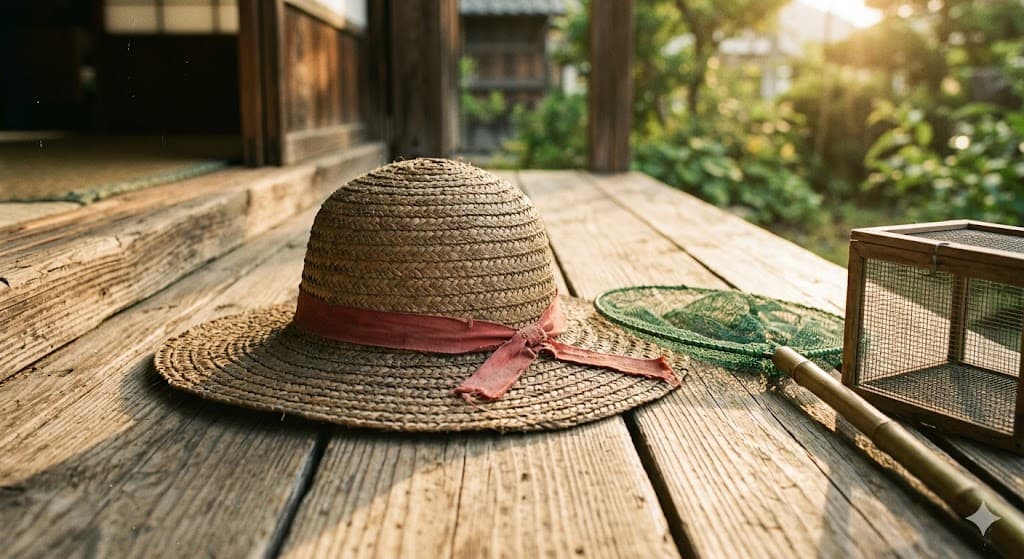
 The 麦わら帽子 as cultural memory — a simple woven object that carries an entire season of Japanese boyhood.
So where does the straw hat sit in that memory? Honestly — at the edge. I did wear a 麦わら帽子 during summer, even as a 下町 boy. In the Shōwa 40s and 50s, putting on a straw hat and running outside in July was as ordinary for a Tokyo working-class kid as it supposedly was for a farm child. But the picture that rises when I say the word "mugiwara boushi" is not my own block. It is a boy at a beach clutching a 浮き輪(Ukiwa: inflatable swim ring), or a boy with a 虫取り網 and a 虫かご(Mushikago: insect cage) chasing cicadas along a hedge. The boy is always somewhere slightly more rural, slightly more sunlit, slightly more free than I ever was.
That was my first small realization writing this piece: the Japanese straw-hat-summer-boy is mostly a memory I inherited from manga, anime, and TV, not from my own 足立区 alleys. The cicadas in the neighbor's garden, the long pool line, the 100-yen entry — those I remember with my body. The "straw hat boy chasing bugs across a summer field" lives in me as an image I absorbed from screens and pages.
Related: Witch Hat Atelier and the Culture of Mongai-fushutsu: Why Japanese Masters Hide the Secret explains this in detail.
The Long Cultural Shadow of a Woven Hat
The Folk Object Before It Was a Symbol
The 麦わら帽子 is, in its unromantic origin, a utilitarian object. Straw — specifically 麦わら(Mugiwara: wheat straw), the dried stalks left over after the grain harvest — is cheap, light, breathable, and quietly brilliant at deflecting summer sun. Across the Japanese countryside it was standard working gear for farmers in rice paddies and fields, and for fishermen along coasts where the glare off the water could be as brutal as any equatorial noon. The Western-style round-crowned straw hat specifically arrived in Japan in the 明治時代(Meiji Jidai: Meiji era, 1868–1912) as part of the broader absorption of Western clothing, and domestic production grew steadily through the early twentieth century.
Important to notice: there is nothing inherently nostalgic about a farm tool. A hoe does not make anyone cry.
Related: Witch Hat Atelier and the Politeness Loop: Why Thanks for Your Thanks Is Pure Japanese explains this in detail.
The Shōwa Transmutation
What turned the 麦わら帽子 from equipment into emotion was the postwar 昭和 imagination. In the decades after the war, as Japan urbanized at a terrifying speed and children like me grew up in dense 下町 blocks instead of on farms, the country produced an enormous body of manga, anime, TV drama, and children's magazines that kept returning to a shared scene: the rural 夏休み. A boy. White tank top. Short pants. Straw hat. Net. Cicadas screaming. A river he can swim in. Grandparents' house. Watermelon cooling in a bucket at the well.
 The canonical Shōwa summer scene — a visual template repeated across decades of manga, anime, and television.
This scene became canonical. It lives in countless works, and even people who never experienced it can close their eyes and see it. The 麦わら帽子 is its visual keystone — the single object that, placed on a boy's head, tells a Japanese reader instantly: this is the summer of memory, this is 少年時代, this is the self you were before adulthood taught you to hurry.
Crucially, this image belongs to a generation for whom it was already half-fictional. Children of 下町 Tokyo, Osaka, Nagoya — most of us did not spend summers in our grandparents' rice village. We spent them in front of the TV, watching boys who did, and we incorporated their summers into our own emotional library. When I reach for "Japanese summer," my hand keeps pulling out images drawn by someone else.
Related: Wistoria: Wand and Sword and Hougan-biiki: Why Japan Roots for the Underdog explains this in detail.
Why a Pirate Captain Wears One
Against this backdrop, the decision to put a 麦わら帽子 on the head of the protagonist of 『ワンピース』(Wan Pīsu: the manga/anime titled "One Piece") by 尾田栄一郎(Oda Eiichirō: the manga's creator) is quietly radical. The story's stated world is pirates, bounty hunters, sea kings, and a lost treasure called ワンピース(Wan Pīsu: the titular "One Piece"). Luffy introduces himself in the very first episode with the line translatable as, roughly, I am Luffy, the man who will become Pirate King — a brief piece of dialogue from the opening of the 1999 Toei Animation series based on Oda's 集英社(Shūeisha: the manga's publisher) manga. Everything in the genre pushes toward scale, spectacle, grandeur.
And then — a straw hat. Not a tricorne. Not a bandana-and-skull. A 麦わら帽子 of the exact shape a Japanese reader associates with a boy chasing beetles in August. Within the story it carries a specific dramatic meaning as a keepsake from a mentor. Outside the story, on the symbolic level that Japanese readers feel without articulating, it does something else entirely: it welds the pirate captain to the national image of the summer boy. It says, in effect, this character will never stop being twelve years old inside. That is, I suspect, one reason the work was absorbed so immediately and so widely in Japan. The hat pre-qualifies Luffy for our affection before he does anything.
The Underdog Who Earns the Hat
There is a second cultural gear turning underneath. Japanese audiences are famously drawn to 判官贔屓(Hōgan Biiki: sympathy for the underdog), a phrase rooted in sympathy for 源義経(Minamoto no Yoshitsune: the twelfth-century general), the brilliant, slight-framed warrior whose brother turned on him and who died betrayed at 平泉(Hiraizumi: a town in northern Japan where Yoshitsune met his end). I first met Yoshitsune in a picture book as a lower-grade elementary student in 足立区 in the early 1970s — a small, quick-witted hero who outwits larger men. The shock of learning how he ended, killed not by enemies but by his own side, left a mark on me that later made the word 判官贔屓 immediately understandable.
Shōnen manga is 判官贔屓 translated into serialized form. Readers want heroes who begin weak, mocked, or dismissed and grow through training, setbacks, and loyal friends. A hero who starts already at full power tends to empty out the story — there is no emotional shelter for the reader to take. 『ワンピース』 begins with a boy, a small boat, and a straw hat too big for his head. The straw hat is a statement that this story is, underneath its oceans and warlords, about becoming.
What the Straw Hat Remembers That We Have Forgotten
Having lived outside Japan for many years now, I notice the 麦わら帽子 differently than I did as a boy in those 下町 alleys. In the tropical city where I live, the sun never takes a vacation. There is no 夏休み here, no seasonal contract between the body and the calendar that says, "for six weeks you will be a different, freer person." The sun is simply on, every month, year-round. Paradoxically, it is under this flat equatorial light — walking outdoors with my eyes squinted against the glare — that the specifically Japanese experience of summer comes back to me most vividly. I think of the cicadas I could not catch. The pool line that wrapped around the block. A straw hat I owned and half-remember wearing.
 What Japanese life has largely stopped doing, Japanese culture still carefully keeps as image.
Japan has held on to the image of the straw-hatted boy with extraordinary tenacity. New manga and anime still use it. Advertisers use it. Convenience stores roll out 夏休み promotional visuals with exactly this silhouette. But I wonder — when was the last time a Japanese child genuinely had that summer? Not the mediated one, the real one: a rural grandmother's house, a river you actually swim in, a boy with a net who actually catches something. For many of us it was already thin by the 1970s. For children now growing up with air conditioning, smartphones, and cram school August schedules, I suspect the 麦わら帽子 is almost entirely a cultural image — something that arrives through 『ワンピース』 goods, Ghibli posters, and summer-festival branding, rather than through the body.
This is not a lament. One of the quiet genius moves of Japanese popular culture has always been to preserve in image what it has allowed to fade in practice. The country that tore down most of its 銭湯 still animates them lovingly. The country whose children no longer chase cicadas still puts a straw hat on its most famous pirate and lets that hat do the emotional work of an entire lost August. Luffy's 麦わら帽子 is not just Luffy's. It is a reliquary for a summer most of us never quite had, kept safe on the head of a character we will not let grow old.
FAQ
Q: Is the straw hat in One Piece tied to a specific real-world Japanese region or folk tradition?
A: Not really. It draws on the generic postwar image of a Japanese summer boy rather than on a specific local folk costume. The power of the symbol comes from its nationwide familiarity through manga, anime, and TV, not from a regional origin.
Q: Did Japanese city kids actually wear straw hats, or is that a rural thing?
A: Both. Through the Shōwa 40s and 50s, straw hats were ordinary summer wear for 下町 children in Tokyo too, not only a countryside item. What changed was the symbolism: in popular imagery the hat became increasingly attached to a rural summer scene, even as many of the children wearing them were urban.
Q: Why do Japanese readers respond so strongly to heroes who start weak, like Luffy in his opening episode?
A: Much of it comes from 判官贔屓(Hōgan Biiki: sympathy for the underdog), a culturally embedded preference for the betrayed or outmatched side, traced back to figures like Minamoto no Yoshitsune. Shōnen storytelling extends this into a ritual of growth, training, and earned strength — which is why a boy in an oversized hat declaring he will become Pirate King reads as thrilling rather than absurd.
Key Insights to Remember
- The 麦わら帽子 is a small masterpiece of Japanese emotional engineering: a real utilitarian object that, through decades of manga, anime, and TV, was slowly converted into a shared national image of boyhood summer. Its weight on Luffy's head is not costume design — it is cultural memory weaponized for affection. A viewer does not have to be told what it means; the image has already been installed by the time the viewer is old enough to watch.
- The specific genius of using a straw hat in a pirate story is tonal collision. 海賊 implies scale, violence, ambition; 麦わら帽子 implies smallness, softness, a boy who could not actually catch a cicada. By fusing the two, 尾田栄一郎 produces a hero whose grandiosity never quite cancels his tenderness. Japanese audiences feel this balance instinctively and forgive the character almost anything because of it.
- Living away from Japan has taught me that the things Japanese culture has preserved most successfully are often the things Japanese life has most thoroughly stopped doing. Public baths, cicada-catching, grandmother-village summers — these survive as image far more than as practice. Luffy's 麦わら帽子 is part of that strange curatorial instinct. It is a summer memory held in amber on the head of a character who will sail forever without aging, so that the memory does not have to.
Sources
- Mugiwara bōshi (straw hat) — history and use in Japan — Kotobank / 日本大百科全書
- Monkey D. Luffy — character profile and the significance of his straw hat — One Piece Wiki
- Minamoto no Yoshitsune and the origin of hōgan-biiki (sympathy for the underdog) — Encyclopædia Britannica
- One Piece (manga) — publication history by Shūeisha and Eiichiro Oda — Viz Media
About the author

Spoiler-free cultural deep-dives into anime, manga & live-action Japanese drama
- ●Tokyo-born, 3rd-generation Edokko (江戸っ子)
- ●Lifelong manga reader & anime viewer since the kaiju era
- ●Writes from outside Japan — distance as a cultural lens
- ●Spoiler-free · sourced · Kanji + Romaji + English
A Tokyo-born, 3rd-generation Edokko writer who has spent years living outside Japan. I use the anime, manga, and live-action Japanese drama you already love as a doorway into the folklore, language, religion, and everyday history behind them — written so even first-time fans can follow along, with sources for every claim.
Enjoy this article?
Get the next spoiler-free cultural deep-dive straight to your inbox.
Related Articles

Crayon Shin-chan and Nagashi Somen: Why Japan Sends Its Summer Noodles Down a Bamboo Flume
How a Crayon Shin-chan episode turns nagashi somen into salaryman theatre — and the real 1955 origin of Japan's flowing noodles, from Takachiho Gorge to Kagoshima's rotating rival.
8/9/2026

Naruto and the Naruto Strait Whirlpools: The Real Uzushio Behind the Uzumaki Name
How the anime Naruto links to the real Uzushio whirlpools of Tokushima's Naruto Strait — a tidal wonder you can visit, and the spiral motif behind it.
7/17/2026
SPY x FAMILY and O-juken: The Real Exams Behind Eden Academy
How SPY x FAMILY dramatizes O-juken, Japan's high-stakes early-childhood entrance exams, and the parent-child interview that judges the whole family.
7/8/2026

Attack on Titan and On-Gaeshi: Why Hannes's Debt to the Jaeger Family Is More Than a Favor
How Attack on Titan dramatizes on-gaeshi — the lifelong Japanese debt of gratitude behind Hannes's vow, and why the English word favor can't carry its weight.
7/6/2026
Death Note and Hissatsu Shigotonin: Japan's Shadow Justice
How Death Note channels Japan's shadow-justice tradition — the TV drama Hissatsu Shigotonin, whose hidden killers punish evil the law itself cannot touch.
7/1/2026

Kaiju No. 8 and the Ritual of All Night Nippon: The Late-Night Radio Culture Behind Hoshi Night Nippon
How Kaiju No. 8's Hoshi Night Nippon bit recreates Japan's late-night radio ritual, from radio names to the postcard-artisan culture of listener submissions.
6/28/2026