Straight to Hell and Daisakkai: How One Fortune-Teller's Word Entered Everyday Japanese
How the drama Straight to Hell dramatizes Daisakkai — tracing how one fortune-teller's term escaped its book and lodged inside ordinary Japanese speech.

Tokyo-born, 3rd-generation Edokko · writing on Japanese culture from outside Japan
Spoiler-Free Cultural Analysis
This article explores the real cultural and historical background behind the live-action drama 『地獄に堕ちろ』(Jigoku ni Ochiro: Straight to Hell), focusing on the fortune-telling concepts that shaped its central figure. No plot developments beyond the opening premise are discussed — only the cultural ideas the show takes as given.
Key Takeaways
- 大殺界(Daisakkai: a three-year period of misfortune in 六星占術) is not an ancient term — it was coined and popularized in postwar Japan by a single fortune-teller, and yet it became common enough to slip into casual everyday speech.
- 六星占術(Rokusei Senjutsu: Six-Star Fortune-Telling) sits in a much older Japanese habit of dividing life into lucky and unlucky stretches of time — a habit that runs back to the medieval folk practice of 厄年(Yakudoshi: unlucky years of life).
- Watching a real, recent television personality become the central figure of a prestige drama tells you something specific about how postwar Japanese popular culture treats fortune-tellers — not as exotic mystics, but as media celebrities whose vocabulary travels.
Key Terms Explained
- 大殺界(Daisakkai) / The Great Killing Sphere — In 六星占術, a three-year cycle every twelve years when a person's luck is said to bottom out. Major life decisions like marriage, business launches, or moves are conventionally avoided.
- 六星占術(Rokusei Senjutsu) / Six-Star Fortune-Telling — A divination system developed in postwar Japan that sorts people into six "star-people" categories (Saturn, Mercury, Mars, Jupiter, Venus, Moon), each with plus and minus variants.
- 厄年(Yakudoshi) / Unlucky Years — Traditional ages, drawn from older folk and Buddhist sources, at which a person is thought especially vulnerable to misfortune. Visits to shrines for 厄払い(Yakubarai: ritual unlucky-year cleansing) remain common.
- 占い師(Uranaishi) / Fortune-Teller — A practitioner of divination, ranging from street-corner palm readers to television celebrities to authors of bestselling almanacs.
- 歯に衣着せぬ(Ha ni Kinu Kisenu) / Saying Things Without Dressing Them Up — A Japanese idiom for blunt, unvarnished speech, often attached to plain-spoken commentators.
A Television Fortune-Teller in the Living Room
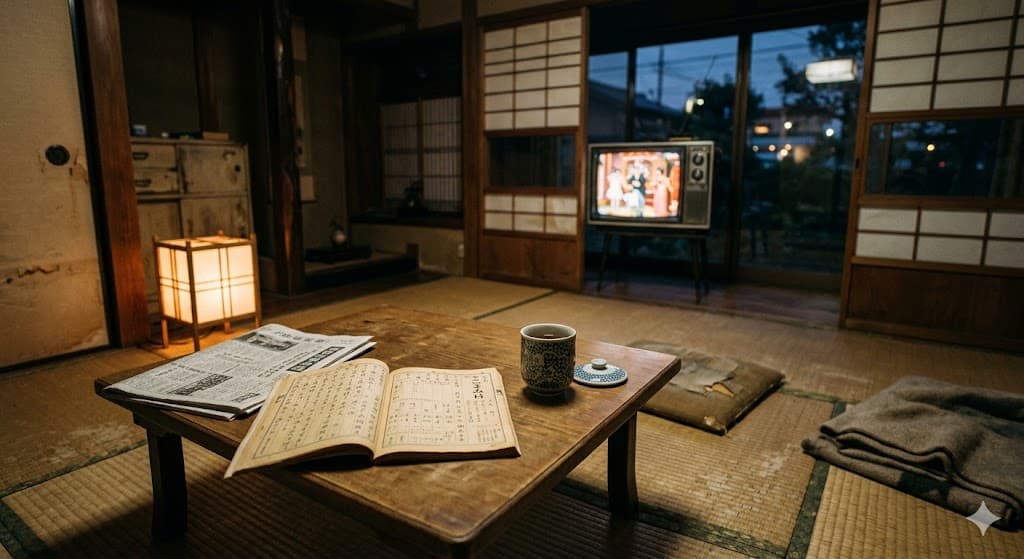
The first time I remember 細木数子(Hosoki Kazuko: postwar fortune-teller and television personality) as a fixture, I was in my younger years, watching her on a variety show on the family television. What stayed with me was not the divination. It was the speech. She would face down a celebrity guest and tell them, on national broadcast, exactly the thing nobody else in the studio was willing to say. Some of her sharper lines I still remember decades later — not because I believed them, but because they sounded the way an older relative might speak after the formalities had been used up.
 A Showa-era family television set, the medium through which fortune-telling vocabulary entered Japanese living rooms.
The word 大殺界(Daisakkai) was everywhere in those years, but I never took it personally. I knew it the way one knows a song that is constantly on the radio. People around me said things like 「今、大殺界だから」(ima, daisakkai dakara: "because I'm in my Daisakkai right now") to explain why they were postponing a wedding or holding off on changing jobs. I noticed it. I didn't consult any chart for myself. I have never had a 厄払い(Yakubarai) done at a shrine, despite having grown up inside a culture that takes 厄年(Yakudoshi) for granted. The closest I get to divination is pulling an 御神籤(Omikuji: paper fortune slip) at 初詣(Hatsumōde: New Year's first shrine visit), the way one might check the morning horoscope page in a newspaper — half ritual, half conversation starter.
So when I saw that a prestige live-action drama was being built around Hosoki herself — not a fictional analogue, but the woman by name — I recognized immediately what the show was doing. It wasn't asking whether Daisakkai is real. It was asking how a word made in a fortune-teller's study in Tokyo ended up in the mouths of office workers and housewives all over the country.
How Rokusei Senjutsu Became a Household Vocabulary
The Book That Outsold the Shrines
 Fortune-telling almanacs of the kind that turned Rokusei Senjutsu into a household reference across postwar Japan.
Rokusei Senjutsu is, by ordinary standards, a young system. It was introduced in 1982 through a book by Hosoki Kazuko, and the divination industry around it grew with extraordinary speed. The cumulative print run of the Rokusei Senjutsu books has crossed fifty million copies, a figure recognized in the Guinness records as the best-selling fortune-telling book series in the world.
That number is worth pausing on. Japan is a country of roughly 125 million people. A fortune-telling book series whose cumulative sales approach half the population is not a niche occult product. It is closer to a household reference. The closest cultural parallel might be a long-running almanac that families keep on a shelf and consult at decision points — births, weddings, business launches, moves.
The system itself sorts people into one of six "star-people" categories based on date of birth: 土星人(Dosei-jin: Saturn-person), 水星人(Suisei-jin: Mercury-person), 火星人(Kasei-jin: Mars-person), 木星人(Mokusei-jin: Jupiter-person), 金星人(Kinsei-jin: Venus-person), and 天王星人(Ten'ōsei-jin: Uranus-person, sometimes treated as Moon-person in popular shorthand). Each is further split into plus and minus types. The drama's opening reading scene — a woman told she is 土星人プラス(Dosei-jin Plus) and therefore entering three years of Daisakkai — is the system's most familiar move.
The Three Bad Years
Within Rokusei Senjutsu, every twelve-year cycle contains a three-year stretch when one's fortune is said to drop sharply. This is the Daisakkai. The specific years are subdivided into 陰影(In'ei: shadow), 停止(Teishi: standstill), and 減退(Gentai: decline) — a vocabulary of slowing-down rather than catastrophe. The standard advice is conservative: don't marry during your Daisakkai, don't start a business, don't change addresses, don't take on a new partner.
What gave this advice its bite was less the system itself than the way it was delivered. Hosoki built her television presence on a blunt, scolding speaking style — a manner often described as 歯に衣着せぬ物言い(Ha ni Kinu Kisenu Monoii: speech with nothing wrapped around it). She would tell guests, in front of millions of viewers, that their marriage plans were a disaster, that they were going to be cheated, that they needed to wake up. The blend of plain folk-divination grammar and tabloid-style confrontation made the Daisakkai land harder than its written explanation alone would have.
A New Word on Old Foundations
Daisakkai is a recent coinage, but the underlying instinct — that life has unlucky stretches one should respect — is much older. The most established Japanese version is 厄年(Yakudoshi). In the conventional reckoning, men's unlucky ages cluster around 25, 42, and 61, with 42 (read in Japanese as shi-ni, homophonous with "to die") treated as the gravest. Women's unlucky ages are typically given as 19, 33, and 37. The year before each is called 前厄(Maeyaku: pre-unlucky year), the year itself 本厄(Honyaku: main unlucky year), and the year after 後厄(Atoyaku: post-unlucky year), which produces, in effect, a three-year cluster of caution around each.
This is the structure Daisakkai inherits. Three years of caution, with a recommendation to suspend major decisions, treated as something the calendar imposes rather than something the person chose. Yakudoshi has roots that trace into Heian-period court customs and Buddhist temple practice; the modern shrine ritual of 厄払い(Yakubarai) is still active in neighborhoods all over Japan. Daisakkai is not a continuation of Yakudoshi — the two systems compute the bad years differently and answer to different cosmologies — but they occupy the same cultural slot. A space the Japanese calendar has always reserved for "this is the year to be careful."
Why a Drama, and Why Now
Building a prestige drama around the woman who popularized Daisakkai works because the word itself is one of the few pieces of postwar Japanese fortune-telling vocabulary that crossed completely out of its origin domain. People who have never owned a Rokusei Senjutsu book still say 「大殺界だから」 to excuse themselves from a risky decision. The phrase has functionally rejoined Yakudoshi as a piece of everyday excuse-grammar — a portable, socially recognized reason to defer.
A drama can stage that crossing. It can show, in its opening minutes, a fortune-teller using the term in a reading, and trust the audience to recognize it without footnoting. That recognition itself is the cultural fact the show is built on.
Fortune-Telling at Arm's Length
Living outside Japan for many years has changed how I notice these things. In a country without 初詣 lines, without small shrines tucked between apartment buildings, without 厄年 charts printed in convenience-store calendars, the absence of fortune-telling vocabulary becomes audible. The English-language horoscopes I see online treat astrology mostly as personality content — fun, lifestyle, mildly self-help. They rarely supply the specific function Daisakkai and Yakudoshi serve in Japan, which is to give a person an unargued, calendar-imposed reason to slow down.
 Omikuji slips at a Tokyo shrine — the casual end of a divination culture where Daisakkai sits alongside Yakudoshi.
That function is the part of Japanese fortune-telling culture I think foreign readers most often miss. The point of Daisakkai is not, primarily, that the future is being predicted. The point is that the speaker is permitted — even expected — to defer. The phrase 「今、大殺界だから」 ends a conversation in a way "I'd rather not right now" cannot. It outsources the refusal to the cosmos. In a culture where direct refusal is socially expensive, a calendar-imposed three-year shadow is, among other things, a remarkably useful piece of social technology.
I notice this most when I think about what Japan has quietly kept. The Yakudoshi shrine business is still healthy. The horoscope columns are still printed. The Rokusei Senjutsu books are still on the shelf at large bookstores. None of these are in obvious decline, even as younger Japanese people increasingly describe themselves as non-religious. The vocabulary persists because the social function persists. A drama that uses a real fortune-teller as its protagonist is, on one level, a drama about how that function gets installed in a national vocabulary — and who, exactly, gets rich doing the installing.
FAQ
Q: Is Daisakkai a traditional Japanese belief?
A: Not in the strict sense. The specific term and its three-year structure were introduced in 1982 within Rokusei Senjutsu. However, the underlying pattern — designated unlucky years requiring caution — is much older and aligns with the traditional 厄年(Yakudoshi) system, which is why Daisakkai felt immediately recognizable to Japanese readers.
Q: Do Japanese people actually plan their lives around Daisakkai?
A: It varies considerably. Some people genuinely consult Rokusei Senjutsu charts before major decisions like marriage or business launches. Many others, myself included, treat it as common cultural vocabulary without organizing personal decisions around it. The phrase 「今、大殺界だから」 often functions more as a socially recognized excuse than as a literal life-planning system.
Q: How is Daisakkai different from Western astrology?
A: Western horoscopes typically supply daily or monthly personality and mood content. Daisakkai operates on a multi-year cycle and is action-prescriptive — it tells the reader what not to do (don't marry, don't move, don't start a business) during specific years. The unit of advice is the year, not the day, and the verb is usually negative.
Key Insights to Remember
- A single fortune-teller, working in the second half of the twentieth century, can install a new word into the everyday vocabulary of an entire country if the word answers to a social function the older vocabulary already prepared the ground for. Daisakkai succeeded because Yakudoshi had already taught Japanese speakers to expect the calendar to issue periods of caution.
- The cultural weight of Rokusei Senjutsu lies less in its specific predictions than in its delivery. The blunt, scolding speaking register that made Hosoki Kazuko a television fixture — repeatedly described as 歯に衣着せぬ — is itself part of the product. The system traveled because the voice traveled.
- Watching a prestige drama treat a real, recent fortune-teller as a historical subject is a sign of something specific about postwar Japan: the figures who shape national vocabulary are not always temple priests or scholars. Sometimes they are television personalities whose books outsell every shrine pamphlet combined.
Sources & References
About the author

Spoiler-free cultural deep-dives into anime, manga & live-action Japanese drama
- ●Tokyo-born, 3rd-generation Edokko (江戸っ子)
- ●Lifelong manga reader & anime viewer since the kaiju era
- ●Writes from outside Japan — distance as a cultural lens
- ●Spoiler-free · sourced · Kanji + Romaji + English
A Tokyo-born, 3rd-generation Edokko writer who has spent years living outside Japan. I use the anime, manga, and live-action Japanese drama you already love as a doorway into the folklore, language, religion, and everyday history behind them — written so even first-time fans can follow along, with sources for every claim.
Enjoy this article?
Get the next spoiler-free cultural deep-dive straight to your inbox.
Related Articles
Spirited Away and Kamikakushi: The Folklore Behind the Title
Spirited Away's Japanese title ends in kamikakushi. Learn who villages said took children away, why dusk was the dangerous hour, and how they searched for them.
10/25/2026
Fruits Basket and the Zodiac Cat: The Real Japanese Folktale of the Cat Who Missed the Banquet
How Fruits Basket builds its outsider cat on the real Japanese folktale of the rat tricking the cat out of the zodiac, and what eto still means in Japan today.
10/20/2026

March Comes in Like a Lion and Tsukimi: Why Japan Watches the Moon With Rice Dumplings and Pampas Grass
How March Comes in Like a Lion opens onto tsukimi, Japan's moon-viewing harvest observance, and why dumplings, pampas grass and a shifting date belong to it.
8/17/2026

Summer Time Rendering and the Shoryo-uma: The Cucumber Horse That Carries the Dead Home
How Summer Time Rendering's Obon homecoming opens onto shoryo-uma, the cucumber horse for returning ancestors, and why it is only one of many regional forms.
8/16/2026

GeGeGe no Kitaro and Hyakumonogatari: Why Japan Saves Its Ghost Stories for Summer
How GeGeGe no Kitaro connects to hyakumonogatari, the hundred-candle ghost game, and the Edo custom of staging horror in summer to chill the audience.
8/11/2026

Demon Slayer Infinity Castle and the Biwa: Heike and Hōichi
How the biwa that opens Demon Slayer's Infinity Castle leads to blind Heike reciters and Hōichi, who played night after night for a court that was not there.
8/7/2026