Parasyte: The Maxim and Sanshi: Japan's Folk Belief That Creatures Live Inside You
How Parasyte: The Maxim echoes sanshi and hara no mushi, the old Japanese belief that worms live inside the body and quietly govern our moods, hunger, and warnings.

Tokyo-born, 3rd-generation Edokko · writing on Japanese culture from outside Japan
Spoiler-Free Cultural Analysis
This article explores the folklore, language, and religious history behind Parasyte: The Maxim — the old Japanese idea that small creatures live within the human body. It discusses only the premise, themes, and atmosphere of the first episode, with no plot revelations beyond the official setup.
Key Takeaways
- Japanese has a whole family of everyday phrases that blame your anger, your moods, your dislikes, and even your hunger on a worm living in your belly — and most people who use them daily never stop to picture the creature the grammar implies.
- Behind those casual idioms sits a genuine old belief system: the 三尸(Sanshi: three corpse-worms) of Daoist origin, monitored through the all-night 庚申待(Kōshin-machi: the Kōshin vigil), in which worms inside you reported your sins to Heaven while you slept.
- Parasyte: The Maxim opens on almost exactly this image — something crawling in to live inside a human body — which makes a modern science-fiction premise rhyme, perhaps unknowingly, with centuries of Japanese folk anatomy.
Key Terms Explained
三尸 (Sanshi) / Three Corpse-Worms — Three spirit-creatures believed in old Daoist-derived lore to live inside every human body, keeping a ledger of the host's misdeeds.
庚申待 (Kōshin-machi) / The Kōshin Vigil — An all-night wake held once every sixty days, when people stayed awake so the worms could not slip out and report on them to Heaven.
腹の虫 (Hara no Mushi) / The Belly Bug — The "worm in the gut" blamed for both anger that won't subside and a stomach that growls with hunger.
虫の知らせ (Mushi no Shirase) / A Premonition — Literally "a bug's notice"; an inexplicable foreboding, usually of something bad, said in older times to come from an insect inside you.
疳の虫 (Kan no Mushi) / The Child's Fretful Worm — The worm once blamed for a baby's night-crying, colic, and tantrums, traditionally dealt with by a ritual sealing.
The Worm I Have Always Blamed for My Bad Moods
When I am angry and can't shake it, I say 腹の虫が治まらない(Hara no Mushi ga Osamaranai: the belly bug won't settle down). When someone is short-tempered for no clear reason, I say they are 虫の居所が悪い(Mushi no Idokoro ga Warui: the bug is in a bad spot). When I instinctively distrust a person, it is 虫が好かない(Mushi ga Sukanai: the bug doesn't take to them). And when a deal sounds too convenient, too one-sided, I call it a 虫がいい(Mushi ga Ii: the bug has it good) story. None of this is poetry to me. These phrases come out of my mouth without a moment's thought, the way breathing does.
 In Japanese, anger and hunger alike are blamed on a worm living in the belly — the hara no mushi.
It took me an embarrassingly long time to notice the strange thing they all assume: that there is a small 虫(Mushi: a bug, insect, or worm) living inside me, and that it — not quite me — is the one in the bad mood. The grammar quietly hands my temper over to a creature in my gut. As a Tokyo-born 江戸っ子(Edokko: a third-generation native Tokyoite), I grew up steeped in these expressions, yet the actual old beliefs underneath them were almost unknown to me until well into adulthood. The idea of the 三尸 reporting my conduct to Heaven, and the night-long vigil people kept to stop them, was not part of my childhood at all; even 疳の虫(Kan no Mushi: the fretful-child worm), the worm blamed for a crying baby, was barely familiar in my own household.
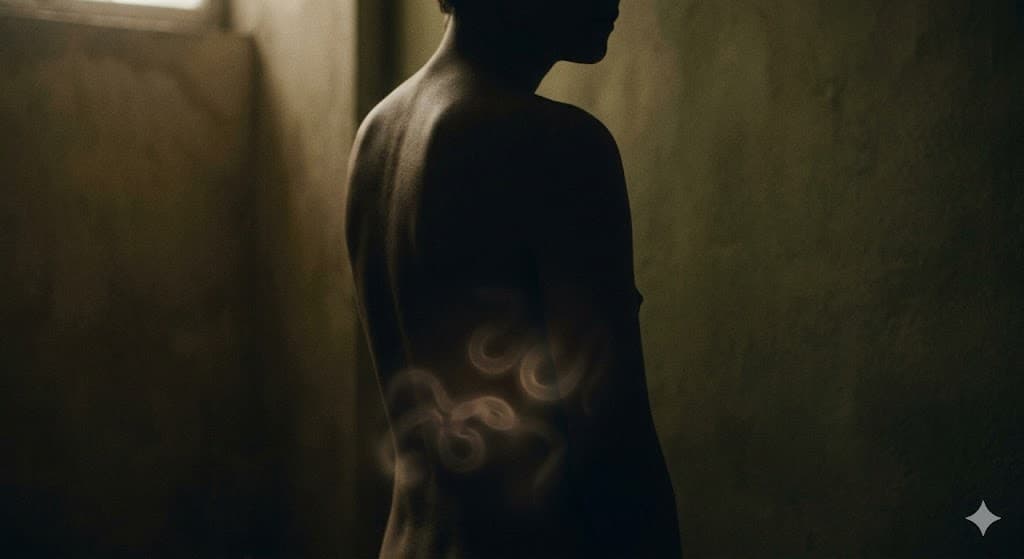
That gap — fluent in the idioms, blank on the faith behind them — is exactly why the opening of Parasyte: The Maxim unsettled me in a way I didn't expect. The premise is simple and stark: a snake-like creature burrows into a high-school boy and takes up residence inside his body, feeding on what his bloodstream carries, the two of them forced into an uneasy coexistence. The first episode even frames its hero as someone who flinches at insects — startled by a spider, told he ought to outgrow his fear of bugs — moments before a far stranger creature moves in for good. A living thing takes up residence inside a human and begins to share the controls. Stated that plainly, it is not a new science-fiction idea at all. It is one of the oldest things Japanese people have said about their own bodies.
Three Corpses, a Sleepless Night, and a Report to Heaven
The Sanshi and the Kōshin Vigil
 Roadside Kōshin stones still mark the spots where neighbors once stayed awake all night to stop the three worms from reporting to Heaven.
The most elaborate version of "creatures live inside you" came to Japan from China. In Daoist physiology, three demonic things called the 三尸 dwell in the human body and actively work to shorten the life of their host. Their method is bureaucratic rather than violent: they keep a record of everything bad you do. Then, once every sixty days, on the night marked 庚申(Kōshin: the 57th day of the old sexagenary calendar cycle), the worms wait for you to fall asleep, slip out of your body, and ascend to 天帝(Tentei: the Heavenly Emperor) to file their report. For each misdeed, days are subtracted from your allotted lifespan.
The countermeasure was as simple as it was demanding: don't sleep. If you stayed awake the whole night, the worms could not leave to inform on you. This wake was the 庚申待, and the belief around it is called 庚申信仰(Kōshin Shinkō: the Kōshin faith) — a blend of Daoism with Japanese Buddhism, 神道(Shintō: Japan's indigenous religion), and local custom. It reached the 平安時代(Heian Jidai: the Heian period) court by around the ninth century, was taken up by the 侍(Samurai: the warrior class) class in the 室町時代(Muromachi Jidai: the Muromachi period), and spread to ordinary townspeople in the 江戸時代(Edo Jidai: the Edo period), where it became a genuinely popular institution. Neighbors would gather, share food and talk, and keep each other awake through the long night. Many small roadside stone markers called 庚申塔(Kōshin-tō: Kōshin stones) still stand around Japan as the quiet residue of all those vigils.
The faith also gave us something nearly everyone recognizes without knowing its source. The 見ざる・聞かざる・言わざる(Mizaru, Kikazaru, Iwazaru: see-not, hear-not, speak-not — the three wise monkeys) are tied to the Kōshin tradition, partly through a pun: the verb-ending -zaru (do not) sounds like saru (monkey). The monkeys' lesson fits the worms perfectly — give the creatures inside you nothing to report.
The Belly Bug of Anger and Hunger
Most Japanese people today have never heard of the Sanshi, yet they carry a downstream version of the idea in their daily speech. The 腹の虫 is the workhorse here. When anger refuses to die down, the belly bug "won't settle." When your stomach growls before lunch, that, too, is the belly bug — older texts even describe it as the worm crying out. The same logic extends across the body: a person who looks utterly harmless is said to have a face that 虫も殺さぬ(Mushi mo Korosanu: wouldn't even kill a bug), and someone barely clinging to life is at 虫の息(Mushi no Iki: an insect's breath).
There is a real linguistic root under all this. The everyday character for mushi is 虫, but its older, fuller form, 蟲, once referred to nearly every kind of creature — and people held that humans, too, had insects within them that drove their thoughts and feelings. In that older worldview, "the bug made me do it" was not a metaphor at all. Your moods had a small, semi-independent author living in your gut.
The Crying Baby's Worm and the Ritual to Seal It
The most touching branch of this belief attached itself to small children. A baby who cries through the night, throws sudden tantrums, runs a mysterious low fever, or simply will not be soothed was said to be troubled by the 疳の虫. The character 疳(Kan) refers to a childhood condition tied to poor digestion or parasites, and over time the phrase became a catch-all explanation for whatever was making a child fretful. A remarkable sixteenth-century medical manuscript even illustrated these internal bugs as distinct little monsters, each responsible for its own ailment — drawings that look startlingly like the rogues' gallery of a modern monster show.
Since you obviously could not treat an infant the way an adult was treated, parents turned to a ritual remedy: 虫封じ(Mushi-fūji: sealing the worm). Certain shrines and temples specialized in it, praying to drive out or pacify the offending creature, and some collected so many votive plaques requesting this that the shrines became known locally as "bug" shrines. Here the worm crosses fully from idiom into devotion — a thing you took your sick child to a holy place to have removed.
The Worm That Warns You
Then there is the phrase I find quietly eerie even now: 虫の知らせ. It names a premonition, almost always of something bad — a sense that arrives before any news could. One theory traces it straight back to the Sanshi, the insects that carried knowledge out of your body; another points to later Edo-period beliefs in which several bugs inside a person governed not only mood but awareness itself. The English "a little bird told me" is light and gossipy. The Japanese version is darker and more interior: the warning comes not from outside, from a bird, but from a creature within you that knows something you don't.
I have had exactly one experience I can only file under this word. A bad feeling I could not reason my way out of, with no information behind it, that turned out to be right. I had not been told anything; there was only the unease, arriving first. Even now, the only language I have for it is 虫の知らせ — and that, I think, is the real staying power of these phrases. They survive because they describe something we still feel happening to us from the inside.
Crickets in a Cage and the Worms We Stopped Believing In
Living outside Japan for many years has made me notice how thoroughly this older relationship with small creatures has thinned out — not only the worms inside the body, but insects in general. As a child in autumn I would hear 鈴虫(Suzumushi: bell crickets) and 松虫(Matsumushi: pine crickets) start up at the end of summer, and people kept them in small cages simply to enjoy the clear sound they made. Where I live now, I almost never encounter the singing of autumn insects, and I find myself remembering that those voices were a particular Japanese way of marking the season turning.
 Bell crickets kept in small cages for their song — a reminder that the bug was never only a thing to fear.
That memory points at something the Parasyte premise quietly understands: in the Japanese imagination, the bug has never been only a thing to fear. It was both repellent and cherished — a crawling creature you flinched from, and a singer you caged so you could keep its music. The boy in the story who startles at a spider, and is then inhabited by something far stranger, lives out that whole ambivalence in a single episode. The horror works precisely because the culture it comes from has spent centuries treating the creatures inside and around us as intimate, not alien.
What modern Japan has largely set down is the literal belief. Few people now stay awake on Kōshin nights; the faith lost official standing in the 明治時代(Meiji Jidai: the Meiji period) when Shinto and Buddhism were administratively separated and much of this lore was dismissed as superstition. We kept the grammar and discarded the cosmology. We still say the belly bug won't settle; we no longer imagine it filing a report to Heaven. There is something a little lonely in that. The phrases used to be the visible tip of a whole picture of the self — a body shared with small, watchful tenants who shaped your temper and your fate. Now they are charming fossils we use without seeing. A work like Parasyte: The Maxim, by literalizing the tenant, briefly hands the old picture back to us, and lets us feel why our ancestors found it so easy to believe that we are never quite alone in our own skin.
FAQ
Q: Did Japanese people really believe worms lived inside the body?
A: Yes, in a serious sense. The Daoist-derived Sanshi belief — that three worms inside you reported your conduct to Heaven — was held at the Heian court, embraced by samurai, and widely practiced by ordinary people through the Edo period. Separately, the idea that internal "bugs" governed a child's moods (the kan no mushi) was common enough to support dedicated shrine rituals.
Q: Is the Kōshin belief still practiced today?
A: Only faintly. The all-night vigils have largely disappeared, and the faith lost ground after the Meiji-era separation of Shinto and Buddhism, when it was treated as superstition. What survives most visibly are the old roadside Kōshin stones and the three wise monkeys, plus the many "worm" idioms that outlived the belief that produced them.
Q: Is Parasyte: The Maxim based on the sanshi belief?
A: There is no claim that it was deliberately modeled on it. The resonance is structural: both center on a creature that lives inside a human and shares control of the body. That overlap is what makes the premise feel so native to a Japanese audience, whose language already assumes a small resident in the gut.
Key Insights to Remember
- The Japanese "worm" idioms are not decorative metaphors bolted onto plain feelings; they are the worn-down remains of a complete folk anatomy in which a semi-independent creature inside you authored your anger, hunger, dislikes, and dread. Using the phrase is effortless; recovering the belief behind it takes real work, even for a native speaker.
- The same culture that produced horror about creatures invading the body also caged crickets to savor their song and took fretful children to shrines to have a worm gently sealed away. This doubled attitude — the bug as both threat and intimate — is the deep soil that makes a story about a body-sharing parasite land as something familiar rather than merely grotesque.
- What gets lost when a belief fades is rarely the words; it is the worldview the words once pointed to. We still say the belly bug won't settle and still feel a premonition arrive from somewhere inside us, but we have stopped picturing the watchful tenant who used to explain it. Fiction that literalizes that tenant briefly returns the old picture, and with it the unsettling intuition that the self was never imagined as a single, sealed thing.
Sources & References
- Three Corpses — Wikipedia
- Kōshin — Wikipedia
- Sanshi: The Three Body-Parasite Problem — Uncanny Japan
- Bug News: Mushi no Shirase — Uncanny Japan
- Kan-no-mushi: Parasites Living Inside Your Spine — Uncanny Japan
- A-Yokai-A-Day: Sanshi — MatthewMeyer.net
- Kan-no-mushi 疳の虫: The Disease Causing Bug — Institute for Classical Asian Medicine
- Mushi 虫 — Meaning in Japanese (Japanese with Anime Bestiary)
- Animal-Related Expressions in Japanese — Maggie Sensei
- Miyake Hachimangū — Wikipedia
About the author

Spoiler-free cultural deep-dives into anime, manga & live-action Japanese drama
- ●Tokyo-born, 3rd-generation Edokko (江戸っ子)
- ●Lifelong manga reader & anime viewer since the kaiju era
- ●Writes from outside Japan — distance as a cultural lens
- ●Spoiler-free · sourced · Kanji + Romaji + English
A Tokyo-born, 3rd-generation Edokko writer who has spent years living outside Japan. I use the anime, manga, and live-action Japanese drama you already love as a doorway into the folklore, language, religion, and everyday history behind them — written so even first-time fans can follow along, with sources for every claim.
Enjoy this article?
Get the next spoiler-free cultural deep-dive straight to your inbox.
Related Articles

Spirited Away and Kamikakushi: The Folklore Behind the Title
Spirited Away's Japanese title ends in kamikakushi. Learn who villages said took children away, why dusk was the dangerous hour, and how they searched for them.
10/25/2026
Fruits Basket and the Zodiac Cat: The Real Japanese Folktale of the Cat Who Missed the Banquet
How Fruits Basket builds its outsider cat on the real Japanese folktale of the rat tricking the cat out of the zodiac, and what eto still means in Japan today.
10/20/2026

March Comes in Like a Lion and Tsukimi: Why Japan Watches the Moon With Rice Dumplings and Pampas Grass
How March Comes in Like a Lion opens onto tsukimi, Japan's moon-viewing harvest observance, and why dumplings, pampas grass and a shifting date belong to it.
8/17/2026

Summer Time Rendering and the Shoryo-uma: The Cucumber Horse That Carries the Dead Home
How Summer Time Rendering's Obon homecoming opens onto shoryo-uma, the cucumber horse for returning ancestors, and why it is only one of many regional forms.
8/16/2026

GeGeGe no Kitaro and Hyakumonogatari: Why Japan Saves Its Ghost Stories for Summer
How GeGeGe no Kitaro connects to hyakumonogatari, the hundred-candle ghost game, and the Edo custom of staging horror in summer to chill the audience.
8/11/2026

Demon Slayer Infinity Castle and the Biwa: Heike and Hōichi
How the biwa that opens Demon Slayer's Infinity Castle leads to blind Heike reciters and Hōichi, who played night after night for a court that was not there.
8/7/2026