Scarlet and the Whistling Arrow: How the Kaburaya Carried Japan's Belief That Sound Itself Could Drive Away Evil
How Mamoru Hosoda's Scarlet uses one whistling arrow to open a door into the kaburaya, Japan's signal arrow, ritual instrument and ward against the unseen.

Tokyo-born, 3rd-generation Edokko · writing on Japanese culture from outside Japan
Spoiler-Free Cultural Analysis
This article focuses on a single sound effect that appears early in 果てしなきスカーレット(Hateshinaki Sukāretto: Scarlet of the Endless): one whistling arrow cutting through the air. No plot points, no character arcs, no ending. Only the cultural history standing behind that small "hiss."
Key Takeaways
- The whistling arrow in Japan is called 鏑矢(Kaburaya: a turnip-headed signal arrow), and its purpose was never just to wound. The sound it produced was the message — opening battles, warning travelers, and, in older belief, frightening away unseen spirits.
- Japanese culture has a long-running idea that sound itself can purify or protect a space. The kaburaya sits in the same family of practices as 鳴弦(Meigen: bowstring-twanging rites) and 蟇目(Hikime: hollow-headed ritual arrows), all of which "cleanse" by acoustic means rather than physical contact.
- A small whistling-arrow moment in an anime is rarely just a sword-fight prop. It carries the residue of 流鏑馬(Yabusame: mounted archery rituals at shrines) and the very old idea that the boundary between the human world and what lies outside it can be marked, and defended, by a single carrying tone.
Key Terms Explained
- 鏑矢 (Kaburaya) / Whistling Arrow — A signal arrow whose hollow turnip-shaped head produces a loud whistling tone in flight. Used historically to open battles, signal commands, and in some rites to ward off evil.
- 鳴弦 (Meigen) / Bowstring Twanging — A ritual of plucking the bowstring without releasing an arrow, performed to purify a space or protect a person, especially around childbirth or the imperial household.
- 蟇目 (Hikime) / Hollow Ritual Arrowhead — A larger, hollow arrowhead (related to the kaburaya) used in purification rites, where the sound rather than the strike was the point.
- 流鏑馬 (Yabusame) / Mounted Shrine Archery — A ritual of horseback archery preserved at major shrines, descended from older battlefield practice but now performed as a prayer for peace, good harvest, and protection.
- 破魔矢 (Hamaya) / Demon-Breaking Arrow — A decorative arrow received at shrines around the New Year, named for its older meaning as an arrow that "breaks evil." A direct surviving descendant of the warding-arrow tradition.
The Sound That Came Before the Battle
There is a moment, early in Hateshinaki Sukāretto, where the air does a very specific thing. A bow is drawn, a string strains, and then comes a single line in the subtitle track: a whistling arrow, hissing through the air. The fight pauses around that sound. Nobody sees the arrow yet. They hear it.
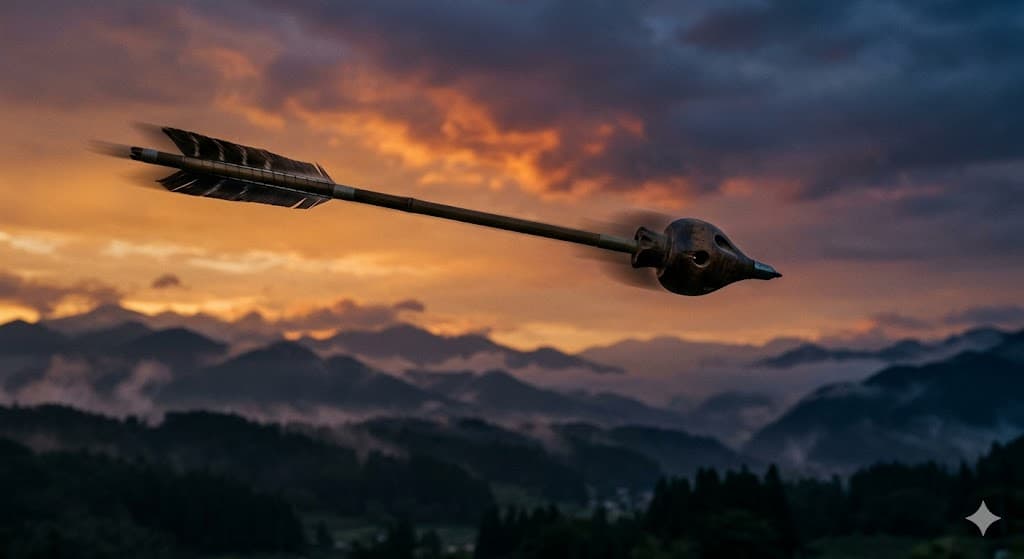
 The hollow, drilled head of the kaburaya — the small chamber that turned an arrow's flight into a far-carrying whistle.
That detail stopped me, because the sound — not the strike — is the whole point of the arrow it describes.
I came up through 日本体育大学(Nippon Taiiku Daigaku: Nippon Sport Science University), where 弓道(Kyūdō: the way of the bow) and archery were part of the daily landscape. There were students in 道着(Dōgi: training uniform), there was the soft thud of straw 的(Mato: targets), there was the long stillness before release that anyone who has watched kyūdō remembers. I never picked up a bow myself. I walked past the dōjō for years and let it stay other people's discipline. But that proximity is exactly why a single hissing arrow in an anime catches my ear now. The sound carries a whole history of meaning that the modern viewer is not necessarily told.
In old Japan, certain arrows were not designed to kill. They were designed to announce. The 鏑矢(Kaburaya: a turnip-headed signal arrow) is the most famous of these. Its head was carved or fitted from a hollow piece — wood, bone, or horn — drilled with holes, so that as it cut through the air it whistled with a high, carrying tone. That tone could be heard across a valley. It opened battles. It signaled positions. And, in a layer older than warfare alone, it did something stranger: it warned away whatever was listening from the other side.
The Older Life of the Kaburaya
The kaburaya is older than the period dramas that made it famous. By the time of the 源平合戦(Genpei Gassen: Genpei wars of the late 12th century), it had become a fixed opening signal — a single whistling shot fired to declare a battle joined. The image is striking: thousands of mounted warriors, weapons drawn, and the entire field waiting on one hollow turnip-head whistling overhead to mark the start.
The Battle Signal
The pragmatic function is the easy one to explain. A signal arrow solved a real problem on a chaotic field. Drums and conch shells could be lost in the noise; a kaburaya cut above it. The whistle carried a distance, and everyone — friend, enemy, allied clan — heard the same tone at the same time. Battles in this period followed a ritualized opening, and the kaburaya was the audible threshold of that opening. Before it: gathering, posturing, names called. After it: combat.
What is easy to miss is that this is already a use of sound as a marker — not as a weapon. The arrow could kill if it struck. But its job was to be heard before anything else happened.
Yabusame: The Sound Preserved in Ritual
The same arrow-as-signal logic lives on, in slowed-down form, in 流鏑馬(Yabusame: mounted shrine archery). At shrines such as 鶴岡八幡宮(Tsurugaoka Hachimangū: a major Shinto shrine in Kamakura), riders thunder down a straight track and fire at three wooden targets in succession. The targets shatter loudly when struck, and the sound itself is part of the prayer. In some yabusame variants, kaburaya-type whistling shafts are used, so the air carries the high whistle before the wood crack of impact. This is no longer battlefield communication. It is a public, audible ritual addressed to the spirits of the place — a request for harvest, protection, peace.
 Yabusame at a Shinto shrine preserves, in ritual form, the same arrow-as-signal logic that once opened battlefields.
I have never seen yabusame in person. The closest I have come is the same television footage everyone else has seen: the moment of release, the gallop, the wood breaking. That is honest to admit. Most Japanese people today encounter yabusame the same way — through a screen, framed as cultural heritage rather than lived ritual. But knowing the kaburaya is in those shots changes how the footage sounds.
Meigen and Hikime: When Sound Alone Was the Rite
This is where the deeper layer opens up. There is a related practice called 鳴弦(Meigen: bowstring twanging), where the archer draws the bow and releases the string without an arrow at all. The sharp twang is the entire ritual. Meigen was performed in the imperial household, around births, around illness, around any moment when the boundary between the living world and the spirit world felt thin. The belief was direct: the sound of the bowstring frightened away malevolent spirits.
A close cousin is 蟇目(Hikime: a large, hollow ritual arrowhead) — sometimes translated as a "toad's-eye" arrow because of the round holes drilled into the head, with 蟇 meaning toad. Hikime arrows were fired in purification rites and exorcisms. They were not aimed at a target in any practical sense. The whistling, droning tone they made in flight was understood to drive away whatever needed to be driven away. The arrow was an instrument; the air was the temple.
Once you know this layer, the kaburaya stops looking like just a battlefield tool. It belongs to a much older Japanese intuition: that certain sounds carry a force, and that the right sound, made deliberately, can mark a boundary, clean a space, or push something unseen back across the line.
The Hamaya: The Tradition That Survived in Your Pocket
Most people in Japan have, at some point, brought home a 破魔矢(Hamaya: a demon-breaking arrow) from a shrine at the new year. It is a decorative arrow, often white-fletched, tied with a small wooden plaque. People place it on a shelf or near the entrance of the home.
 The hamaya — a household-scale survivor of the old belief that an arrow's shape and sound can drive evil away.
The name is not poetic dressing. 破 means break, 魔 means evil or demonic, 矢 means arrow. It is, literally, an arrow that breaks evil. The hamaya descends from this same archery-as-protection tradition — a portable household version of the same idea that powered meigen and hikime.
I admit I did not understand any of this as a child. Growing up in 足立区(Adachi-ku: a working-class ward of Tokyo), I saw hamaya in homes and at shrines every new year, but I took them for ordinary lucky charms. The actual meaning — that the arrow shape itself is a protective device, a miniature of the warding arrows of older Japan — landed for me only as an adult. This is the kind of thing about Japanese culture that does not always get explained at home. It hides in objects you walk past for years.
What the Single Whistling Arrow Carries Now
When a modern anime gives us a single line in the sound design — a whistling arrow, hissing through the air — that small acoustic moment is sitting on top of all of this. Battlefield signal. Shrine ritual. Bowstring rite around a sickbed. New year's decoration over a doorway. The sound is the through-line.
I have lived outside Japan for many years, in a tropical country with no shrines, no shrine archery, no household hamaya, and no inherited memory of an arrow's whistle meaning anything specific. The distance is useful. It lets me notice that Japan kept, longer than most cultures, the belief that sound has agency — that ringing, whistling, twanging, clapping are not just sensory decoration but ways of acting on the world.
Some of this survives in plainer forms. The clack of 拍子木(Hyōshigi: wooden clapper sticks) during a night watch, calling "be careful with fire." The slow strikes of 除夜の鐘(Joya no Kane: the 108 New Year's Eve temple bells), each toll said to cleanse one of the worldly desires. The shrine 鈴(Suzu: bell) you ring before prayer and the 柏手(Kashiwade: ritual handclaps) you give in front of the deity. None of these are weapons. All of them mark, separate, and clean by sound.
The kaburaya is the older, sharper, military-grade ancestor of that whole family. When you hear it hiss once in Hateshinaki Sukāretto, the show is not asking you to know any of that. But the resonance is there for anyone who does. A single whistling arrow is, in the long Japanese imagination, a way of saying: the next space we enter is not the same as the one we were just standing in. And historically, that announcement was thought to push back what should not cross over with us.
FAQ
Q: Is the kaburaya a real weapon or a ritual object?
A: Both. The kaburaya began as a practical battlefield signal arrow, used to open engagements and communicate over distance. Over time it picked up ritual meaning, and the related forms — meigen (bowstring twanging) and hikime (hollow ritual arrowheads) — emphasized the sound itself as protective. By the modern period, the warding meaning had largely outlived the battlefield meaning.
Q: How is the kaburaya connected to the hamaya I see at shrines on New Year?
A: They share the same root idea. The hamaya — literally "demon-breaking arrow" — is a domesticated, household-scale version of the older belief that arrows, and especially the sound or motion of arrows, can drive off harmful spirits. The kaburaya and hikime carried that belief on a battlefield and at a shrine; the hamaya carries it into your home.
Q: Why would a sound, on its own, be thought to drive away evil?
A: This is a recurring assumption across Japanese ritual life, not unique to archery. Temple bells, hyōshigi clappers, shrine bells, ritual handclaps, and bowstring twanging all share the idea that audible vibration can mark or purify a space. The kaburaya is the most dramatic version because the sound travels farthest and is unmistakable, but it sits inside a much wider acoustic-ritual tradition.
Key Insights to Remember
- The whistling arrow is one of the clearest cases where a Japanese cultural object refuses the split between practical and ritual. The kaburaya signaled the start of battles and marked spiritual boundaries, and the same hollow head produced both effects. To treat it as only a weapon, or only a charm, is to miss what it actually was.
- Japan has a long-running intuition that sound is not passive. Meigen, hikime, temple bells, shrine bells, and hyōshigi clappers all assume that the right sound, made deliberately, can clean a place or push something unseen back. The kaburaya is the loudest and oldest expression of this idea, and the hamaya at your shelf is its quietest survivor.
- A single sound cue in a modern anime — one hissing arrow in the subtitle track — is a small door into this layer. The show does not have to explain it, and most viewers do not need it explained to feel the moment. But the resonance is real. When the air hisses, it is carrying a thousand years of Japanese belief about what a boundary sounds like.
Sources & References
About the author

Spoiler-free cultural deep-dives into anime, manga & live-action Japanese drama
- ●Tokyo-born, 3rd-generation Edokko (江戸っ子)
- ●Lifelong manga reader & anime viewer since the kaiju era
- ●Writes from outside Japan — distance as a cultural lens
- ●Spoiler-free · sourced · Kanji + Romaji + English
A Tokyo-born, 3rd-generation Edokko writer who has spent years living outside Japan. I use the anime, manga, and live-action Japanese drama you already love as a doorway into the folklore, language, religion, and everyday history behind them — written so even first-time fans can follow along, with sources for every claim.
Enjoy this article?
Get the next spoiler-free cultural deep-dive straight to your inbox.
Related Articles
Spirited Away and Kamikakushi: The Folklore Behind the Title
Spirited Away's Japanese title ends in kamikakushi. Learn who villages said took children away, why dusk was the dangerous hour, and how they searched for them.
10/25/2026
Fruits Basket and the Zodiac Cat: The Real Japanese Folktale of the Cat Who Missed the Banquet
How Fruits Basket builds its outsider cat on the real Japanese folktale of the rat tricking the cat out of the zodiac, and what eto still means in Japan today.
10/20/2026

March Comes in Like a Lion and Tsukimi: Why Japan Watches the Moon With Rice Dumplings and Pampas Grass
How March Comes in Like a Lion opens onto tsukimi, Japan's moon-viewing harvest observance, and why dumplings, pampas grass and a shifting date belong to it.
8/17/2026

Summer Time Rendering and the Shoryo-uma: The Cucumber Horse That Carries the Dead Home
How Summer Time Rendering's Obon homecoming opens onto shoryo-uma, the cucumber horse for returning ancestors, and why it is only one of many regional forms.
8/16/2026

GeGeGe no Kitaro and Hyakumonogatari: Why Japan Saves Its Ghost Stories for Summer
How GeGeGe no Kitaro connects to hyakumonogatari, the hundred-candle ghost game, and the Edo custom of staging horror in summer to chill the audience.
8/11/2026

Demon Slayer Infinity Castle and the Biwa: Heike and Hōichi
How the biwa that opens Demon Slayer's Infinity Castle leads to blind Heike reciters and Hōichi, who played night after night for a court that was not there.
8/7/2026