Violet Evergarden and Daihitsuya: Japan's Scribes for Hire
How Violet Evergarden's Auto Memory Doll profession mirrors Japan's centuries-old daihitsuya tradition — scribes who wrote letters, lawsuits, and lives for those who could not.

Tokyo-born, 3rd-generation Edokko · writing on Japanese culture from outside Japan
Spoiler-Free Cultural Analysis
This article explores the real cultural and historical roots behind the Auto Memory Doll profession introduced in the opening episode of Violet Evergarden — no plot turns are revealed beyond the official premise. The focus is the long Japanese tradition of writing on behalf of those who could not write for themselves.
Key Takeaways
- The "Auto Memory Doll" job in Violet Evergarden looks European on the surface, but its structure — sitting in a small office, listening to a stranger's heart, shaping their words onto paper for a fee — matches the Japanese 代筆屋(Daihitsuya: ghostwriter/scribe-for-hire) lineage almost beat for beat.
- The line "there are still many people who don't know how to write" is not artistic license. Edo-era Japan had high literacy by world standards but a steeply uneven one — by class, gender, and region — and scribes filled the gap at station fronts, temple gates, and government offices.
- The modern 行政書士(Gyōseishoshi: administrative scrivener) profession traces directly to the Meiji-era 代書人(Daishōnin: licensed scribe) system established in 1872, meaning the Auto Memory Doll has a real-world descendant still working in Japanese cities today.
Key Terms Explained
- 代筆屋 (Daihitsuya) / Ghostwriter for hire — A general term for someone who writes letters or documents on another person's behalf in exchange for payment.
- 代書屋 (Daishoya) / Scribe for hire — Often used interchangeably with daihitsuya; in the late Edo and Meiji period this term came to refer specifically to those who drafted official or legal documents.
- 代書人 (Daishōnin) / Licensed scribe — The Meiji-era profession formalized in 1872; the direct ancestor of today's administrative and judicial scriveners.
- 公事宿 (Kujiyado) / Lawsuit inn — Edo-period inns near magistrates' offices that lodged plaintiffs from the provinces and drafted their legal filings.
- 行政書士 (Gyōseishoshi) / Administrative scrivener — A national licensed profession that drafts paperwork for submission to government offices; the modern descendant of the Meiji daishōnin.
A Job I Have Quietly Been Doing for Decades
There is a moment in the first episode of Violet Evergarden where President Hodgins, walking the protagonist through his new postal company, gestures to the writing department upstairs and mentions, almost in passing, that many people still cannot write. The line is dropped lightly. The show moves on. But it lodged in me the first time I watched the scene, because for most of my own working life I have been quietly doing a version of the same job.
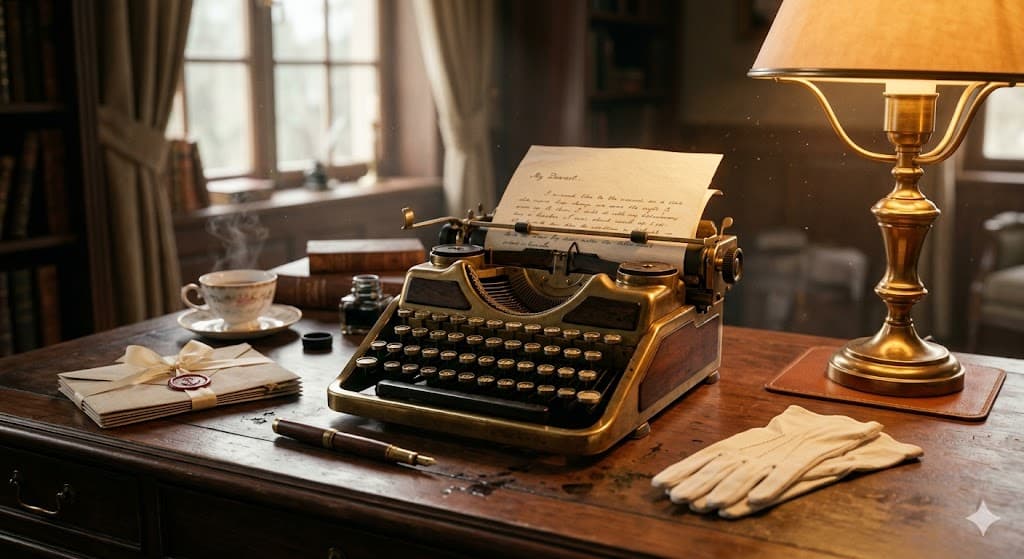
 The Auto Memory Doll's typewriter recalls a profession that long predates the show — translating unspoken feelings into ink for a fee.
Across decades of working life, I have written things in other people's names more times than I can count. Sometimes it was a client who had a clear sense of what they wanted to say but no instinct for how to put it on a page. Sometimes it was a colleague during the 1980s and 90s ワープロ(Wāpuro: word processor) transition years — someone who could write perfectly well by hand but could not yet make the new machine do what their pen used to do, and so I ended up drafting the document for them. When I set up my own company in Japan in 2000, I did not write the articles of incorporation myself; I hired a 行政書士(Gyōseishoshi: administrative scrivener) and a 司法書士(Shihōshoshi: judicial scrivener) to draft them so the filing would pass on the first attempt. I could have written it myself in theory. In practice, what I was paying for was the same thing Violet sits down at her typewriter to provide: someone whose hands and head know exactly how the words need to land for the document to do its job in the world.
That is what an Auto Memory Doll really is. The chrome of automation and the slightly steampunk uniforms make the profession feel invented for the show. The work itself is one of the oldest in Japan.
The Real History Behind the Auto Memory Doll
Edo-Era Literacy Was High by World Standards — and Sharply Unequal
There is a popular line, repeated in tourist guides and casual histories, that Edo-period Japan had the highest literacy rate in the world. The truth is more complicated. Late-Edo literacy in the city of Edo itself ran high — possibly seventy percent or more of the urban population could read and write at some level, supported by an extensive network of 寺子屋(Terakoya: temple-school-style commoner schools) that taught reading, writing, and 算盤(Soroban: abacus arithmetic). Across the country as a whole, late-Edo literacy stood at roughly forty-three percent for men and about fifteen percent for women — a sharply uneven distribution, but high by global nineteenth-century standards.
What gets lost in the patriotic version of this story is the second number. A male literacy rate near half and a female literacy rate around fifteen means that across the country, on any given street, you were standing next to people who could not write a letter to a sibling, file a complaint with the magistrate, or sign a contract for the rice they grew. The gap was filled, as gaps like that always are, by people who could.
The Edo Scribes: Public-Facing Letter Writers and the Lawsuit Inns
Two species of ghostwriter populated the Edo cityscape. The first was the street-corner or station-front 代書屋(Daishoya: scribe for hire), often working from a small stall, who would draft a love letter for a young person who could not put their feelings on paper, write home for a migrant worker who had finally saved enough to send word to his village, or fill out a basic petition. These were not legal specialists. They were translators between speech and ink.
 Street-corner daishoya served as translators between speech and ink for those who could not write their own letters or petitions.
The second was a more formal and more lucrative role. 公事宿(Kujiyado: lawsuit inns) — also called kujininjado — were inns that housed people who had come to the city for lawsuits or trials. The proprietors and clerks of these inns were officially permitted to assist with legal procedures, drafted the documents that needed to be submitted to the magistrates, and performed a role similar to that of a lawyer. There were no licensed attorneys in the modern sense, but the kujiyado proprietor functioned as one — drafting filings, advising on procedure, and handling negotiation. In Edo, kujiyado were heavily concentrated around the Bakurochō district and were frequently mentioned in 川柳(Senryū: comic verse) of the period, giving a sense of how busy and visible the trade was.
A more disreputable cousin existed in parallel: the 公事師(Kujishi: lawsuit broker). Kujishi took on legal work for clients, taught them procedure, drafted their filings, and sometimes overstepped by posing as relatives or village officials in court, or buying up old debt notes specifically to force the debtor into a settlement. The shogunate treated them as unlicensed and tried to suppress them, but their function placed them at the historical root of what would eventually become the Japanese attorney.
The Meiji Reorganization: From Daishoya to Daishōnin
When the Meiji government began rebuilding the country's legal infrastructure, it had to do something about the patchwork of unlicensed scribes, lawsuit innkeepers, and brokers operating across the country. In 1872, the Meiji government established a Daishōnin (licensed scribe) system as part of its introduction of a modern judicial framework. Today, court-related documents are handled by 司法書士(Shihōshoshi: judicial scrivener). Documents submitted to administrative bodies were regulated through late-Meiji metropolitan and prefectural ordinances and a 1920 Home Ministry "Scribe Rules" regulation, and today are handled by 行政書士(Gyōseishoshi: administrative scrivener) under the 1951 Gyōseishoshi Law.
 Today's gyōseishoshi offices sit on quiet shopping streets — the unbroken continuation of a scribe tradition reaching back to the Meiji daishōnin system.
In the 1872 司法職務定制(Shihō Shokumu Teisei: Regulations on Judicial Offices), three professions were defined: 証書人(Shōshonin: notary), 代言人(Daigennin: advocate), and 代書人(Daishōnin: scribe). The shōshonin became today's notary, the daigennin became today's attorney, and the daishōnin became today's judicial and administrative scriveners. In 1919 the Judicial Scrivener Law separated court-document work from general administrative-document work, and in 1920 the Home Ministry's Scribe Rules formalized the latter as the foundation of the modern administrative scrivener profession.
What I find striking is the through-line. The street-corner daishoya writing a young man's love letter, the kujiyado proprietor drafting a peasant's petition to the magistrate, the Meiji daishōnin filling out a residency form for a worker newly arrived in Tokyo, and today's gyōseishoshi handling business permits and visa renewals are all doing the same job in successive costumes. Auto Memory Doll is the next costume in that line.
What the Show Quietly Gets Right About a Vanishing Job
The detail that turns Violet Evergarden's premise from gimmick into something close to documentary is the social setting Hodgins describes. The Meiji-era daishōnin system was created precisely because administrative procedures had become too complex for ordinary citizens to navigate alone. Writing was no longer enough; even literate people needed someone to write for them in the specific register the state demanded.
The same gap reopens in different shapes in every generation. When I helped colleagues compose memos on early word processors, the problem was not that they could not write — they had written by hand for decades — but that the new medium had its own grammar and they could not yet hear it. When I hired a 行政書士(Gyōseishoshi: administrative scrivener) to draft my company's filings in 2000, the problem was not that I could not write Japanese; it was that the Legal Affairs Bureau spoke a specific dialect of paperwork in which a single misplaced phrase could send my application back for a second attempt I did not have the patience for.
And the most direct version of the problem has not disappeared either. I knew a junior high school student near a family I am close to who struggled to read. He was approaching his high school entrance exams and the obstacle came before the actual content — he could not parse the question text in the time allowed, and both he and his parents were exhausted by it. I had thought, in the lazy way most modern people think, that "people who cannot write" belonged to old photographs and pre-war villages. The encounter rearranged that assumption. Reading and writing difficulties are still present in Japan, quietly, in numbers nobody quite likes to publish.
From the outside, having lived away from Japan long enough to forget how things look up close, I have come to see the ghostwriter's job as one of those quiet civic functions that civilizations either acknowledge or hide. Japan acknowledged it. It built scribes into its inns, then into its government, then into a licensed profession that still sits on quiet shopping streets behind small signboards reading 行政書士事務所(Gyōseishoshi Jimusho: administrative scrivener's office). Violet's job — the part of it that involves sitting across a desk from someone whose feelings need to leave their body and reach another person — was already an old job when the show invented its name.
FAQ
Q: Is the Auto Memory Doll profession in Violet Evergarden based on a real historical job?
A: The Western-style steampunk setting is invented, but the underlying profession — sitting in a public-facing office, taking down a client's spoken words and shaping them into a written letter or document for a fee — closely mirrors the long Japanese tradition of 代筆屋(Daihitsuya) and 代書屋(Daishoya) scribes, which evolved into the licensed 代書人(Daishōnin) of the Meiji period and the modern administrative and judicial scriveners.
Q: Did most people in Edo-period Japan really not know how to write?
A: Literacy was relatively high for the era, but very unevenly distributed. Late-Edo male literacy stood at roughly forty-three percent across the country, with female literacy around fifteen percent, and sharp differences between cities and villages, samurai and commoners, men and women. Scribes-for-hire existed precisely because the gap between those who could write and those who needed something written was large enough to support a profession.
Q: Does the daihitsuya tradition still exist in some form today?
A: Yes. The Meiji 1872 daishōnin system evolved into the modern 司法書士(Shihōshoshi: judicial scrivener) — which handles court and registration documents — and the 行政書士(Gyōseishoshi: administrative scrivener) — which handles documents submitted to government offices. Both professions are licensed by national examination and remain a working part of Japanese civic life. Informal ghostwriters for personal letters and speeches also still exist, often advertising online.
Key Insights to Remember
- The Auto Memory Doll is fiction wrapped around a very Japanese reality. The image of a stranger paying someone to translate their unspoken feelings into a written letter — for a marriage, a confession, a farewell — sits at the center of Edo-period scribe culture. The show's emotional engine is not invented; it is borrowed from a job that existed on real Japanese streets for centuries.
- Literacy is never a yes-or-no condition. Even societies with strong reading cultures contain people who cannot write what the situation demands — sometimes for class reasons, sometimes for gender reasons, sometimes because the document type has its own dialect that ordinary writing skills cannot reach. Japan responded by professionalizing the gap rather than pretending it did not exist, and that response runs in an unbroken line from the kujiyado innkeeper to today's administrative scrivener.
- Watching this episode from outside Japan, what stands out is how matter-of-factly Hodgins delivers the line about people who still cannot write. There is no sentimentality and no embarrassment. The civic acknowledgment that some people will always need help putting their lives onto paper is itself a cultural inheritance, and it is one of the things the country has quietly kept while letting other traditions go.
Sources & References
About the author

Spoiler-free cultural deep-dives into anime, manga & live-action Japanese drama
- ●Tokyo-born, 3rd-generation Edokko (江戸っ子)
- ●Lifelong manga reader & anime viewer since the kaiju era
- ●Writes from outside Japan — distance as a cultural lens
- ●Spoiler-free · sourced · Kanji + Romaji + English
A Tokyo-born, 3rd-generation Edokko writer who has spent years living outside Japan. I use the anime, manga, and live-action Japanese drama you already love as a doorway into the folklore, language, religion, and everyday history behind them — written so even first-time fans can follow along, with sources for every claim.
Enjoy this article?
Get the next spoiler-free cultural deep-dive straight to your inbox.
Related Articles
Your Name and Kumihimo: The Real Japanese Craft Behind Mitsuha's Braided Cord
How Your Name dramatizes kumihimo as a picture of musubi, and the real braided-cord craft behind it, from samurai armor to the modern kimono obijime.
10/12/2026

Touch and the Alps Stand of Koshien: Why Japan Unbolts Stadium Seats for a School Brass Band
How Touch's high-school baseball world leads to Koshien's Alps Stand, named by a cartoonist, and why seats are removed each August for school brass bands.
8/14/2026

Summer Wars and Hanafuda: The Flower Cards That Built Nintendo Before Video Games
How Summer Wars puts a deck designed to survive a gambling ban on the table, and why Nintendo spent its first 86 years making those flower cards by hand.
8/13/2026

In This Corner of the World and Japan's Noon Silence on August 15: The Minute a Whole Country Stops
How In This Corner of the World, set in wartime Kure, connects to Japan's mokutō, the noon silence each August 15 timed to the 1945 surrender broadcast.
8/12/2026

Sailor Moon and the Sailor Fuku: Why Japan Put a Skirt on a British Naval Uniform
How the sailor uniform behind Sailor Moon reached Japan — a British naval design adopted in 1920 so girls could do gymnastics, and the school that first paired the top with a skirt.
8/6/2026

Silver Spoon and Japan's Agricultural High Schools: The Real Nōgyō Kōkō Behind Ooezo
How Silver Spoon draws on Japan's real agricultural high schools — around 300 of them — and why their student farming clubs were deliberately modelled on an American organisation after the war.
8/5/2026