Sukuna Meaning: The Real Two-Faced King Behind Jujutsu Kaisen's Ryomen Sukuna
How Jujutsu Kaisen's Ryomen Sukuna draws on the Nihon Shoki (720 CE), which calls him a two-faced, four-armed rebel, while Hida honors him as a temple founder.

Tokyo-born, 3rd-generation Edokko · writing on Japanese culture from outside Japan
Spoiler-Free Cultural Analysis
This article explores the real eighth-century chronicle entry and the regional folk tradition behind the name "Ryomen Sukuna," not the plot of Jujutsu Kaisen. No story revelations beyond the premise of episode one — only the history, geography, and competing memories the name carries.
Key Takeaways
- The name Ryomen Sukuna comes from a single short passage in 日本書紀(Nihon Shoki: Chronicles of Japan, completed 720 CE) describing a two-faced, four-armed figure who defied the imperial court — making it one of Japan's oldest written demon-king accounts.
- In the 飛騨(Hida: a mountainous region in northern Gifu Prefecture) region, the same figure is remembered not as a monster but as a founder, a Buddhist patron, and an agricultural leader, still enshrined at temples such as 千光寺(Senkō-ji) and 善久寺(Zenkyū-ji).
- The split between "rebel as recorded by the court" and "hero as remembered by the locals" is one of the cleanest examples in Japanese history of how the same person can be canonized twice — once with horns, once with halos — depending on who held the pen.
Key Terms Explained
- 両面宿儺 (Ryōmen Sukuna) / Two-Faced Sukuna — A legendary figure recorded in the Nihon Shoki as having two faces, four arms, and four legs; the source name behind the cursed spirit in Jujutsu Kaisen.
- 日本書紀 (Nihon Shoki) / Chronicles of Japan — Japan's second-oldest extant book and its first official imperial history, completed in 720 CE under the Yamato court.
- 飛騨 (Hida) / Hida Region — A mountainous province in what is now northern Gifu Prefecture, historically isolated from the capital and home to its own traditions of woodworking, mining, and folk veneration.
- 武振熊命 (Takefurukuma no Mikoto) / Commander Takefurukuma — The imperial general the Nihon Shoki credits with subjugating Sukuna; remembered in court records as the ancestor of the 和邇(Wani) clan.
- 千光寺 (Senkō-ji) / Senkō Temple — A Shingon Buddhist temple in Takayama, Gifu, whose founding tradition credits Ryomen Sukuna himself as its patron and Buddhist founder roughly 1,600 years ago.
A Hero Hidden Inside a Villain's Name
I had heard, in passing, the idea that in some parts of Japan the villains of the official history books are quietly worshipped as heroes. It was the kind of thing that sounds plausible the moment you hear it — of course there must be people somewhere whose great-grandfather's great-grandfather had refused to bow to the court, and of course those people would keep the memory differently. But when I tried to put a name to the pattern, I came up empty. I could not, at that moment, name a single example. It was a shape I could recognize without being able to point at anything specific.
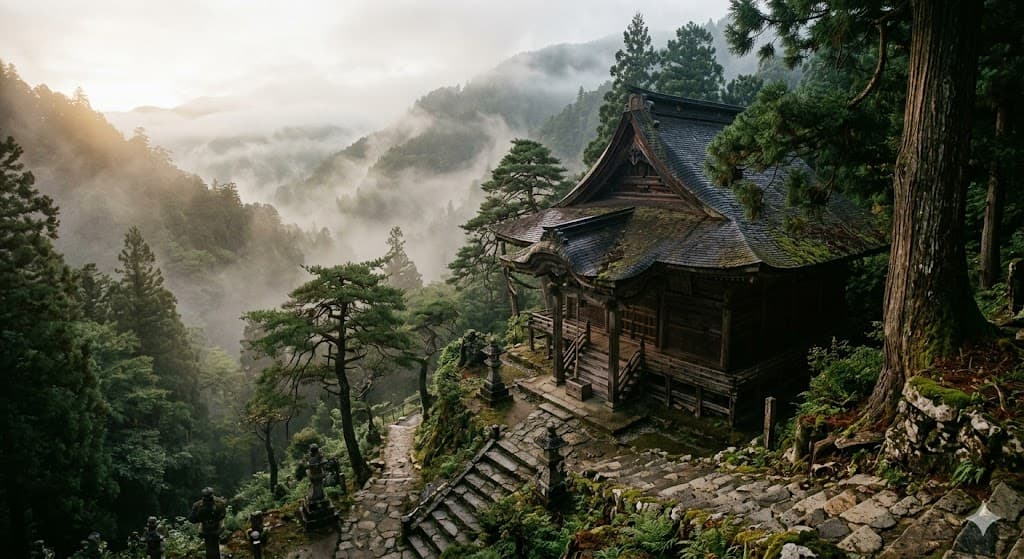
 The mountainous Hida region of northern Gifu, where local tradition has preserved a memory of Ryomen Sukuna sharply different from the one recorded in the imperial chronicle.
I am a 江戸っ子(Edokko: a Tokyo native, third generation in my case), and 飛騨(Hida) had always been one of those interior regions whose name I had heard on travel programs without ever attaching a face to. My knowledge of the 日本書紀(Nihon Shoki) was, honestly, the same shape: I could recite the date 720 CE and the phrase "official chronicle" the way one recites a station name on a train line one has never gotten off at. The text itself I had never read. So when Jujutsu Kaisen's first episode introduced a cursed spirit called Ryomen Sukuna, and I learned the name was not invented but lifted from a chronicle entry I had only ever known by title, what struck me was not the manga's audacity. It was that the manga had handed me, finally, the specific name I had been missing — the example I had not been able to produce when the pattern was first described to me.
The thread leads to a single short paragraph in the eleventh volume of the Nihon Shoki, in the reign of 仁徳天皇(Nintoku-tennō: Emperor Nintoku, traditionally 313–399 CE). And from that paragraph, two completely incompatible portraits of the same man have been drawn for thirteen centuries. The court drew one. Hida drew the other. And almost nobody outside Hida has heard the second portrait described.
What the Chronicle Actually Says, and Who Was Holding the Pen
The Nihon Shoki entry is brief enough that most readers, including most Japanese readers, have never seen it quoted in full. In the sixty-fifth year of Emperor Nintoku's reign in 飛騨国(Hida no Kuni: Hida Country), a man named Sukuna is recorded as having one body and two faces, one set against the other so that they faced opposite directions, four arms and four legs, knees but no heels, exceptional speed and strength, and the ability to wield swords on each side and bows in all four hands. He refused imperial commands and took pleasure in plundering the people, so the court sent an emissary to kill him.
 The Nihon Shoki, completed in 720 CE, devotes only a short paragraph to Sukuna — yet that single passage has shaped his official image for thirteen centuries.
That emissary was 武振熊命(Takefurukuma no Mikoto). He is named as the founder of the 和珥部臣(Wanibe no Omi: the Wanibe noble line) — the ancestor of the 和邇(Wani) clan — sent by the emperor to vanquish the creature. The chronicle gives Sukuna no speech, no motive beyond cruelty, no negotiation. He is described, condemned, and killed in a handful of sentences.
Who Wrote It, and Why That Matters
To read the passage well, one has to remember who was writing. The Nihon Shoki was completed in 720 CE — Japan's oldest official chronicle, compiled by the Yamato court itself. The court was, in 720, in the middle of an ongoing project to consolidate authority over regions that had previously been semi-independent: the 蝦夷(Emishi: the non-Yamato peoples of eastern and northern Honshu), the 隼人(Hayato: the southern peoples of Kyushu), and the mountain peoples of central Honshu including Hida. A chronicle written by the conquering side will, predictably, describe the conquered side in monstrous terms. The two faces, the four arms, the inhuman speed: these are the standard literary signature of "this person was not really a person, so killing him was not really a wrong."
The Physical Description as Political Argument
I find the specific detail of "two faces, turned away from each other" worth pausing on. It is not the description of a deformity. It is, structurally, the description of a being that cannot be looked at honestly from any single direction — which is exactly how a centralized state would prefer to characterize a regional leader whose followers still remembered him fondly. A figure whose face you cannot meet straight on does not need to be debated; he only needs to be defeated.
The Other Memory: Hida's Founder, Builder, Buddhist Patron
The remarkable thing — the thing the chronicle does not tell you and never will — is that Hida itself remembered Sukuna entirely differently.
 Senkō-ji in Takayama, Gifu, whose founding tradition credits Ryomen Sukuna himself — the same figure the imperial chronicle condemned as a monster.
Senkō-ji and the Founder Tradition
Senkō-ji, an ancient temple in what is now Takayama City, traces its founding back roughly 1,600 years to Ryomen Sukuna of Hida Province. In local Hida and 美濃(Mino: the southern half of Gifu) tradition, Sukuna is treated as a hero and benefactor; he is regarded as 開基(Kaiki: temple founding patron) of Senkō-ji and 善久寺(Zenkyū-ji) in 丹生川町(Nyūkawa-chō: a district of Takayama City), and is credited with introducing Buddhism to Hida Province.
Local accounts describe him not as a marauder but as a regional ruler, a priest, and a leader of agriculture — which is why so many shrines and temples carry his name, and why even an elongated, creamy-flavored local pumpkin known as 宿儺かぼちゃ(Sukuna Kabocha: a Hida heirloom pumpkin variety) is named after him.
The Counter-Narrative: A Defender, Not an Invader
The Hida version flips every detail of the imperial story. In one local account preserved near the cave associated with him, the Yamato court ordered the subjugation of Ryomen Sukuna who dwelled in a cave in the Hida mountains, and Takefurukuma — who served 神功皇后(Jingū Kōgō: Empress Jingū, the legendary regent of the early imperial line) — was dispatched. Sukuna chose to leave the cave to fight in the open so that war would not reach the village; he received hospitality from the people and cared about their difficulties. In this telling, the two-faced king is the one trying to keep civilians out of the line of fire.
Some Hida legends go further still, describing Sukuna as the just and compassionate lord of the region before the Yamato imperial house arrived, and saying he resisted the Yamato invasion led by Takefurukuma and fell in battle protecting his land. This is not the monster of the chronicle. This is a defeated king mourned by his own people.
The Statue That Lets You See Both Faces at Once
What I find most moving about the Hida tradition is that it never tries to erase the strangeness of the two faces — it just reinterprets what the two faces mean. A 武将(Bushō: military commander) statue in the main hall of Senkō-ji in Nyūkawa-chō has faces on the front and back of the head, while another statue carved by 円空(Enkū: the wandering Edo-period Buddhist sculptor, 1632–1695) at the same temple shows a smiling face with an angry face on its shoulder. One face for compassion, one face for the wrath that protects what compassion alone cannot. The same body, the same person, doing both kinds of work at once.
Two Histories, One Country, and What That Tells Us About Memory
The Hida–Yamato split is not a curiosity. It is, I think, the single best illustration in early Japanese history of a pattern that runs through the whole archipelago: the same human being can be canonized as a demon by the people who killed him and as a saint by the people he led, and both canonizations can be sincere, and both can survive for a thousand years inside the same country without ever forcing a public resolution.
A Country That Doesn't Insist on Choosing
Living outside Japan for many years, I have noticed that other cultures tend, eventually, to demand that history pick a side. Either the figure was a villain or he was a hero; either the chronicle is true or the local tradition is true; either the central government's history book is the history or it isn't. Japan, on this point, has been quietly stubborn. Senkō-ji has not lobbied to have the Nihon Shoki rewritten. The Imperial Household Agency has not asked Senkō-ji to take down its statues. They sit in parallel, the way 阿吽(a-un: the paired open- and closed-mouthed guardian forms at a shrine gate) sit — facing different directions, doing different work, neither one cancelling the other.
What Hida Reminds Us About the Word "Demon"
There is a habit, when discussing Japanese folklore for an outside audience, of translating 鬼(Oni: ogre or demon) and similar words straight into "demon" and then importing the moral weight that the English word carries. Sukuna shows why that habit is risky. The same figure who appears in the Nihon Shoki under language we would translate as "monstrous bandit" appears in Hida temple records as a 観音菩薩(Kannon Bosatsu: the Bodhisattva of Compassion) manifestation. The Japanese category that the word "demon" is trying to translate has always been wider, stranger, and more morally complicated than the English word allows. A two-faced king can found a temple. An oni can be the thing you thank for the harvest. A rebel against the throne can be the grandfather of the village.
Why It Matters That a Manga Reached Back This Far
When Jujutsu Kaisen names its central cursed spirit Ryomen Sukuna, it is not making up a scary word that sounds Japanese. It is pulling, deliberately, on a name that has been carrying two opposite charges for thirteen hundred years. The character in the manga reads, in Japan, against a backdrop of temple statues in Gifu that most domestic readers have never personally seen but have at least heard of. The horror of the cursed spirit lands harder, not softer, when you know that the historical Sukuna had a smile carved into half of his face by Enkū, and an axe carved into his hand by the same sculptor because the woodworkers of Hida wanted their founder remembered with a tool, not just a weapon.
FAQ
Q: What does the name Sukuna (宿儺) mean in Japanese?
A: 宿儺 (Sukuna) is an ancient personal name preserved in the Nihon Shoki (日本書紀: Japan's oldest chronicle, 720 CE). 宿 carries the sense of 'lodge' or 'dwell,' suggesting a being that inhabits a place or body, and 儺 is a rare kanji tied to 追儺 (tsuina: ancient exorcism ritual that drives out demons). Together the name reads as a presence that both dwells and must be exorcised. The fuller name 両面宿儺 (Ryomen Sukuna) adds 両面 ('two-faced'), literally describing the chronicle's four-armed, two-faced figure of Hida. Jujutsu Kaisen layers all of this weight onto its King of Curses without altering a single character of the original kanji.
Q: Is Ryomen Sukuna a real historical figure?
A: He appears as a specific named figure in the Nihon Shoki, Japan's oldest official chronicle, completed in 720 CE. Whether the historical person behind the description actually had two faces and four arms is, of course, another matter — most modern historians read the description as a literary device the imperial court used to dehumanize a regional leader who refused to submit. But the entry itself is a real eighth-century text describing a real conflict between the Yamato court and the Hida region.
Q: Where can I see traditional images of Ryomen Sukuna today?
A: The most famous extant images are at Senkō-ji in Takayama, Gifu Prefecture — including a striking seated Ryomen Sukuna carved by the Edo-period sculptor Enkū. The temple is open to visitors and has long traditions of associating Sukuna with its founding. Zenkyū-ji and several other temples in the wider Hida region also venerate him.
Q: Why does the same figure appear as villain in one source and hero in another?
A: Because the Nihon Shoki was written by the Yamato court, while the temple traditions and folk memories were preserved by the people of Hida itself. Centralized state chronicles tend to portray defeated regional powers as monstrous; the regions themselves tend to remember the same figures as founders, protectors, or culture-bringers. This split is not unique to Sukuna in Japanese history, but Sukuna is one of the clearest and oldest examples.
Key Insights to Remember
- The Nihon Shoki passage on Sukuna is a single short paragraph, but it carries enormous weight precisely because it is so brief and so absolute: the court's job, in writing it, was not to explain Sukuna but to close his case. Everything we know about the man comes either from those few sentences or from the local traditions that the chronicle was trying, implicitly, to overwrite.
- The dual veneration at Senkō-ji is not a contradiction the Japanese tradition is trying to resolve. It is the form the tradition takes. Two faces on one body, an angry expression on one shoulder and a smiling one on the other — this is not a costume Sukuna wears. It is how a culture that does not insist on either/or makes room for the truth that the same person can be the thing that destroyed your enemies and the thing your enemies wrote down as a monster.
- When a contemporary anime reaches back into a text from 720 CE to name its antagonist, it is not borrowing a word. It is reactivating a thirteen-hundred-year-old argument about who gets to write the official version of who someone was. The fact that most Japanese readers and almost all overseas readers experience the name Ryomen Sukuna for the first time through Jujutsu Kaisen is itself part of that argument: the chronicle won the long fight for visibility, and the regional memory has been waiting, very patiently, for a chance to be heard again.
Sources & References
- Ryomen-sukuna — Japanese Wiki Corpus
- The Real Ryomen Sukuna: The History Behind Jujutsu Kaisen's King of Curses — Tokyo Weekender
- Myth and History: Jujutsu Kaisen's Ryomen Sukuna — Anime News Network
- Meditation / Senkoji Temple — Hida Takayama Official Tourism
- Spiritual Retreat and Forest Pilgrimage at Senkoji Temple in Hida Takayama — Wabunka
- Ryomen Sukuna: The Ancient Japanese Demon King Behind Jujutsu Kaisen's Most Feared Villain — Zenchantique
- Ryomen Sukuna: Awesome Saint or Japan-Destroying Demon? — Uncanny Japan Podcast Ep. 145
- Enku's Buddhas: Sculptures from Senkoji Temple and the Hida Region — Heritage of Japan
About the author

Spoiler-free cultural deep-dives into anime, manga & live-action Japanese drama
- ●Tokyo-born, 3rd-generation Edokko (江戸っ子)
- ●Lifelong manga reader & anime viewer since the kaiju era
- ●Writes from outside Japan — distance as a cultural lens
- ●Spoiler-free · sourced · Kanji + Romaji + English
A Tokyo-born, 3rd-generation Edokko writer who has spent years living outside Japan. I use the anime, manga, and live-action Japanese drama you already love as a doorway into the folklore, language, religion, and everyday history behind them — written so even first-time fans can follow along, with sources for every claim.
Enjoy this article?
Get the next spoiler-free cultural deep-dive straight to your inbox.
Related Articles
Your Name and Kumihimo: The Real Japanese Craft Behind Mitsuha's Braided Cord
How Your Name dramatizes kumihimo as a picture of musubi, and the real braided-cord craft behind it, from samurai armor to the modern kimono obijime.
10/12/2026

Touch and the Alps Stand of Koshien: Why Japan Unbolts Stadium Seats for a School Brass Band
How Touch's high-school baseball world leads to Koshien's Alps Stand, named by a cartoonist, and why seats are removed each August for school brass bands.
8/14/2026

Summer Wars and Hanafuda: The Flower Cards That Built Nintendo Before Video Games
How Summer Wars puts a deck designed to survive a gambling ban on the table, and why Nintendo spent its first 86 years making those flower cards by hand.
8/13/2026

In This Corner of the World and Japan's Noon Silence on August 15: The Minute a Whole Country Stops
How In This Corner of the World, set in wartime Kure, connects to Japan's mokutō, the noon silence each August 15 timed to the 1945 surrender broadcast.
8/12/2026

Sailor Moon and the Sailor Fuku: Why Japan Put a Skirt on a British Naval Uniform
How the sailor uniform behind Sailor Moon reached Japan — a British naval design adopted in 1920 so girls could do gymnastics, and the school that first paired the top with a skirt.
8/6/2026

Silver Spoon and Japan's Agricultural High Schools: The Real Nōgyō Kōkō Behind Ooezo
How Silver Spoon draws on Japan's real agricultural high schools — around 300 of them — and why their student farming clubs were deliberately modelled on an American organisation after the war.
8/5/2026