SPY x FAMILY and O-juken: The Real Exams Behind Eden Academy
How SPY x FAMILY dramatizes O-juken, Japan's high-stakes early-childhood entrance exams, and the parent-child interview that judges the whole family.

Tokyo-born, 3rd-generation Edokko · writing on Japanese culture from outside Japan
Spoiler-Free Cultural Analysis
This article explores the real Japanese cultural and historical background behind the entrance-exam world depicted in SPY x FAMILY, drawing only on the widely known premise of Episode 1. It contains no plot twists or story revelations — only the atmosphere, the setting, and the genuine social system that inspired it.
Key Takeaways
- O-juken is not a plot device invented for the anime. It is a real, high-pressure system in which children as young as five or six sit entrance examinations for elite private and national elementary schools, often after a year or more of formal preparation.
- The parent-child interview shown in the story mirrors a genuine convention: many schools assess the entire household, not just the child, and the requirement that both parents attend "with no exceptions" reflects real practice rather than comic exaggeration.
- The figure of the "education mother" and the cram-school industry that surrounds O-juken grew directly out of postwar Japan's economic boom and its exam-driven path to social mobility.
Key Terms Explained
- お受験 (O-juken) / Early-Childhood Entrance-Exam Competition — The honorific o- attached to 受験 (juken: taking an exam), signaling the specialized, socially charged world of exams for elementary schools and kindergartens.
- 親子面接 (Oyako Mensetsu) / Parent-Child Interview — An interview format in which the child and both parents sit together and are evaluated as a single family unit.
- 教育ママ (Kyōiku Mama) / Education Mother — A mother who devotes herself, sometimes to excess, to managing her child's academic achievement.
- 幼児教室 (Yōji Kyōshitsu) / Preschool Prep Room — Cram schools specializing in coaching very young children, and their parents, for elementary entrance exams.
- 行動観察 (Kōdō Kansatsu) / Behavioral Observation — A test format in which examiners watch how a child behaves and cooperates in group play, rather than scoring written answers.
The Ordinary Public-School Route, and the Families Who Chose the Other One
I grew up going the most ordinary route there is. Born in a working-class part of downtown Tokyo, I walked to the local 公立(Kōritsu: public) elementary school like nearly everyone around me, and my home was a 放任(hōnin: hands-off) household — the kind where no parent stood behind you waving a banner toward a name-brand school. お受験(O-juken: early-childhood entrance-exam competition) was, from the start, something that belonged to other people.
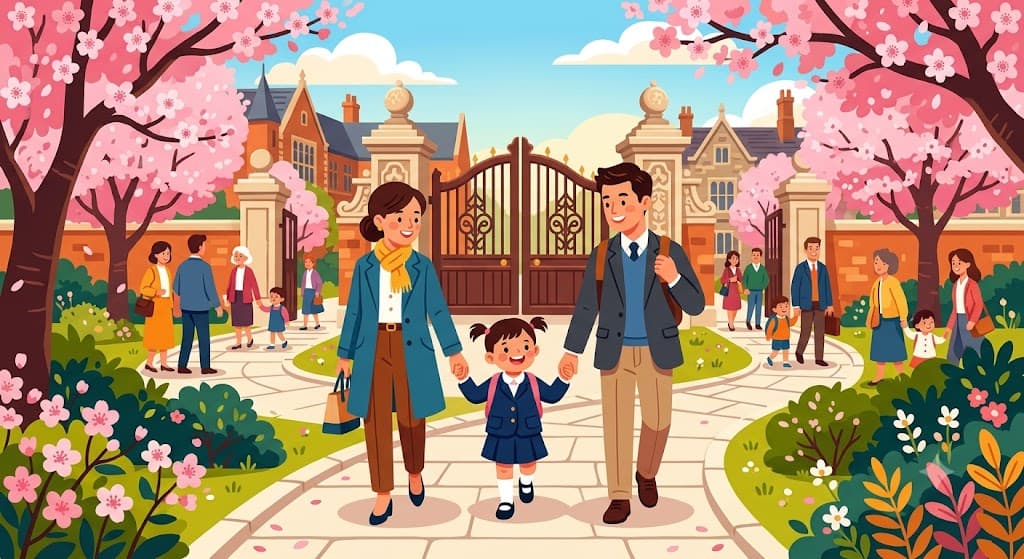 For O-juken, it is the whole family — not just the child — that prepares to walk through the gate.
And yet those other people were right there. A few classmates, and relatives on the お受験組(o-juken-gumi: the exam-bound set), lived by a completely different clock — lessons, prep rooms, rehearsed manners — and even as a child I could feel how sharply their family's plan differed from mine. What stayed with me was not envy. It was a small, persistent unease: the person supposedly taking the exam was a five- or six-year-old, but the one who looked truly desperate was almost always the parent. The child would be coloring or fidgeting while the mother's face carried the weight of the whole enterprise.
That memory is exactly why the opening of SPY x FAMILY landed for me not as fantasy but as documentary. A man is handed a mission that requires, of all things, a child enrolled in an elite academy on a brutal deadline — and the story treats "get the kid into the prestigious school" as a genuine operation, complete with an entrance exam and, at the climax, an interview the whole family must attend. Strip away the espionage, and what's left is a startlingly accurate portrait of a real Japanese ritual.
The Machinery Behind a Five-Year-Old's Exam
From Postwar Boom to the Education Mother
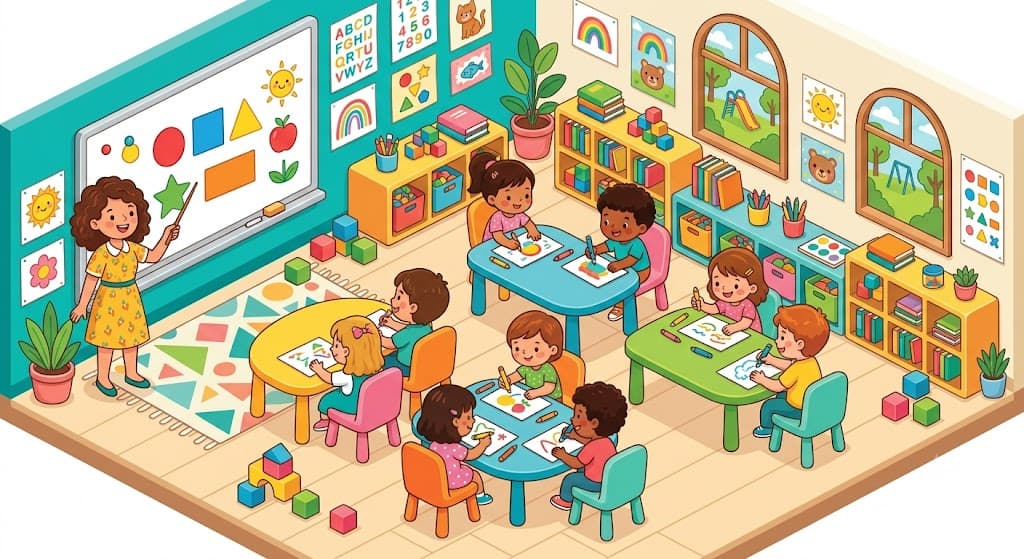 Preparation for elementary entrance exams often begins a year or more in advance at specialized preschool prep rooms.
The world of O-juken did not appear out of nowhere. It grew alongside postwar Japan's rapid economic growth, when access to higher education widened and exam success became the main ladder for social mobility. In a system where the school you entered could shape the rest of your life, families began investing earlier and earlier — and the responsibility for that investment fell, by cultural default, largely on mothers.
That is the soil from which the 教育ママ(Kyōiku Mama: education mother) grew. The stereotype — a mother who monitors homework, enrolls her child in cram schools, and treats child-rearing as a full-time academic vocation — became a recognizable figure as the economy boomed, and by the 1980s the phrase was firmly lodged in the national vocabulary. It is Japan's cousin to the "tiger mother" and the "stage mother" archetypes elsewhere: admired, feared, and resented all at once. Read against this background, the anime's premise — a family assembled specifically to clear an elite school's gate — is really a spy-thriller exaggeration of a pressure millions of ordinary households have felt for real.
What the Entrance Exam Actually Tests
The exams themselves are stranger, and more revealing, than the word "test" suggests. They mostly target children in the 年長(Nenchō: the final preschool year, around five to six years old), with private-school examinations concentrated in the autumn. Depending on the school — private, or the harder-to-enter 国立(Kokuritsu: national) — the assessment blends several formats.
There is the paper test, but there is also the 行動観察(Kōdō Kansatsu: behavioral observation), in which examiners simply watch how a child shares toys, waits a turn, or handles a small setback during group play. And there is the oral portion, where a young child is asked, in their own words, about their family and daily life. What is being measured is not raw knowledge so much as temperament, upbringing, and the household behind the child. This is why Anya's mind-reading gift is such a sharp joke: the exam is designed to see through rehearsed answers, and a child who can literally read the room is the ultimate cheat against a system built to detect coaching.
The Parent-Child Interview: Judging the Whole Family
Here is where the story is most precisely faithful to life. In the anime, the school's invitation specifies a three-person interview that both parents must attend, with no exceptions — and that is not a writer's flourish. Real Japanese elementary-school admissions commonly include an 親子面接(Oyako Mensetsu: parent-child interview), and while formats vary — child alone, parents alone, parents and child together — the joint interview with both mother and father present is a familiar convention.
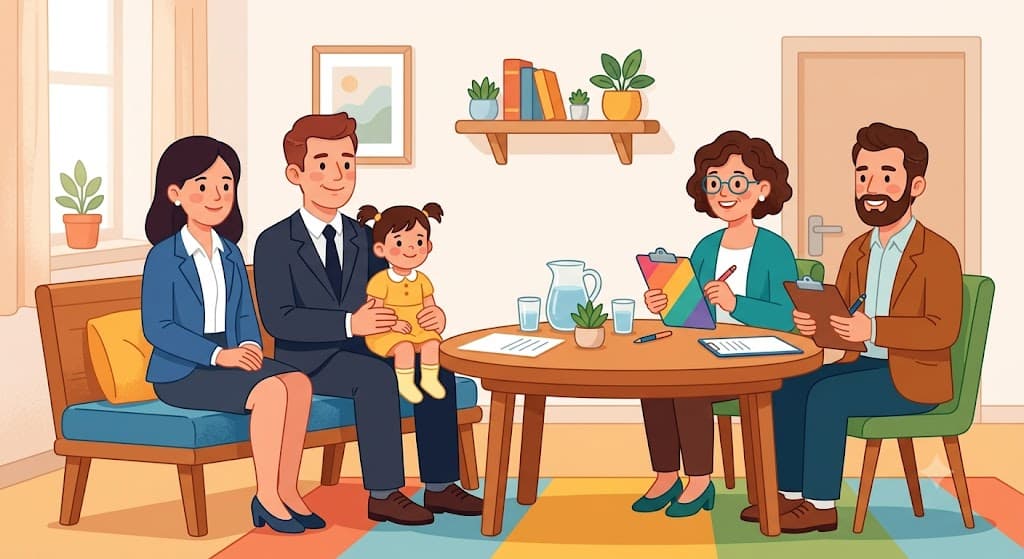 In the parent-child interview, the household is assessed as a single unit, from educational philosophy to how parents respond when the child stumbles.
What matters is that the family is being assessed as a unit. Interviewers probe the household's educational philosophy, its values, and — increasingly in recent years — the father's involvement in raising the child, not just the mother's. They watch how a parent reacts when the child stumbles on a question. And because young children cannot be fully scripted, the interviews are famous for the moment a rehearsed household is undone by a single honest sentence — the child of a family that prides itself on home cooking cheerfully announcing a love of instant cup noodles. That is the exact comic engine of SPY x FAMILY's Eden Academy: the more perfectly the adults prepare their cover, the more devastating the child's unfiltered truth becomes.
Watching O-juken From the Outside
I never sat on either side of a parent-child interview. My own credential is on the teaching side — I trained in health and physical education at Nippon Sport Science University and did my teaching practicum — and it is from that vantage, learning how children actually develop, mind and body, in the early years, that my old unease sharpened into a real question. Setting a five-year-old to compete against other five-year-olds, and sorting them by test performance that young, sits awkwardly with everything the developmental side of that training taught me.
Living outside Japan for many years has only widened that gap in perspective. From a distance, what strikes me most is how specifically Japanese this whole ritual is. The idea that a very young child would aim for a name-brand school, and that a family would be judged as a group in an interview room, is genuinely hard to convey abroad; people raised elsewhere often have no comparable frame for it. That is why I think SPY x FAMILY travels so well as a cultural export without meaning to. Under the gags and the spycraft, it is quietly teaching a global audience one of Japan's most distinctive institutions — the moment when a household, not just a student, walks in to be examined.
None of this is a verdict on the families who choose that road. Watching from the outside has taught me that the Japanese way is one option among many, not the single correct one — and O-juken is a vivid example of a society solving the universal problem of "how do we give our children a good start" with an answer that is unmistakably its own.
FAQ
Q: Is the Eden Academy entrance process in SPY x FAMILY realistic?
A: The core elements are. A prestigious school with a competitive entrance exam, a formal application, and a parent-child interview requiring both parents to attend all reflect genuine Japanese O-juken practice. The espionage framing is fiction, but the admissions ritual is drawn closely from reality.
Q: Do Japanese children really take entrance exams that young?
A: Yes. O-juken most often targets children in their final preschool year, roughly five to six years old, who sit examinations for private and national elementary schools. Preparation frequently begins a year or more in advance at specialized preschool cram schools.
Q: Why does the school insist that both parents attend the interview?
A: Because the parent-child interview is designed to evaluate the whole family — its educational philosophy, its values, and how parent and child relate. Assessing both parents together, rather than the child alone, lets a school judge whether the household as a unit aligns with its approach.
Key Insights to Remember
- The anime's premise inverts a real dynamic that anyone near O-juken has noticed: officially the child is the candidate, but the family is the true subject of examination. The parent-child interview makes the household itself the thing being judged, which is why a spy who must fabricate an entire family is such a fitting protagonist for this particular ritual.
- O-juken is best understood not as a quirk but as a product of history. It crystallized when postwar economic growth turned exam success into the main route to social mobility, and it carries the figure of the education mother as a direct inheritance from that era's pressures.
- The gap that makes O-juken hard to explain abroad is also what makes SPY x FAMILY an unintentional cultural teacher. Comedy that depends on a child derailing a rehearsed family interview only works because the interview format is real — and in laughing at Anya, an overseas audience is quietly absorbing something specific about how Japan admits its children to school.
Sources & References
- Kyōiku mama — Wikipedia
- Education mama — Fiveable, History of Japan
- 小学校受験とは?流れ・必要な準備・両親の服装まで徹底解説 — AOYAMA Journal
- 小学校受験のプロが語る、受かる面接VS落ちる面接! — SHINGA FARM
- 【小学校受験/面接】聞かれやすい質問と合格するための回答例をご紹介! — 天神メディア
About the author

Spoiler-free cultural deep-dives into anime, manga & live-action Japanese drama
- ●Tokyo-born, 3rd-generation Edokko (江戸っ子)
- ●Lifelong manga reader & anime viewer since the kaiju era
- ●Writes from outside Japan — distance as a cultural lens
- ●Spoiler-free · sourced · Kanji + Romaji + English
A Tokyo-born, 3rd-generation Edokko writer who has spent years living outside Japan. I use the anime, manga, and live-action Japanese drama you already love as a doorway into the folklore, language, religion, and everyday history behind them — written so even first-time fans can follow along, with sources for every claim.
Enjoy this article?
Get the next spoiler-free cultural deep-dive straight to your inbox.
Related Articles

Crayon Shin-chan and Nagashi Somen: Why Japan Sends Its Summer Noodles Down a Bamboo Flume
How a Crayon Shin-chan episode turns nagashi somen into salaryman theatre — and the real 1955 origin of Japan's flowing noodles, from Takachiho Gorge to Kagoshima's rotating rival.
8/9/2026

Naruto and the Naruto Strait Whirlpools: The Real Uzushio Behind the Uzumaki Name
How the anime Naruto links to the real Uzushio whirlpools of Tokushima's Naruto Strait — a tidal wonder you can visit, and the spiral motif behind it.
7/17/2026

Attack on Titan and On-Gaeshi: Why Hannes's Debt to the Jaeger Family Is More Than a Favor
How Attack on Titan dramatizes on-gaeshi — the lifelong Japanese debt of gratitude behind Hannes's vow, and why the English word favor can't carry its weight.
7/6/2026
Death Note and Hissatsu Shigotonin: Japan's Shadow Justice
How Death Note channels Japan's shadow-justice tradition — the TV drama Hissatsu Shigotonin, whose hidden killers punish evil the law itself cannot touch.
7/1/2026

Kaiju No. 8 and the Ritual of All Night Nippon: The Late-Night Radio Culture Behind Hoshi Night Nippon
How Kaiju No. 8's Hoshi Night Nippon bit recreates Japan's late-night radio ritual, from radio names to the postcard-artisan culture of listener submissions.
6/28/2026
One Piece and the Art of Nanori & Mie: Why the Hero Names the Move Before He Throws the Punch
How One Piece's named attacks carry the samurai nanori battle-cry and the kabuki mie pose — the old grammar of declaring yourself before you strike.
6/23/2026