Naruto and the Naruto Strait Whirlpools: The Real Uzushio Behind the Uzumaki Name
How the anime Naruto links to the real Uzushio whirlpools of Tokushima's Naruto Strait — a tidal wonder you can visit, and the spiral motif behind it.

Tokyo-born, 3rd-generation Edokko · writing on Japanese culture from outside Japan
Spoiler-Free Cultural Analysis
This piece follows the word Naruto backward through a Japanese fish cake and out to a real strait in 徳島県(Tokushima-ken: a prefecture in western Japan) where tidal whirlpools genuinely form. It discusses geography, food history, and an ancient design motif — no plot points from the anime are revealed.
Key Takeaways
- The name at the center of a globally famous ninja story is not invented — it traces back through a spiral-patterned ramen topping to a real ocean channel where some of the world's largest tidal whirlpools appear on a daily schedule.
- The 鳴門海峡(Naruto Kaikyō: the Naruto Strait) whirlpools are a place you can physically visit, viewed from a glass-floored bridge walkway or a sightseeing boat, which makes this one of the rare cases where a pop-culture name points to an actual tourist destination.
- The spiral itself is one of the oldest decorative forms in the Japanese archipelago, reaching back thousands of years to prehistoric pottery, long before it ever swirled inside a bowl of ramen or on a character's clothing.
Key Terms Explained
- 渦潮 (Uzushio) / Tidal Whirlpool — The swirling vortices that form in a narrow strait when fast-moving tidal water meets slower water at the edges.
- 鳴門海峡 (Naruto Kaikyō) / The Naruto Strait — A roughly 1.3-kilometer-wide channel between Shikoku and Awaji Island, famous for the fastest tidal currents in Japan.
- 渦巻き (Uzumaki) / Spiral or Whorl — The general Japanese word for a spiral pattern; also the surname of the anime's hero and the name of an ancient decorative motif.
- なると巻き (Narutomaki) / Spiral Fish Cake — A steamed fish-paste cake with a pink spiral cross-section, named after the strait's whirlpools and commonly sliced onto ramen.
- 縄文 (Jōmon) / Japan's Prehistoric Period — The long era of early pottery-making cultures whose ceramics carried some of the archipelago's earliest spiral designs.
The Swirl I Ate Without Ever Thinking About It
For most of my childhood, a bowl of ramen simply came with a pink spiral in it. That thin slice of なると(Narutomaki: spiral fish cake), sitting next to the チャーシュー(Chāshū: sliced roast pork) and the メンマ(Menma: fermented bamboo shoots), was just part of the furniture of the bowl. I did not like it especially or dislike it. I never saved it for last, and I never pushed it to the side. It was there the way the steam was there — a thing you eat without ever asking why it exists.
 The pink spiral of narutomaki sits in nearly every classic bowl of ramen, so ordinary that most people never ask where its name comes from.
And the spiral was everywhere else, too. The green coil of the 蚊取り線香(Katori Senkō: mosquito coil) burning on a summer evening. The "dizzy eyes" drawn as two little spirals in manga whenever a character got knocked silly. The curl on top of soft-serve ice cream. Swirled hard candy. I could not have told you what any of it meant, and I never thought there was anything to explain. Growing up in Japan, the spiral was so ordinary it was invisible.
Here is the part I find slightly embarrassing to admit. The most famous spiral of all — the actual 渦潮(Uzushio: tidal whirlpool) at the Naruto Strait, the one everything else is named after — I have only ever seen on a screen. On television, in photographs, in the little travel segments that used to run on afternoon programs. I knew it was a real place where the sea turns in on itself. I never once got on a boat and went. That gap — between the swirl I ate a hundred times and the swirl I never traveled to see — is exactly the thread I want to pull on here.
A Name That Nests Three Layers Deep
The word Naruto is a set of Russian dolls. On the outside is Naruto Uzumaki (うずまきナルト), the ninja hero. Inside that is なると巻き(Narutomaki), the fish cake. And inside that is the real strait whose water actually spins. Each layer borrowed its swirl from the one beneath it, and the deepest layer is not fiction at all — it is oceanography.
The Physics of a Roaring Gate
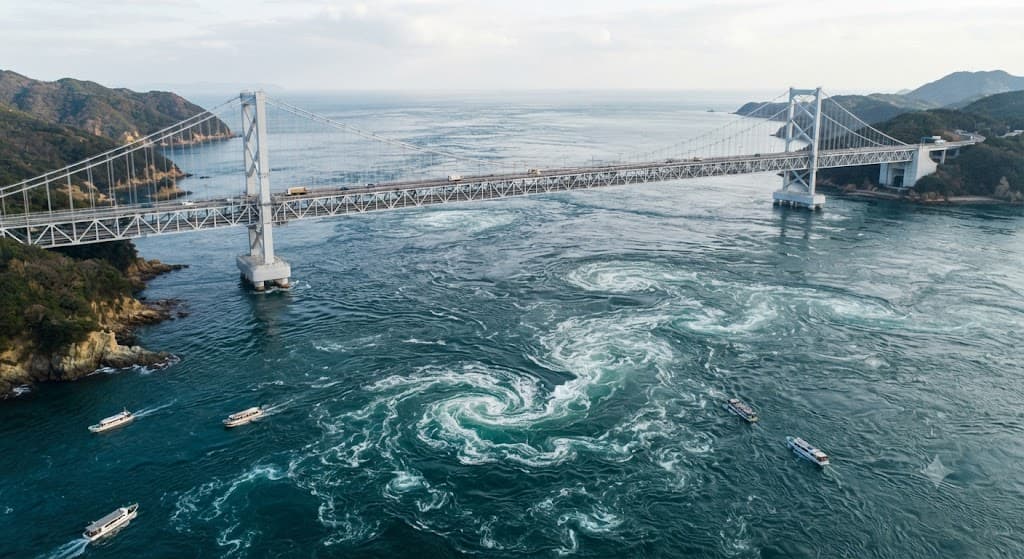
The 鳴門海峡(Naruto Kaikyō) is a narrow channel, only about 1.3 kilometers across, between 鳴門市(Naruto-shi: a city in Tokushima) on 四国(Shikoku: the smallest of Japan's four main islands) and 淡路島(Awajishima: Awaji Island) in 兵庫県(Hyōgo-ken: a prefecture facing the Seto Inland Sea). On one side lies the 瀬戸内海(Seto Naikai: the Seto Inland Sea); on the other, the 紀伊水道(Kii Suidō: the Kii Channel) opening toward the Pacific. Because of the way the tides move through this region, the water level on the two sides of the strait can differ by as much as 1.5 meters. When that difference releases, an enormous volume of seawater has to squeeze through the narrow gap all at once.
 Tidal currents rushing through the narrow Naruto Strait spin the sea into vortices that can reach around 20 meters across.
The result is the fastest tidal current in Japan — reaching roughly 20 kilometers per hour during spring tides — and it ranks among the great tidal currents of the world, spoken of alongside the Strait of Messina in Italy and the Seymour Narrows in Canada. The whirlpools form where the fast water rushing through the center meets the slower water along the edges; that shearing between fast and slow spins the sea into vortices that can reach around 20 meters across. They appear on a predictable rhythm, roughly four times a day around the tidal shifts, and grow largest in spring and autumn. The very name is thought to come from the roaring sound of that rushing water — a "roaring gate," 鳴る門(Naru-to: roaring gate), where the sea itself makes noise.
What moves me about this is that it is not metaphorical. There is no symbolism required. The sea genuinely turns in a circle, on a timetable, in a place with a train station and a bus stop.
From Whirlpool to Fish Cake
The fish cake came next. なると巻き(Narutomaki) is a specific kind of かまぼこ(Kamaboko: steamed fish-paste cake), a food family with centuries of history in Japan. Kamaboko is made from 擂り身(Surimi: minced, rinsed white fish) that is blended, shaped, and steamed. To make the naruto version, part of the paste is tinted pink, then the sheets are rolled together so that a slice reveals a spiral — and that spiral was made to echo the whirlpools of the Naruto Strait. The style is generally dated to the Edo period, and today much of Japan's supply is produced in 焼津(Yaizu: a fishing port), in 静岡県(Shizuoka-ken: Shizuoka Prefecture on the Pacific coast).
This is worth stating plainly because the internet gets it backward constantly: the fish cake is not named after the anime. The food came first by well over a century. The pink swirl on your ramen is a tiny edible portrait of a natural phenomenon in Tokushima, and it has been sitting quietly in noodle bowls since long before any ninja put on a headband.
The Spiral as an Ancient Motif
Go one layer deeper than the strait itself and you reach the pure shape — the 渦巻き(Uzumaki) as design. This is far older than the fish cake or the anime. Spiral motifs, sometimes called 渦巻文(Uzumaki-mon: spiral pattern), appear on pottery from the 縄文(Jōmon) period, Japan's prehistoric era of hunter-gatherer potters, thousands of years ago. Some Middle Jōmon vessels carry bold spiral decoration unlike anything that came before them.
 Spiral motifs carved into Jōmon-period pottery show how far back the swirl reaches in the Japanese archipelago, long before ramen or anime.
What the spiral meant to those makers is genuinely unknown, and its meaning remains unresolved, though it is often loosely associated with water, growth, and the cycle of life. Over the long span of Japanese art the motif kept resurfacing — in textiles and dyeing, and folded into some 家紋(Kamon: family crests) as a mark of lineage. So the swirl carries a strange double life: it is at once one of the most ancient shapes in the culture and one of the most mundane, equally at home on a prehistoric pot and on a burning mosquito coil.
The Layer That Never Travels
Living outside Japan for many years has shown me something about this word that I could not see from the inside. Overseas, Naruto is one thing: the title of an anime. Say it to almost anyone under a certain age and they know the show. But the other two layers — the fish cake, the strait — almost never come up. The pink swirl in the ramen, the roaring channel in Tokushima, the Jōmon pottery: all of that stays home. What crosses the ocean is the outermost doll, and the ones nested inside it are left behind.
There is a quiet irony there. The anime made the word Naruto one of the most recognizable Japanese words on the planet, more familiar to a lot of people than the names of Japanese cities. Yet the very thing the name originally pointed to — a real place you can stand above and watch the sea spin — remains almost unknown outside Japan. The map got a landmark that most people who use the name will never connect to a location.
And I am hardly in a position to lecture anyone, because I did the same thing from within. I ate the swirl for years, I recognized it instantly as a food, and I still never went to see the water it was copied from. The spiral was so woven into daily life that its source became easy to overlook — which may be the most Japanese fate a symbol can have: to be everywhere, meaning something, and noticed by almost no one.
FAQ
Q: Are the Naruto whirlpools real, and can you actually visit them?
A: Yes. They are genuine tidal whirlpools in the Naruto Strait between Tokushima on Shikoku and Awaji Island. You can view them from sightseeing boats that go right up to the vortices, or from the 渦の道(Uzu no Michi: the Whirlpool Path), a 450-meter glass-floored walkway built beneath the 大鳴門橋(Ōnaruto-kyō: the Ōnaruto Bridge) about 45 meters above the sea.
Q: Is the anime character Naruto named after the fish cake or the whirlpools?
A: The naming runs through the same spiral lineage. The fish cake, narutomaki, is named after the strait's whirlpools and predates the anime by well over a century. The character's family name, Uzumaki, literally means "spiral," so the whole chain — hero, fish cake, strait — shares one swirling image rather than one borrowing directly from another.
Q: When is the best time to see the whirlpools?
A: They are largest during spring tides in spring and autumn, and generally strongest around the new and full moon. On any given day they appear around the tidal shifts, roughly within an hour or so before and after, so checking a tide table before you go is essential.
Key Insights to Remember
- A single word can be an archaeological dig. Peel back Naruto and you pass through modern pop culture, then Edo-period food craft, then prehistoric pottery — three layers of Japanese history stacked inside one swirl, each reusing the shape of the one below it.
- The most striking thing about the Naruto whirlpools is that they need no interpretation. Unlike most cultural symbols, this one is a literal, measurable, scheduled natural event; the fish cake and the character are downstream copies of something the sea does on its own, on a timetable, in a specific strait you can travel to.
- When a cultural export travels, it usually travels thin. The anime carried the word Naruto around the world while leaving its roots — the food, the geography, the ancient motif — at home. Recognizing a name is not the same as understanding what it once pointed to, and the distance between the two is where a lot of Japanese culture quietly lives.
Sources
- Naruto Strait — Travel Japan (Japan National Tourism Organization)
- Naruto Whirlpools — Tokushima Prefecture Official Tourism
- Naruto whirlpools — Wikipedia
- Tide table — Uzushio Sightseeing Boat / Uzu no Michi
- Narutomaki — Wikipedia
- Jomon pottery and the uzumaki-mon spiral motif — Jomon Archaeological Sites
- The Meaning of Traditional Japanese Patterns (Uzumaki motif) — Polina Couture
About the author

Spoiler-free cultural deep-dives into anime, manga & live-action Japanese drama
- ●Tokyo-born, 3rd-generation Edokko (江戸っ子)
- ●Lifelong manga reader & anime viewer since the kaiju era
- ●Writes from outside Japan — distance as a cultural lens
- ●Spoiler-free · sourced · Kanji + Romaji + English
A Tokyo-born, 3rd-generation Edokko writer who has spent years living outside Japan. I use the anime, manga, and live-action Japanese drama you already love as a doorway into the folklore, language, religion, and everyday history behind them — written so even first-time fans can follow along, with sources for every claim.
Enjoy this article?
Get the next spoiler-free cultural deep-dive straight to your inbox.
Related Articles

Crayon Shin-chan and Nagashi Somen: Why Japan Sends Its Summer Noodles Down a Bamboo Flume
How a Crayon Shin-chan episode turns nagashi somen into salaryman theatre — and the real 1955 origin of Japan's flowing noodles, from Takachiho Gorge to Kagoshima's rotating rival.
8/9/2026

SPY x FAMILY and O-juken: The Real Exams Behind Eden Academy
How SPY x FAMILY dramatizes O-juken, Japan's high-stakes early-childhood entrance exams, and the parent-child interview that judges the whole family.
7/8/2026

Attack on Titan and On-Gaeshi: Why Hannes's Debt to the Jaeger Family Is More Than a Favor
How Attack on Titan dramatizes on-gaeshi — the lifelong Japanese debt of gratitude behind Hannes's vow, and why the English word favor can't carry its weight.
7/6/2026
Death Note and Hissatsu Shigotonin: Japan's Shadow Justice
How Death Note channels Japan's shadow-justice tradition — the TV drama Hissatsu Shigotonin, whose hidden killers punish evil the law itself cannot touch.
7/1/2026

Kaiju No. 8 and the Ritual of All Night Nippon: The Late-Night Radio Culture Behind Hoshi Night Nippon
How Kaiju No. 8's Hoshi Night Nippon bit recreates Japan's late-night radio ritual, from radio names to the postcard-artisan culture of listener submissions.
6/28/2026
One Piece and the Art of Nanori & Mie: Why the Hero Names the Move Before He Throws the Punch
How One Piece's named attacks carry the samurai nanori battle-cry and the kabuki mie pose — the old grammar of declaring yourself before you strike.
6/23/2026