Kaiju No. 8 and the Ritual of All Night Nippon: The Late-Night Radio Culture Behind Hoshi Night Nippon
How Kaiju No. 8's Hoshi Night Nippon bit recreates Japan's late-night radio ritual, from radio names to the postcard-artisan culture of listener submissions.

Tokyo-born, 3rd-generation Edokko · writing on Japanese culture from outside Japan

Spoiler-Free Cultural Analysis
This article looks at the real Japanese radio culture echoed in one short bonus segment of Kaiju No. 8 — the late-night broadcasting ritual, listener handles, and the bond between radio and fandom. It touches only on the existence of an end-of-episode comedy corner, not on the main story, so there are no plot spoilers ahead.
Key Takeaways
- The "Hoshi Night Nippon" bonus segment is a near-direct affectionate parody of オールナイトニッポン(Ōru Naito Nippon: All Night Nippon), a late-night radio institution that has shaped Japanese broadcast comedy since the 1960s.
- The moment a host reads out a listener message signed with a playful handle reproduces one of the most beloved rituals of Japanese radio: the ラジオネーム(Rajio Nēmu: radio name) and the culture of listener submissions built around it.
- Late-night radio became one of the original homes of Japanese fan and otaku culture — a place where being seen, named, and read aloud mattered as much as the jokes themselves.
Key Terms Explained
- オールナイトニッポン (Ōru Naito Nippon) / All Night Nippon — A long-running late-night radio program block on a major Japanese broadcaster, known for loose, intimate, comedy-driven talk hosted by entertainers and, more recently, musicians and voice actors.
- 深夜放送 (Shin'ya Hōsō) / Late-Night Broadcasting — Radio (and later TV) aired in the small hours, with a freer, more personal tone than daytime programming, historically a refuge for students and night owls.
- ラジオネーム (Rajio Nēmu) / Radio Name — A pen name or handle a listener attaches to their submission so the host can read it on air without using a real name. An early form of the online username.
- 投稿 (Tōkō) / Listener Submission — A message, joke, or theme-corner entry mailed or emailed to a show, the raw material that makes listener-driven radio work.
- はがき職人 (Hagaki Shokunin) / Postcard Artisan — A regular listener so skilled at submissions that their handle becomes familiar to the whole audience; "postcard" survives in the name even after email took over.
Falling Asleep to a Voice in the Dark
When I was young, I listened to late-night radio almost every night, and All Night Nippon above all. I was not tuning in for news or music. I was there for the talk — the loose, unscripted, slightly conspiratorial voice of the host filling the dark of my room while the rest of the house slept.
 A radio-cassette player in the dark — for many, late-night radio was a voice that filled the room after the rest of the house had gone to sleep.
Beat Takeshi's show was the one I never missed. It was popular enough that the next morning a friend would sometimes play a tape of the previous night's broadcast at school, so even the kids who had fallen asleep could catch up. The broadcasts ran so late that when I could not stay awake to the end, I set the timer on my radio-cassette player to record them and listened back the next day.
There was another host's All Night Nippon I followed even more closely, because I sent postcards to it every week. After a while my radio name got read on air often enough that the host started to recognize it — I had quietly become one of the regulars, a はがき職人(Hagaki Shokunin: postcard artisan). Years later I actually met that host at an event for the show. That is the detail I keep returning to when I watch the "Hoshi Night Nippon" corner tucked at the end of a Kaiju No. 8 episode: the show does not just imitate the sound of radio. It reproduces the exact ritual that once made me, a teenager mailing postcards into the night, feel like I belonged to something.
The Long Night History Behind a Bonus Corner
The bonus segment in Kaiju No. 8 is built around a vice-captain hosting his own late-night radio show and welcoming a nervous first guest. The host opens by reading out a message that "arrived" for them, signed by a listener using the handle "Third Division Stan," then turns it into a comedy bit. To a Japanese viewer, every beat of that — the cozy late-hour framing, the host-and-guest banter, the reading of a submission signed with an invented name — lands instantly as a loving send-up of All Night Nippon. The very title, swapping in the host's own name, signals the parody before a word is spoken.
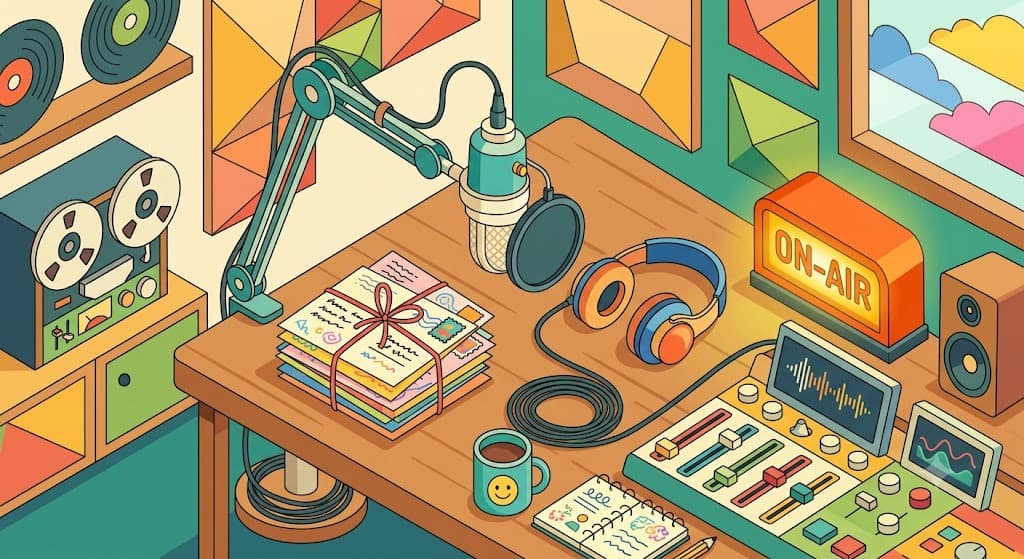 Listener postcards were the raw material of late-night radio, each signed with a chosen radio name for the host to read aloud.
Where late-night radio came from
All Night Nippon began in the 1960s as a block of programming aimed at the hours when most stations had gone quiet. That emptiness was the point. With fewer listeners and looser expectations, hosts could drop the formal announcer's voice and simply talk — about nothing, about themselves, about whatever a caller or a postcard set off. Over the decades the chair passed through comedians, musicians, and eventually voice actors and idols, but the texture stayed the same: one familiar voice, speaking as if directly to you, late enough that it felt private.
For a generation of students, 深夜放送(Shin'ya Hōsō: late-night broadcasting) was a parallel world that opened only after the adults were asleep. You listened alone, in the dark, often with one earbud so no one would hear. That intimacy is what an anime can borrow in thirty seconds: the moment a character starts a late-night show, the audience already knows the emotional register.
The radio name and the artisans of submission
The engine of this culture was the listener, not the host. A show would open theme corners — funny answers to a prompt, confessions, complaints, wordplay — and listeners would mail in 投稿(Tōkō: listener submissions). To protect privacy and to add a little theater, each writer attached a ラジオネーム(Rajio Nēmu: radio name): a chosen handle, often a pun or an in-joke, that the host read aloud.
Out of this grew the はがき職人(Hagaki Shokunin: postcard artisan) — the listener whose submissions were so consistently sharp that their handle became a recurring character on the show. Regular listeners learned these names and waited for them. When email and web forms replaced postcards, the role survived under a new label, メール職人(Mēru Shokunin: email artisan), but the spirit did not change. The handle, the repeat appearances, the quiet competition to be read — this is, in hindsight, the social shape of an online community, decades before the internet. The "Third Division Stan" gag works precisely because it names that ritual: a listener invents a handle that broadcasts their loyalty, and the host reads it as if greeting an old friend.
Radio as an early home for fandom
Late-night radio and Japanese fan culture grew up together. The shows took requests, ran corners about anime, manga, music, and games, and treated the audience's obsessions as the main content rather than a niche to be tolerated. Being a devoted listener was itself an identity, expressed through your radio name and the inside jokes you shared with strangers you would never meet. When Kaiju No. 8 hands a popular character his own pretend radio show and has him read fan-style mail, it is placing the series inside that long lineage — acknowledging that the bond between a story and the people who love it has sounded like late-night radio for a very long time.
What the Handle Kept, and What the Night Lost
Living outside Japan for many years, I have noticed how much of that radio ritual quietly migrated and how much simply faded. The radio name did not really die — it became the username. Every handle on a forum, every screen name in a chat, carries the same logic I learned mailing postcards: choose a name, build a reputation under it, wait to be acknowledged. In that sense the world caught up with late-night radio rather than leaving it behind.
 The radio name quietly became the username — the same habit of choosing a handle and building a reputation under it, carried into online life.
What has thinned out is the particular intimacy of the medium. A submission read on air was scarce and slow. You wrote it, mailed it, waited days, and might never be chosen; when your radio name finally came out of the host's mouth, the whole audience heard it at the same moment, in the same dark. That combination of patience, scarcity, and shared time is hard to reproduce in a feed that answers instantly and privately. From a distance I can see that what late-night radio offered was not just jokes but a sense of being one of many night owls awake together — a feeling a parody corner in an anime can summon with surprising tenderness, precisely because so many people still remember it.
FAQ
Q: Is "Hoshi Night Nippon" a real radio show?
A: No. It is a short bonus comedy segment inside Kaiju No. 8, built as an affectionate parody of the real late-night radio program All Night Nippon. The title swaps the host character's own name into the format as a wink to viewers.
Q: What is a "radio name," and why does the segment use one?
A: A radio name (ラジオネーム) is a handle a listener attaches to a submission so the host can read it aloud without using their real name. The segment has a host read a message signed by a listener handle, reproducing one of the most recognizable rituals of Japanese listener-driven radio.
Q: Why is late-night radio so tied to anime and fan culture in Japan?
A: Late-night broadcasting was loose, personal, and aimed at students and night owls, and many shows openly catered to listeners' enthusiasms for anime, music, and games. It became an early gathering place for fans to share inside jokes under chosen handles, long before online communities existed.
Key Insights to Remember
- A thirty-second bonus corner can carry an entire cultural history. "Hoshi Night Nippon" works not because the jokes are universal but because the form — late-night intimacy, a host reading a listener's handle — is instantly legible to anyone raised on Japanese radio, and quietly mysterious to anyone who was not.
- The radio name was a username before usernames existed. The habit of choosing a handle, performing under it, and earning recognition from a community of strangers was rehearsed for decades on late-night radio; the internet inherited the behavior more than it invented it.
- Some cultural rituals survive by changing medium, and some survive only as memory. The handle moved cleanly into online life, but the scarcity and shared timing that made being "read on air" feel special did not travel as easily — which is part of why a parody of it can feel unexpectedly moving.
Sources & References
- All Night Nippon — Official Site, Nippon Broadcasting System (https://www.allnightnippon.com/)
- All Night Nippon — Wikipedia (https://en.wikipedia.org/wiki/All_Night_Nippon)
- Kaiju No. 8 — Official Anime Site (https://kaiju-no8-anime.com/)
About the author

Spoiler-free cultural deep-dives into anime, manga & live-action Japanese drama
- ●Tokyo-born, 3rd-generation Edokko (江戸っ子)
- ●Lifelong manga reader & anime viewer since the kaiju era
- ●Writes from outside Japan — distance as a cultural lens
- ●Spoiler-free · sourced · Kanji + Romaji + English
A Tokyo-born, 3rd-generation Edokko writer who has spent years living outside Japan. I use the anime, manga, and live-action Japanese drama you already love as a doorway into the folklore, language, religion, and everyday history behind them — written so even first-time fans can follow along, with sources for every claim.
Enjoy this article?
Get the next spoiler-free cultural deep-dive straight to your inbox.
Related Articles

Crayon Shin-chan and Nagashi Somen: Why Japan Sends Its Summer Noodles Down a Bamboo Flume
How a Crayon Shin-chan episode turns nagashi somen into salaryman theatre — and the real 1955 origin of Japan's flowing noodles, from Takachiho Gorge to Kagoshima's rotating rival.
8/9/2026

Naruto and the Naruto Strait Whirlpools: The Real Uzushio Behind the Uzumaki Name
How the anime Naruto links to the real Uzushio whirlpools of Tokushima's Naruto Strait — a tidal wonder you can visit, and the spiral motif behind it.
7/17/2026
SPY x FAMILY and O-juken: The Real Exams Behind Eden Academy
How SPY x FAMILY dramatizes O-juken, Japan's high-stakes early-childhood entrance exams, and the parent-child interview that judges the whole family.
7/8/2026

Attack on Titan and On-Gaeshi: Why Hannes's Debt to the Jaeger Family Is More Than a Favor
How Attack on Titan dramatizes on-gaeshi — the lifelong Japanese debt of gratitude behind Hannes's vow, and why the English word favor can't carry its weight.
7/6/2026
Death Note and Hissatsu Shigotonin: Japan's Shadow Justice
How Death Note channels Japan's shadow-justice tradition — the TV drama Hissatsu Shigotonin, whose hidden killers punish evil the law itself cannot touch.
7/1/2026
One Piece and the Art of Nanori & Mie: Why the Hero Names the Move Before He Throws the Punch
How One Piece's named attacks carry the samurai nanori battle-cry and the kabuki mie pose — the old grammar of declaring yourself before you strike.
6/23/2026