SHOSHIMIN and the Spring-Limited Craze: Why a Tart Sells Out
How SHOSHIMIN: How to Become Ordinary turns a spring-limited strawberry tart into a window on shun and kisetsu gentei, Japan's culture of the fleeting.

Tokyo-born, 3rd-generation Edokko · writing on Japanese culture from outside Japan
Spoiler-Free Cultural Analysis
This article explores the real cultural and historical background behind the seasonal-sweets motif in SHOSHIMIN: How to Become Ordinary — the ideas of seasonality, "first things," and limited availability that frame the show's first episode. It discusses themes, atmosphere, and the history of Japanese food seasonality only, with no plot revelations.
Key Takeaways
- The "spring-limited, one per customer, sold out by evening" strawberry tart that frames the opening of SHOSHIMIN is not just a plot device; it is a compact picture of a centuries-old Japanese relationship with seasonal food.
- Japan's modern 季節限定 (kisetsu gentei) and 期間限定 (kikan gentei) marketing labels are the commercial descendants of much older ideas — 旬 (shun), the seasonal peak, and 初物 (hatsumono), the prized first of the season.
- The quiet pleasure of a thing precisely because it will soon be gone connects to 物の哀れ (mono no aware), the aesthetic of impermanence — which is why "sold out" can feel oddly satisfying rather than merely disappointing.
Key Terms Explained
- 旬 (Shun) / Seasonal Peak — The short window when an ingredient is at its best in flavor, abundance, and price. The character wraps the element for "day" (日) inside an enclosing stroke (勹), originally pointing to a span of about ten days — a brief period when something is exactly right.
- 初物 (Hatsumono) / The Season's First — The first catch or harvest of a given food. In folklore, eating it was said to add seventy-five days to your life, which made the first of anything an object of real excitement.
- 季節限定 (Kisetsu Gentei) / Season-Limited — A modern retail label marking a product sold only during a particular season, such as a spring strawberry item that vanishes once summer arrives.
- 期間限定 (Kikan Gentei) / Period-Limited — A close cousin meaning "available only for a fixed stretch of time," whether or not it maps onto a natural season.
- 物の哀れ (Mono no Aware) / The Pathos of Things — A classical aesthetic of gentle, bittersweet awareness that all things pass, which makes fleeting things feel more precious rather than less.
The One Who Watches the Line, Not the One in It
I have never been the person who joins the line for a 季節限定(Kisetsu Gentei: a season-limited product). When I hear "this week only" or "spring exclusive," my hand does not reach for my wallet. My honest reaction is closer to here we go again, another limited drop — I tend to watch the whole phenomenon from one step back, half-treating it as a news item and half-suspecting, a little coolly, that "limited" is also simply a clever way for a shop to sell things. So when I first watched the opening of SHOSHIMIN: How to Become Ordinary, I recognized the energy on screen immediately, but from the outside.
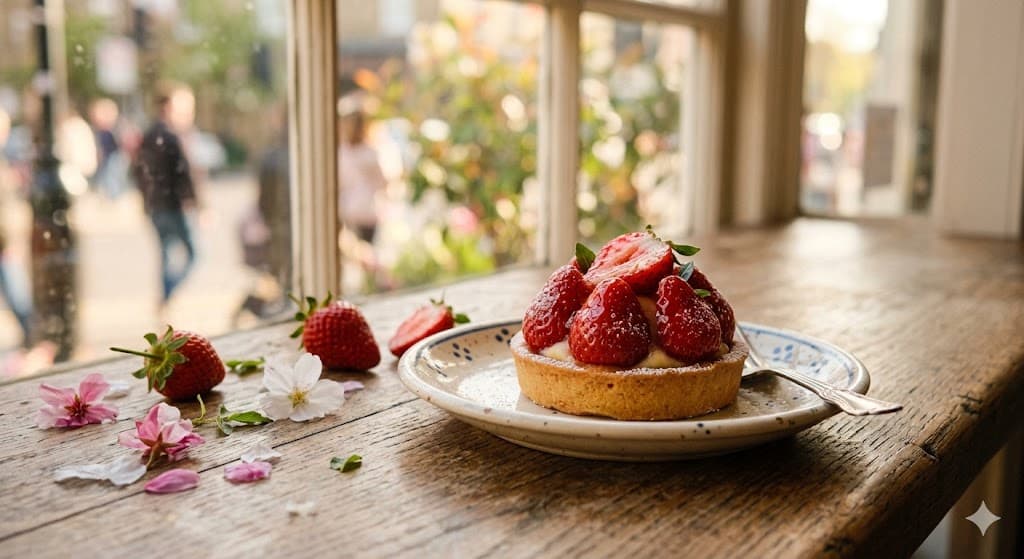
 A spring-limited strawberry tart like the one that drives the opening of SHOSHIMIN — sold only briefly, only one per customer.
The episode builds its quiet tension around a spring-limited strawberry tart from a shop named "Alice." The conditions are stated plainly and they are entirely familiar to anyone raised in Japan: it is sold only in spring, only one per customer, and if you do not get there fast enough, it will be gone by late afternoon. What fascinates me is that a mystery series chose this — not a jewel, not a body, but a pastry with an expiry on the calendar — as the engine of its first story. The deadline that pulls the characters across town is not life or death. It is the closing window of a season, and the show treats that window with complete seriousness, because culturally, it is serious.
The Long Calendar Behind a Single Tart
The instinct dramatized in that episode did not begin with modern bakeries. It rests on a way of eating that Japan has refined for centuries, and the strawberry tart is only its newest, sweetest costume.
旬: A Season Has Three Acts
The core idea is 旬(Shun: the seasonal peak of a food) — the short stretch when an ingredient is most abundant, most flavorful, and, conveniently, often most affordable. But the traditional palate does not treat a season as a single block of time. It hears three acts. 走り(Hashiri: the first run) is the early arrival, prized for novelty even before the flavor has fully ripened. 盛り(Sakari: the peak) is true shun, the moment of fullest taste. And 名残(Nagori: the lingering trace) is the close of the season, eaten with a touch of nostalgia, as a way of saying goodbye until next year.
Once you know this three-part rhythm, the strawberry tart's "today is the last day" framing reads differently. The characters are not merely chasing a dessert; they are trying to catch nagori before it slips into next spring. The urgency is built into the structure of the season itself.
初物: The Edo Appetite for the First
Layered on top of shun is 初物(Hatsumono: the first of the season). To eat the season's first bonito, first tea, or first fruit was considered lucky — folk belief held that it could lengthen your life by seventy-five days. During the Edo period (1603–1867), this appetite became something close to a craze. Seasonal food calendars were printed so townspeople could track what was about to arrive, and the first catch of skipjack tuna grew so expensive that Edoites joked about pawning their belongings just to afford a taste. People of Edo are even said to have faced west — toward the Buddhist paradise — to give thanks when eating the first bounty of a season.
 In the Edo period, the season's first foods, or hatsumono, were prized enough that people paid dearly just to taste them first.
This is the part outsiders sometimes miss. The willingness to pay more, travel farther, and queue longer for the first or only version of a food is not modern consumer madness invented by advertising. It is a very old reflex, and the spring strawberry tart sits directly in its lineage.
From 旬 to 季節限定: When the Shop Learned to Sell the Calendar
The leap from shun and hatsumono to today's 季節限定 and 期間限定 labels is short. A bakery that releases a strawberry item only in spring is doing, in commercial form, what the Edo calendar did culturally: it is telling you that a window has opened and will close. The "one per customer" rule and the "sold out by evening" reality are not arbitrary cruelty. They convert the natural scarcity of a season into a scarcity you can feel in a single afternoon. The shop has, in effect, learned to sell the calendar back to us — and the deep cultural soil that makes this work was tilled long before refrigerated display cases existed.
物の哀れ: Why "Sold Out" Can Feel Right
There is one more layer, and it is the quietest. 物の哀れ(Mono no Aware: the pathos of things) is a classical aesthetic — codified in the Edo period by the scholar Motoori Norinaga in his readings of The Tale of Genji — that finds a gentle, bittersweet beauty precisely in the fact that things do not last. Cherry blossoms move us because they fall. A season's food is treasured because its window closes.
Seen through this lens, a sold-out sign is not only a frustration. It is confirmation that the thing was real, brief, and worth wanting. The strawberry tart matters in SHOSHIMIN because it can be missed. A pastry that was available every day of the year, in unlimited quantity, simply could not carry the same emotional weight — and the show, knowingly or not, is built on that understanding.
What a Year-Round Menu Quietly Erases
For most of my life, my own sense of "seasonal food" was never the refined stuff of the tea ceremony. It was humble and popular: 冷やし中華(Hiyashi Chūka: chilled ramen) and watermelon announcing that summer had arrived, and 中華まん(Chūka-man: steamed buns) signaling the first cold of winter. These were the everyday flavors that told my body what month it was, long before any boutique put a "spring exclusive" sticker in a window. Seasonality, for ordinary people, lived in cheap and cheerful foods as much as in delicacies.
 In Japan, hiyashi chuka signals that summer has arrived; offered year-round elsewhere, that seasonal meaning quietly fades.
Living for many years now in a place where the year splits only into a wet season and a dry one, I have watched that reflex quietly dissolve. At the Japanese restaurants here, hiyashi chūka sits on the menu all year round. In Japan it was a signal — summer is here — and here it is simply available, detached from any calendar. The convenience is real, and I am not complaining about being able to eat it whenever I like. But something has gone missing. The dish no longer means anything in time, and on certain days I find myself unexpectedly missing the season-limited sweets I never even lined up for back home.
That is the strange gift of distance. From inside Japan, the relentless parade of 季節限定 items can look like marketing noise, and I dismissed a fair amount of it as exactly that. From outside, in a land without sharp seasons, I can finally see what the noise was protecting: a habit of letting time mark our food, so that eating becomes a small way of noticing that the year is moving. SHOSHIMIN dramatizes the chase for a fleeting tart with a straight face because, in Japan, that chase is one of the last everyday rituals that keeps the calendar on the tongue.
FAQ
Q: Is the strawberry tart in SHOSHIMIN based on a real Japanese custom?
A: Yes. The "spring-limited, one per customer, gone by evening" framing reflects the very real culture of 季節限定 (season-limited) and 期間限定 (period-limited) products, which itself grows out of older traditions of valuing 旬 (the seasonal peak) and 初物 (the season's first foods).
Q: Why do Japanese shops sell so many "limited" seasonal items?
A: Part of it is ordinary marketing, but the reason it resonates so strongly is cultural. Japan has a long history of prizing foods at their seasonal peak and treasuring the first of the season, so a "this season only" label taps a reflex that predates modern advertising by centuries.
Q: What does mono no aware have to do with a pastry?
A: Mono no aware is the aesthetic appreciation of things precisely because they are fleeting. A sweet that is available only briefly carries more emotional weight than one sold year-round, which is why "sold out until next spring" can feel poignant rather than merely annoying.
Key Insights to Remember
- The spring strawberry tart works as a story engine because it compresses a centuries-old relationship with time into a single afternoon. The deadline the characters race against is really the closing of a season, and Japanese culture has always treated that closing as something worth chasing.
- Modern 季節限定 and 期間限定 labels are not a break from tradition but its continuation in commercial dress. The Edo-era appetite for 初物 — paying more and waiting longer for the first or only version of a food — is the same impulse a bakery now packages as "spring exclusive."
- Seasonality is felt most sharply once it is gone. In a climate without distinct seasons, a dish that was once a signal becomes merely available, and you realize that the "limited" framing was quietly doing the work of keeping the year visible on the plate.
Sources & References
- Japanese Food Culture and Seasonalities — Musubi Kiln
- A Traveler's Guide to "Shun" (旬), Japan's Art of Eating at the Perfect Moment — Welcome To TOKYO Japan
- A Calendar on a Plate: The Philosophy Behind Japan's 72 Seasons of Food — Japaan
- Cuisine and Identity in Contemporary Japan — Association for Asian Studies
- Mono no Aware — KOGEI STANDARD
- Mono No Aware: Blossom, Beauty, and Impermanence in Japanese Philosophy — Philosophy Break
- Case of the Spring-Exclusive Strawberry Tart — Shoshimin Wiki (Fandom)
- SHOSHIMIN: How to become Ordinary — Episode 1 — Anime Feminist
About the author

Spoiler-free cultural deep-dives into anime, manga & live-action Japanese drama
- ●Tokyo-born, 3rd-generation Edokko (江戸っ子)
- ●Lifelong manga reader & anime viewer since the kaiju era
- ●Writes from outside Japan — distance as a cultural lens
- ●Spoiler-free · sourced · Kanji + Romaji + English
A Tokyo-born, 3rd-generation Edokko writer who has spent years living outside Japan. I use the anime, manga, and live-action Japanese drama you already love as a doorway into the folklore, language, religion, and everyday history behind them — written so even first-time fans can follow along, with sources for every claim.
Enjoy this article?
Get the next spoiler-free cultural deep-dive straight to your inbox.
Related Articles

Hyouka and the Kakigori Flag: The Thousand-Year-Old Word for Frozen Sweets Behind Japan's Shaved Ice
How Hyouka's title word hyoka connects to kakigori, the Heian court's shaved ice, and the Meiji regulation that turned an inspection badge into Japan's summer flag.
8/10/2026

Why Does Denji Dream of Toast With Jam? Chainsaw Man and Japan's Quiet Cult of 食パン (Shokupan)
How Chainsaw Man turns toast with butter and jam into an impossible dream, and what 食パン, the kissaten morning set, and margarine reveal about Japan's breakfast table.
7/14/2026

Delicious in Dungeon and the Proverb Hara ga Hettewa Ikusa wa Dekinu: Why Japan Treats Supply as Strategy
How Delicious in Dungeon dramatizes the Japanese proverb hara ga hette wa ikusa wa dekinu, and why Japanese warfare long treated food as seriously as the sword.
5/27/2026
Let This Grieving Soul Retire! and the Culture of 闇鍋 (Yami-nabe): The Japanese Dinner Party Played as Roulette
How Let This Grieving Soul Retire! mirrors Japan's 闇鍋 (Yami-nabe) tradition — a cultural history of the dark-pot dinner from Edo dorms to modern variety TV.
5/11/2026
Haikyu!! and Japan's GROW GROW MILK Carton: How a Postwar School Ritual Shaped a Nation's Relationship with Height
How Haikyu!! Episode 1 quietly nods to Japan's school-milk ritual — and the postwar nutrition policy that turned a daily 200ml carton into a national promise of growing tall.
5/5/2026