Delicious in Dungeon and the Proverb Hara ga Hettewa Ikusa wa Dekinu: Why Japan Treats Supply as Strategy
How Delicious in Dungeon dramatizes the Japanese proverb hara ga hette wa ikusa wa dekinu, and why Japanese warfare long treated food as seriously as the sword.

Tokyo-born, 3rd-generation Edokko · writing on Japanese culture from outside Japan
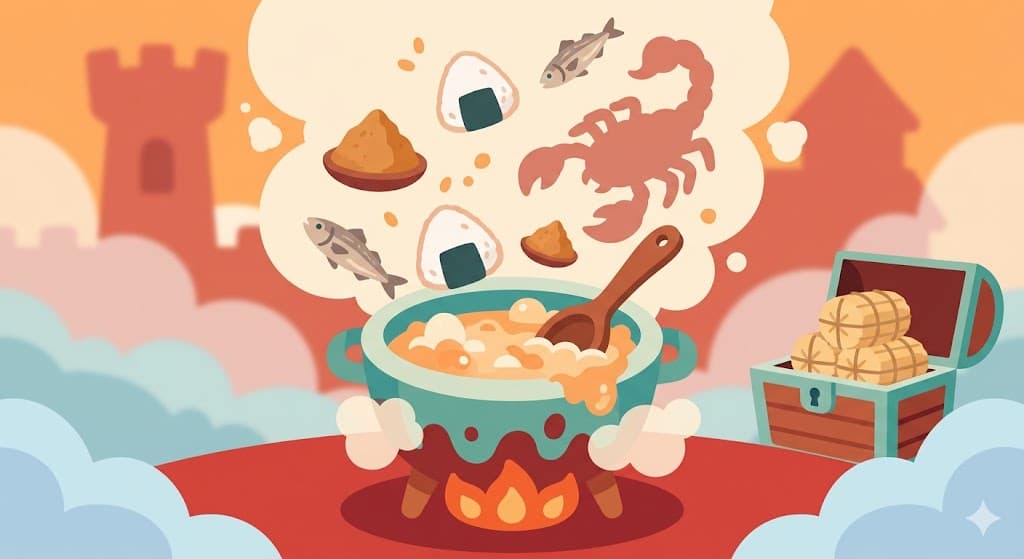
Spoiler-Free Cultural Analysis
This article explores the Japanese proverb and historical mindset behind the opening of Delicious in Dungeon — its themes, atmosphere, and the supply-line history that shaped it. No plot revelations beyond the official Episode 1 premise.
Key Takeaways
- The famous Japanese proverb 腹が減っては戦ができぬ(Hara ga Hette wa Ikusa ga Dekinu: you cannot fight a battle on an empty stomach) is not a piece of folk humor but a hard lesson from the Sengoku and Edo military tradition, where 兵糧(Hyōrō: military provisions) often mattered more than swords.
- Delicious in Dungeon opens with a wipeout caused not by a stronger monster but by exhaustion and missed meals — a near-perfect dramatization of how Japanese strategists historically framed defeat: not as a failure of courage, but as a failure of supply.
- The same "fuel equals fighting power" mindset still runs quietly through modern Japan — in the pre-match meals of school athletes, the ゲン担ぎ(Gen-katsugi: lucky-omen rituals) around exam-week snacks, and the unspoken law that you eat properly before any serious effort.
Key Terms Explained
- 腹が減っては戦ができぬ (Hara ga Hette wa Ikusa ga Dekinu) / You cannot fight on an empty stomach — A widely quoted Japanese proverb stating that without proper food, no real effort is possible.
- 兵糧 (Hyōrō) / Military provisions — The rice, miso, dried foods, and water carried or stockpiled to feed soldiers during a campaign.
- 兵糧攻め (Hyōrōzeme) / Siege by starvation — A classic Sengoku-era tactic of cutting off an enemy castle's food supply rather than attacking the walls.
- 陣中食 (Jinchūshoku) / Camp food — The simple, portable meals eaten by samurai in the field, designed for shelf life and fast preparation.
- ゲン担ぎ (Gen-katsugi) / Good-luck rituals around food — The Japanese habit of eating specific foods before a battle, match, or exam to invite a good outcome, such as カツ丼(Katsu-don: pork cutlet rice bowl) before a contest.
A Lesson Learned on the Practice Field, Not in a Book
The first time I really understood 腹が減っては戦ができぬ(Hara ga Hette wa Ikusa ga Dekinu: you cannot fight on an empty stomach), it was not from a history book. It was from the floor of a gymnasium.
 A proper meal before training or competition has long been treated as part of the preparation itself, not a break from it.
Having studied at 日本体育大学(Nihon Taiiku Daigaku: Nippon Sport Science University), I spent years watching — and being told by older teammates — that what you ate before practice was not a side issue. It was the practice. Skipping a meal before a long session did not make you tougher; it made you slow, sloppy, and prone to injury. Eating a proper bowl of rice and protein before a match was not indulgence. It was preparation. The athletes I respected most were almost obsessive about timing their meals, because they understood, in their muscles, that fatigue from an empty stomach looks exactly like a lack of skill from the outside.
That same logic followed me out of the gym. In the SEO industry in Japan during the 2000s, when all-nighters were normal and judgment calls were made at three in the morning, I learned the hard way that decisions made on an empty stomach were almost always wrong. The body and the mind do not separate as cleanly as we pretend. Hunger comes first as bad temper, then as bad judgment, then as a mistake you cannot unmake.
So when Delicious in Dungeon opens with a party of seasoned adventurers getting wiped out — not by a smarter monster, but because, as one of them admits, they were hungry, and their movements lacked their usual edge — I did not see a comic setup. I saw a proverb I had been living with my whole life, finally put on screen in its purest form.
The Sengoku Origins of Supply-as-Strategy
The proverb 腹が減っては戦ができぬ(Hara ga Hette wa Ikusa ga Dekinu) sounds proverbial in the way Japanese sayings often do — round, common-sense, almost too obvious to bother stating. But it carries the weight of a very specific historical period, and a specific way of thinking about war that the Japanese ruling class spent centuries refining.
 In the Warring States period, rice and miso stockpiles often determined the outcome of a campaign more than swordsmanship did.
The Sengoku Period and the Real Weight of Provisions
In the 戦国時代(Sengoku Jidai: Warring States period, roughly mid-15th to late 16th century), warfare in Japan was not primarily a contest of swordsmanship. It was a contest of logistics. Daimyō who controlled rice production, salt, and transport routes had a structural advantage that no individual warrior, no matter how skilled, could overcome.
The standard ration carried by a foot soldier was strikingly modest. Most accounts describe a daily allowance built around uncooked rice — typically measured in 合(Gō: roughly 180 milliliters per unit) — supplemented with 味噌(Miso: fermented soybean paste), salt, and dried foods such as 干飯(Hoshiī: dried cooked rice that could be rehydrated in the field). Soldiers carried portions of this on their person and depended on supply trains for the rest. Run out, and the campaign was effectively over, regardless of how many men remained.
兵糧攻め: Starving the Enemy Out
The clearest expression of "supply as strategy" was 兵糧攻め(Hyōrōzeme: siege by starvation). Rather than throw soldiers against fortified walls and lose them in waves, a sufficiently patient general would simply cut off the castle's food supply and wait. The most famous example is 豊臣秀吉(Toyotomi Hideyoshi)'s siege of 鳥取城(Tottori Castle) in 1581, where the defenders' suffering became so severe that the campaign is remembered in Japanese military history as a turning point in how war was waged. Hideyoshi did not need to be braver than the defenders. He needed to be more patient, and to control the rice.
That is the dark side of the proverb. "You cannot fight on an empty stomach" is folk wisdom in one direction. In the other direction, it is a strategic doctrine: make your enemy unable to fight by emptying his stomach for him.
Edo-Period Codification
By the time the country settled into the 江戸時代(Edo Jidai: Edo period, 1603–1868), the 武士(Bushi: samurai class) were no longer fighting most of the time. But the discourse about food, discipline, and readiness did not fade. It moved into the realm of household management, etiquette, and what one might call moral economy. A samurai household was expected to manage its rice stipend carefully, to never appear gluttonous but also to never be caught unprepared. The body had to be ready, and readiness was understood to begin at the rice bowl.
The proverb survives because this whole worldview survives in compressed form. Six words in Japanese, and behind them sit centuries of generals counting rice sacks instead of swords.
The Modern Echo: From Athletes to Examinees to the Adventuring Party
What is striking about Japan is how naturally this military-supply mindset translated into peacetime, then into modern competitive life. The proverb did not need to be updated. The contexts simply changed around it.
 Modern Japan still treats pre-battle food as strategy, from katsudon before a match to Kit Kat before an exam.
Japanese sports culture absorbed it almost wholesale. Pre-match meals are taken seriously in a way that can surprise outsiders. The traditional choice of カツ丼(Katsu-don: a fried pork cutlet over rice) before a match is partly nutritional and partly linguistic — カツ(katsu) is a homophone for 勝つ(katsu: to win) — but the underlying assumption is the older one: you eat first, then you fight. No serious coach would let a player go into a real contest hungry, and no serious athlete would expect to win one if they did.
The same pattern reappears in 受験(Juken: entrance-exam) culture. The famous habit of eating キットカット(Kit Kat) before exams — because the name puns on "きっと勝つ"(kitto katsu: I'll definitely win) — looks at first glance like a marketing accident. But it caught on because it fit a much older script: do not face the battle with nothing in your stomach, and while you're at it, give the food a good name. Around exam time, families quietly stock up on these snacks, and the whole thing functions as a small, modern 陣中食(Jinchūshoku: camp food) tradition.
The opening disaster in Delicious in Dungeon sits inside this same logic — and it deepens it. The party did everything that, in a Western adventure framing, ought to have been enough: they were skilled, they were brave, they were committed to the rescue. None of that mattered. They had walked into a trap, lost three days' worth of food, and pressed on anyway. The proverb is the diagnosis of why they fell. And the show's premise — that the only honest way back is to learn to feed yourself from what the dungeon actually contains — is its prescription.
This is also why the show's deeper, almost philosophical line about dungeon food rings true to a Japanese ear. The idea that eating is a privilege for those who live, and that the fed and the unfed exist in a kind of pitiless economy, is not edgy mysticism. It is the same Sengoku worldview, translated downward from the battlefield to the cooking pot. The samurai general counting rice sacks and the dungeon party butchering a giant scorpion are doing the same calculation, only at different scales.
Living outside Japan for many years, I have noticed how rarely this connection is made in foreign coverage of Japanese pop culture. The food in Delicious in Dungeon is treated as charming, gross, or comedic — all of which it is — but rarely as the working out of a centuries-old proverb. The hunger is read as a joke. In the Japanese reading, the hunger is the point.
FAQ
Q: Is 腹が減っては戦ができぬ actually used in everyday Japanese, or is it just a historical phrase?
A: It is used freely in everyday Japanese, often half-jokingly, before lunch breaks at work, before exams, or before any serious task. Its register is closer to common saying than to literary quotation, which is part of why it travels so easily into modern contexts like sports and study.
Q: Did real samurai actually lose battles because of food shortages, or is that an exaggeration?
A: It is not an exaggeration. Siege by starvation was a deliberate, repeatedly used Sengoku-period tactic, and several decisive campaigns turned on supply rather than swordsmanship. The proverb survives precisely because it was a hard-learned military lesson, not a sentimental one.
Q: Why does Delicious in Dungeon spend so much time on cooking instead of fighting?
A: Within the Japanese cultural frame the work is operating in, cooking is fighting — or rather, it is the part of fighting that determines whether the actual fighting can happen. Treating food preparation as strategically central, rather than as a break from the action, is consistent with how Japanese military and athletic traditions have long thought about provisioning.
Key Insights to Remember
- The proverb 腹が減っては戦ができぬ compresses centuries of Japanese military thinking into a single line. Behind its plainness is a Sengoku-era doctrine in which generals counted rice sacks before counting men, and victory often went to whoever controlled the supply, not whoever held the better sword.
- Delicious in Dungeon lands so cleanly with Japanese audiences because its opening defeat is recognizably a logistics defeat, not a courage defeat. The party's wipeout reads, to a Japanese viewer, less like a tragic accident and more like the natural consequence of a rule everyone has been raised to take seriously.
- The same worldview that produced 兵糧攻め(Hyōrōzeme) in the Sengoku era now shows up, softened and domesticated, in the カツ丼 before a match and the キットカット before an exam. The military proverb has migrated into peacetime ritual without losing its underlying claim: fuel is fighting power, and nothing else makes up for its absence.
Sources
About the author

Spoiler-free cultural deep-dives into anime, manga & live-action Japanese drama
- ●Tokyo-born, 3rd-generation Edokko (江戸っ子)
- ●Lifelong manga reader & anime viewer since the kaiju era
- ●Writes from outside Japan — distance as a cultural lens
- ●Spoiler-free · sourced · Kanji + Romaji + English
A Tokyo-born, 3rd-generation Edokko writer who has spent years living outside Japan. I use the anime, manga, and live-action Japanese drama you already love as a doorway into the folklore, language, religion, and everyday history behind them — written so even first-time fans can follow along, with sources for every claim.
Enjoy this article?
Get the next spoiler-free cultural deep-dive straight to your inbox.
Related Articles

Hyouka and the Kakigori Flag: The Thousand-Year-Old Word for Frozen Sweets Behind Japan's Shaved Ice
How Hyouka's title word hyoka connects to kakigori, the Heian court's shaved ice, and the Meiji regulation that turned an inspection badge into Japan's summer flag.
8/10/2026

Why Does Denji Dream of Toast With Jam? Chainsaw Man and Japan's Quiet Cult of 食パン (Shokupan)
How Chainsaw Man turns toast with butter and jam into an impossible dream, and what 食パン, the kissaten morning set, and margarine reveal about Japan's breakfast table.
7/14/2026
SHOSHIMIN and the Spring-Limited Craze: Why a Tart Sells Out
How SHOSHIMIN: How to Become Ordinary turns a spring-limited strawberry tart into a window on shun and kisetsu gentei, Japan's culture of the fleeting.
5/28/2026
Let This Grieving Soul Retire! and the Culture of 闇鍋 (Yami-nabe): The Japanese Dinner Party Played as Roulette
How Let This Grieving Soul Retire! mirrors Japan's 闇鍋 (Yami-nabe) tradition — a cultural history of the dark-pot dinner from Edo dorms to modern variety TV.
5/11/2026
Haikyu!! and Japan's GROW GROW MILK Carton: How a Postwar School Ritual Shaped a Nation's Relationship with Height
How Haikyu!! Episode 1 quietly nods to Japan's school-milk ritual — and the postwar nutrition policy that turned a daily 200ml carton into a national promise of growing tall.
5/5/2026