Why Does Denji Dream of Toast With Jam? Chainsaw Man and Japan's Quiet Cult of 食パン (Shokupan)
How Chainsaw Man turns toast with butter and jam into an impossible dream, and what 食パン, the kissaten morning set, and margarine reveal about Japan's breakfast table.

Tokyo-born, 3rd-generation Edokko · writing on Japanese culture from outside Japan
Spoiler-Free Cultural Analysis
This article explores the real cultural and historical background behind the food imagery in the opening episode of Chainsaw Man — nothing beyond the premise every viewer meets in the first few minutes. No plot revelations, only themes, atmosphere, and the history of the Japanese breakfast table.
Key Takeaways
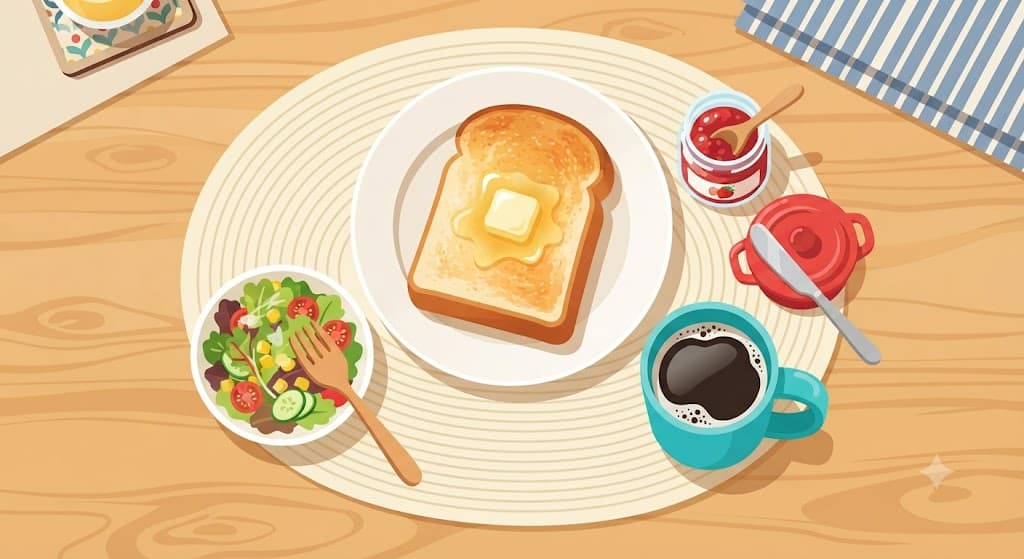
- The reason Denji's dream feels devastating rather than modest is that his wish is not for luxury but for an ordinary Japanese breakfast — and in Japan, bread with butter and jam has historically been exactly that: the small, affordable upgrade that turns a plain morning into a good one.
- 食パン (Shokupan: the soft, square white loaf sold in thick slices) is not simply "white bread." It is a Japanese reinvention of an English loaf, shaped by foreign settlements, postwar school meals, and a mid-century push toward thicker and thicker slices.
- The image of toast, salad, coffee, and a little dessert arriving together on one tray is not a fantasy Denji invented. It is a real and beloved Japanese institution: the 喫茶店 (Kissaten: old-style Japanese coffee shop) モーニング (Mōningu: the discounted "morning set" served with a single cup of coffee).
Key Terms Explained
- 食パン (Shokupan) / Staple-Food Bread — The square or dome-topped white loaf that dominates Japanese supermarket shelves. Sold as an uncut block or pre-sliced, and unusually soft and milky compared with Western sandwich bread.
- 一斤 (Ikkin) / One Loaf Unit — The traditional unit for selling shokupan. Japanese bakers' fair-trade rules set one ikkin at a minimum weight, and the loaf is then divided into a chosen number of slices.
- 六枚切り (Rokumaigiri) / Six-Slice Cut — The most common way of cutting one loaf in eastern Japan. The west prefers five slices, meaning thicker bread. The number on the package is a regional identity marker.
- 喫茶店 (Kissaten) / Old-Style Coffee Shop — The pre-café-chain Japanese coffee house: dim lighting, thick ceramic cups, and a master behind the counter.
- モーニング (Mōningu) / Morning Service — A breakfast set — typically thick toast, a boiled egg, sometimes salad — thrown in free or nearly free with the price of a coffee.
The Tub of Margarine on a 昭和 Breakfast Table
I grew up in a working-class part of 東京 (Tōkyō: Tokyo, Japan's capital), in the years of 昭和 (Shōwa: the Shōwa era, 1926–1989), and breakfast in our house was Japanese: rice, みそ汁 (Misoshiru: miso soup), pickles, sometimes grilled fish. Toast existed, but it was the other option, the one that showed up now and then rather than every morning.
 Butter and jam on thick-cut toast: the small addition that turned an ordinary Shōwa morning into a slightly better one.
And when toast did appear, what we spread on it was not butter. It was margarine — cheaper, always in the refrigerator door, unremarkable. Butter was not something we simply had. Neither was jam. When they did appear, the whole tray felt different. Nothing about the meal had changed structurally: same bread, same plate, same table. Yet one small addition made an ordinary morning feel like a slightly better one.
That is the sensation I hear underneath Denji's fixation on toast with jam. He is not asking for a feast. He is asking for the version of breakfast where the small thing gets added. Anyone who grew up with the margarine tub understands instantly what that request means, and why it hurts.
From English Loaf to Japanese Icon: How Bread Became a Breakfast Dream
The Foreign Loaf That Stayed
 The Japanese loaf began as an English tin-baked bread and was gradually re-engineered softer, milkier and thicker.
Bread arrived in Japan as a foreigner's food. The lineage most often cited begins in the 1860s in 横浜 (Yokohama: the port city just south of Tokyo), where an English baker was making tin-baked loaves for sailors and residents of the foreign settlement; that bakery is generally treated as the ancestor of the Japanese shokupan. The bread of that era was the English-style dome-topped loaf, baked in a metal tin — a shape born in industrialising Britain, not in Japan.
The word itself is a Japanese invention. There is no English term that maps onto 食パン. The most-repeated explanations are that it is short for "bread eaten as a staple food," or that it distinguishes edible bread from the soft bread artists used as an eraser for charcoal drawings. Either way, the name tells you something: this was bread that had to be explained, defined, and given a category before it could belong.
The Postwar Slice
The decisive shift came after the war. School meals resumed as a way of feeding undernourished children, and with rice scarce and American wheat available, those meals were built around bread. A whole generation of Japanese children met bread first not at home, but in a classroom, on a metal tray.
At the same time, the occupying forces wanted sandwich bread, and Tokyo bakeries were asked to cut loaves into eight slices. Thin bread became the national norm for a while. Then, from around 1960, a maker in 関西 (Kansai: the western region around Osaka, Kyoto and Kobe) pushed a six-slice cut on the argument that a thicker slice simply tastes better — and the industry followed. The regional split survives today: the east leans toward six or eight slices, the west toward five or even four. In a country of thin, delicate cuts elsewhere in the cuisine, bread went the opposite direction and got fat.
That thickness matters for our purposes. A thick slice of shokupan is a canvas. It has enough surface and enough body to hold butter that melts down into the crumb, and then jam on top of that. Japanese toast is engineered, almost by accident, for exactly the breakfast Denji describes.
The Coffee Shop That Gives You Breakfast
Then there is the モーニング. Its origins are contested, with 一宮 (Ichinomiya: a textile town in Aichi Prefecture) and 豊橋 (Toyohashi: another city in the same prefecture) both claiming it, and 広島 (Hiroshima: the major city in western Japan) holding an early documented example. The Ichinomiya story is the one I find most telling: in the boom years of the textile trade, mill owners used the local 喫茶店 as a de facto meeting room because their own workshops were too loud for negotiation. A generous master started adding a boiled egg and peanuts to the morning coffee, and the practice spread.
Note what that means. The set was not a product designed by a marketing department. It was a gift — an act of returning something to loyal customers — that hardened over decades into an institution. Order a coffee in the morning in 名古屋 (Nagoya: the largest city of central Japan) or 岐阜県 (Gifu-ken: Gifu Prefecture, just north of it) today and food arrives that you did not pay for.
Toast, salad, coffee, maybe something sweet at the end. That is the モーニング in its ordinary, unremarkable, thoroughly Japanese form. Denji is not dreaming of a rich man's breakfast. He is dreaming of a set meal that, in much of Japan, is handed over for the price of a cup of coffee — and even that lies outside his reach.
What the Small Thing on the Bread Still Means
Japan got rich, and then it got 高級食パン (Kōkyū Shokupan: premium shokupan) — specialist shops selling a single loaf, uncut, soft enough to eat without toasting, at a price that would have astonished my mother. Around 2013 the boom took hold, and the humble staple became a gift item, a queue, a status object.
 The モーニング set — toast, egg, salad and coffee — is exactly the breakfast Denji describes, and in much of Japan it comes with the price of a single cup.
I find that transformation revealing rather than absurd. Something happened between the margarine tub and the premium loaf: bread stopped being what you eat when there is nothing better, and became a thing you choose. The small luxury got promoted, and in the process the emotional weight of the ordinary version quietly drained away.
Living far from Japan for a long time, I notice that I have no particular attachment to bread. だし (Dashi: the savoury stock at the base of Japanese cooking), rice balls, miso soup — those I miss with a physical ache. Bread I do not. And yet the scene in Chainsaw Man lands on me anyway, because what it is really about is not bread at all. It is about the point at which the smallest addition to the plainest meal becomes the outer limit of what a person believes they are allowed to want.
That is a very Japanese calibration of desire, and I am not sure modern Japan, with its premium loaves and its endless limited-edition flavours, still knows how to feel it. A story had to reach back to a boy with an empty refrigerator to make us feel it again.
FAQ
Q: Is toast with butter and jam actually a normal Japanese breakfast?
A: Yes. Rice and miso soup remain the classic image, but bread has been one of the standard Japanese breakfasts for decades, and a thick slice of shokupan with butter — or, in many ordinary households historically, margarine — is entirely everyday. That is precisely why the wish is written the way it is: the dream is aimed at normality, not extravagance.
Q: Why is Japanese bread so thick and soft compared to Western sandwich bread?
A: Two reasons converge. Japanese makers adapted the recipe toward a softer, milkier, more tender crumb suited to local taste, and from around 1960 the industry deliberately moved from thin eight-slice cuts toward thicker six- and five-slice cuts on the grounds that a thicker slice conveys flavour better. The thick, pillowy slice is a Japanese refinement, not an import.
Q: Is the "toast, salad, coffee, dessert" combination a real thing in Japan?
A: It is. The 喫茶店 morning set is a long-standing institution, especially in central Japan, where ordering a coffee before a certain hour brings toast and side items at little or no extra cost. It is one of the few places in Japanese commercial life where you are given more than you paid for, as a matter of custom.
Key Insights to Remember
- The genius of the toast-with-jam motif is that it inverts the usual grammar of ambition. Most stories signal poverty by having a character crave wealth; this one signals it by having him crave the median. When the ceiling of a person's imagination is a normal breakfast, we learn more about their life than any figure on a debt ledger could tell us.
- Shokupan is a case study in how Japan absorbs foreign things. An English tin loaf entered through a port city, was pressed into service by postwar school meals, was re-engineered thicker and softer for local palates, acquired a name that exists in no other language, and ended up as a premium gift item. The object arrived from outside; everything that made it meaningful happened here.
- The モーニング set exists because someone decided to give something away. Its survival for over half a century suggests that Japanese food culture reserves a special place for the unpurchased extra — the boiled egg you did not order, the jam that turns bread into breakfast. Denji's dream is legible to Japanese audiences because it names that extra exactly.
Sources
About the author

Spoiler-free cultural deep-dives into anime, manga & live-action Japanese drama
- ●Tokyo-born, 3rd-generation Edokko (江戸っ子)
- ●Lifelong manga reader & anime viewer since the kaiju era
- ●Writes from outside Japan — distance as a cultural lens
- ●Spoiler-free · sourced · Kanji + Romaji + English
A Tokyo-born, 3rd-generation Edokko writer who has spent years living outside Japan. I use the anime, manga, and live-action Japanese drama you already love as a doorway into the folklore, language, religion, and everyday history behind them — written so even first-time fans can follow along, with sources for every claim.
Enjoy this article?
Get the next spoiler-free cultural deep-dive straight to your inbox.
Related Articles

Hyouka and the Kakigori Flag: The Thousand-Year-Old Word for Frozen Sweets Behind Japan's Shaved Ice
How Hyouka's title word hyoka connects to kakigori, the Heian court's shaved ice, and the Meiji regulation that turned an inspection badge into Japan's summer flag.
8/10/2026
SHOSHIMIN and the Spring-Limited Craze: Why a Tart Sells Out
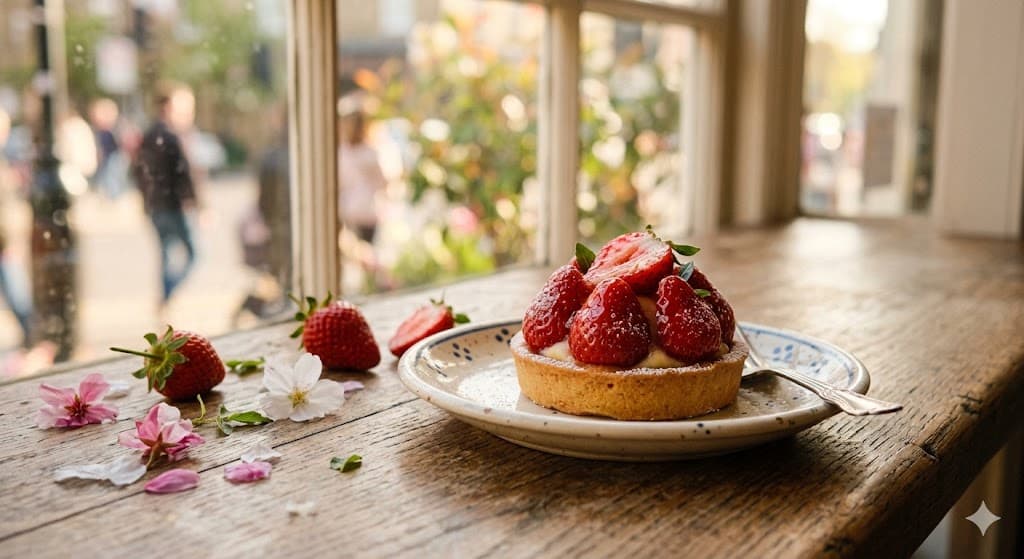
How SHOSHIMIN: How to Become Ordinary turns a spring-limited strawberry tart into a window on shun and kisetsu gentei, Japan's culture of the fleeting.
5/28/2026
Delicious in Dungeon and the Proverb Hara ga Hettewa Ikusa wa Dekinu: Why Japan Treats Supply as Strategy
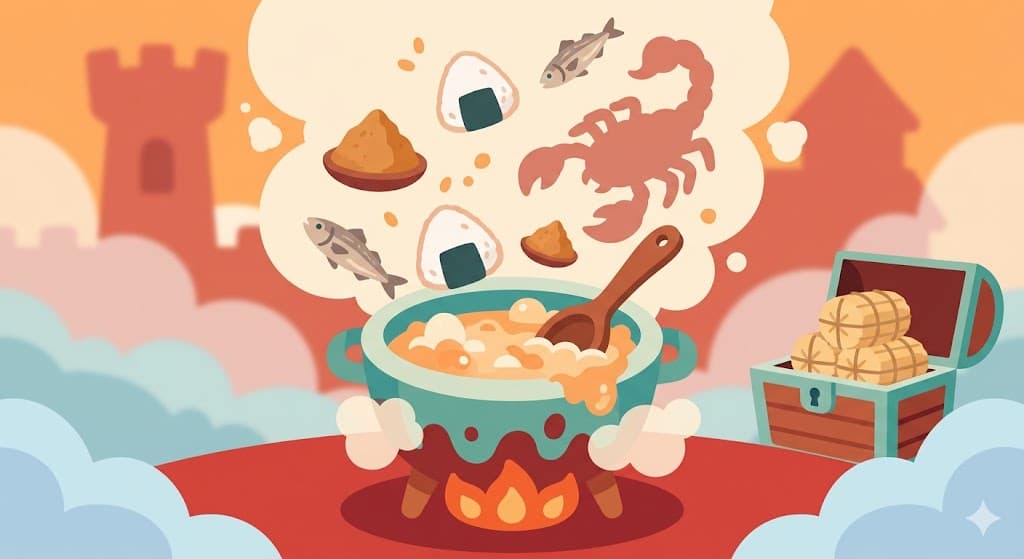
How Delicious in Dungeon dramatizes the Japanese proverb hara ga hette wa ikusa wa dekinu, and why Japanese warfare long treated food as seriously as the sword.
5/27/2026
Let This Grieving Soul Retire! and the Culture of 闇鍋 (Yami-nabe): The Japanese Dinner Party Played as Roulette
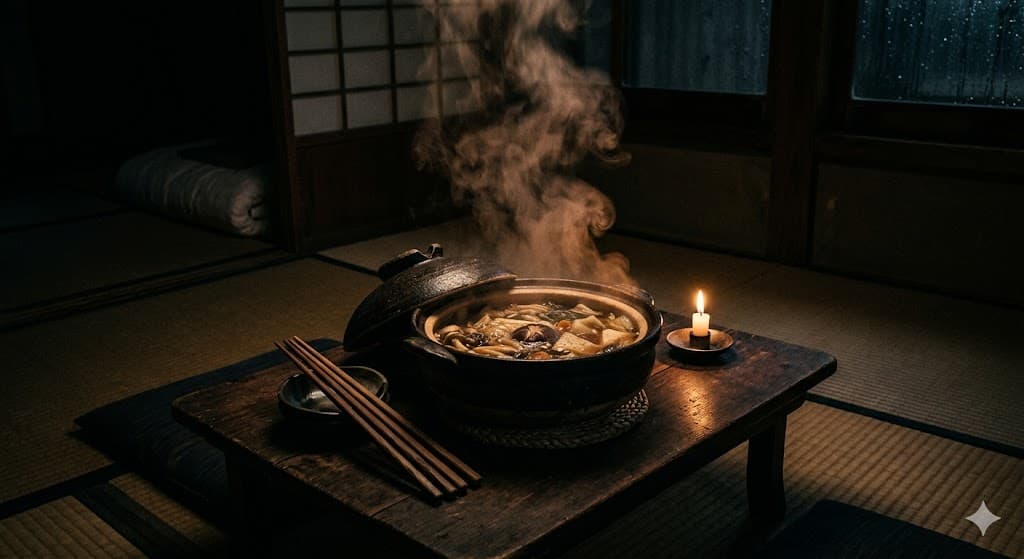
How Let This Grieving Soul Retire! mirrors Japan's 闇鍋 (Yami-nabe) tradition — a cultural history of the dark-pot dinner from Edo dorms to modern variety TV.
5/11/2026
Haikyu!! and Japan's GROW GROW MILK Carton: How a Postwar School Ritual Shaped a Nation's Relationship with Height
How Haikyu!! Episode 1 quietly nods to Japan's school-milk ritual — and the postwar nutrition policy that turned a daily 200ml carton into a national promise of growing tall.
5/5/2026