Kotatsu in Crayon Shin-chan: Why the Noharas Won't Get Out
What is a kotatsu? Through Crayon Shin-chan's Nohara family, see why Japan's heated table sits at the centre of winter home life and when it traditionally comes out for the season.

Tokyo-born, 3rd-generation Edokko · writing on Japanese culture from outside Japan
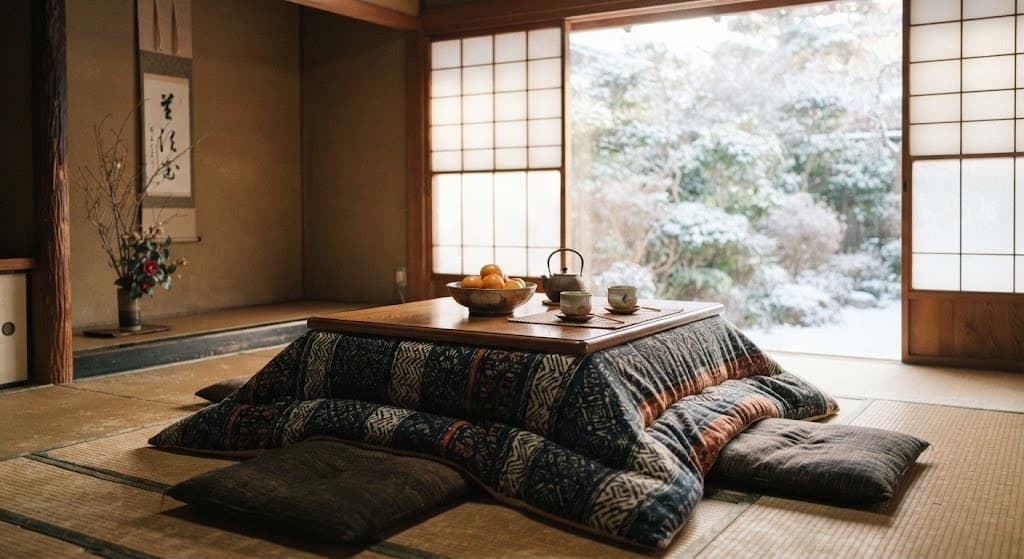
Why would two grown adults fight over who has to flip a switch? In クレヨンしんちゃん (Kureyon Shin-chan: Crayon Shin-chan), Hiroshi and Misae Nohara do exactly that on a cold winter morning, and once the 炬燵 (kotatsu: a low table with a heater and a quilt) is warm, neither of them wants to leave it. The joke only works because, in a Japanese home in winter, the kotatsu is not simply a piece of furniture. It is the place the family does not want to leave.
Spoiler-Free Cultural Analysis
This article looks at the structure, history, and seasonal customs behind the kotatsu in Crayon Shin-chan. It covers only the set-ups described in the official episode synopses, without revealing how either episode ends.
Key Takeaways
- A kotatsu is a heat source enclosed in a wooden frame called a yagura and covered with a futon. One Japanese dictionary describes it as a heating device unique to Japan.
- It spread outward from Zen Buddhist circles in the Muromachi period, was fairly common among ordinary people by the Genroku era (1688–1704), and turned electric in the 1950s. Today it also serves as the dining table and the living-room table.
- In TV Asahi's Crayon Shin-chan episodes titled "Fuyu wa Yappari Kotatsu da zo," Hiroshi and Misae battle over who switches the kotatsu on and who has to leave it for each chore. The fight is silly, and that is the point: it shows how firmly the kotatsu sits at the centre of winter family life.
Key Terms Explained
- 炬燵 (Kotatsu) / Heated Table — A heat source surrounded by a wooden frame and covered with a futon. In older usage, the frame itself was called the kotatsu.
- 櫓 (Yagura) / Frame — The wooden frame that encloses the heat source and holds the futon up.
- 掘りごたつ (Horigotatsu) / Sunken Kotatsu — A kotatsu built into a part of the floor that has been dug out.
- 置きごたつ (Okigotatsu) / Free-Standing Kotatsu — A kotatsu that can be moved around, like a ちゃぶ台 (chabudai: a low dining table).
- 炬燵開き (Kotatsu-biraki) / Kotatsu Opening Day — The day the kotatsu traditionally comes out for the season, a 亥の日 (i no hi: day of the boar) in the tenth month.
- 季語 (Kigo) / Seasonal Word — A word that marks the season in a haiku. Kotatsu is a winter kigo.
A Charcoal Kotatsu at a Friend's House
When I think back on winter in the 下町 (shitamachi: old working-class neighbourhoods) I knew, what comes to mind are the things I later learned were kigo. There was the 木枯らし (kogarashi: the cold wind that strips the trees bare), and there was the kotatsu.
The kotatsu I remember most clearly was not my own. It was a horigotatsu at a friend's house, and it was heated with charcoal. I stretched my legs all the way down to the bottom of the pit, and it was so hot that I thought I might burn myself.
Charcoal was part of winter at home, too. As a child I knew 練炭 (rentan: cylinders of pressed coal dust) and 豆炭 (mametan: small egg-shaped briquettes) as heat sources. I also knew the danger that came with them, 一酸化炭素中毒 (issanka tanso chūdoku: carbon monoxide poisoning), and that the answer was to open a window and let the air through.
Winter also meant my family gathering around a big 土鍋 (donabe: an earthenware cooking pot) once or twice a week. So when I read how the Nohara family refuses to leave the kotatsu, I recognise two things at once: the warm spot everyone gathers around, and the memory of a time when that warmth came from real fire.
Related: Demon Slayer and the Lost Craft of Sumiyaki: What the Kamado Name Really Hides explains this in detail.
The Kotatsu at the Centre of the Winter Living Room
Hiroshi and Misae Versus the Switch
Crayon Shin-chan is based on the original work by 臼井儀人 (Usui Yoshito: the series' creator). The TV anime, animated by シンエイ動画 (Shin'ei Dōga: Shin-Ei Animation), began in spring 1992, and its official episode pages are on the テレビ朝日 (Terebi Asahi: TV Asahi) website.
TV Asahi lists an episode called 冬はやっぱりコタツだゾ (Fuyu wa Yappari Kotatsu da zo: In Winter, It Has to Be the Kotatsu) that aired on 2 February 2018. According to the official synopsis, it is a cold winter morning and nobody wants to get out of bed. Hiroshi and Misae argue over which of them will switch on the kotatsu. After that, the 野原一家 (Nohara ikka: the Nohara family), unwilling to leave the kotatsu, use じゃんけん (janken: rock-paper-scissors) to decide who handles each task, from preparing meals to doing the housework. Janken also closes every episode of another long-running family anime, which I look at in Sazae-san Syndrome: The Anime Behind Japan's Sunday Gloom.
An episode with the same title aired on 11 February 2023. Its synopsis calls the argument over who switches on the kotatsu a 頭脳戦 (zunōsen: a battle of wits), and adds a question mark as a hint not to take it too seriously. The synopsis also calls the issue しょうもない (shōmonai: trivial, not worth the fuss). Once the kotatsu is on, neither of them wants to take a single step out. Making breakfast, washing up, taking in a parcel delivery: every time something needs doing, they fight over it.
Related: Yakiimo: Why Japan's Roasted Sweet Potato Means Winter explains this in detail.
What Sits Under the Quilt
The fight makes sense once you know how a kotatsu works. Japanese dictionaries describe it as a heat source, once charcoal and now usually electric, enclosed by a wooden frame called a 櫓 (yagura: frame) and covered with a 布団 (futon: a quilted blanket). One dictionary calls it a heating device unique to Japan.
The heat is held under the futon, so the warm space is very small and has a clear edge. Your legs are inside that space, and the rest of the room is outside it. In the episode, every chore means pulling your legs out into a cold winter morning, and that is why each one turns into a contest.
There are two basic types. The 掘りごたつ (horigotatsu: sunken kotatsu) is set into a part of the floor that has been dug out. The 置きごたつ (okigotatsu: free-standing kotatsu) can be moved around like a low dining table. Dictionaries also list the 電気ごたつ (denki-gotatsu: electric kotatsu) and 切りごたつ (kirigotatsu), another name for the sunken type.
From Charcoal Pit to Living-Room Table
The history is long, so I will keep it short. The kotatsu spread outward from 禅宗 (Zenshū: Zen Buddhism) circles in the 室町時代 (Muromachi jidai: Muromachi period), and in old usage the frame itself was called the kotatsu. The sunken type is the older one. The horigotatsu developed from the 囲炉裏 (irori: a sunken hearth in the floor), and the okigotatsu developed from the 火鉢 (hibachi: a charcoal brazier).
In the early 江戸時代 (Edo jidai: Edo period), horigotatsu were installed even inside the 御所 (Gosho: the Imperial Palace). By the 元禄 (Genroku: 1688–1704) era, the kotatsu seems to have spread fairly widely among ordinary people. One encyclopedia says this spread was driven above all by two things: the growing availability of cotton futons as cotton production increased, and a larger supply of fuels such as charcoal and たどん (tadon: balls of charcoal dust).
In the 1950s, the heat source switched to electricity. A 1998 study presented to the Japanese Society for the Science of Design says the electric kotatsu spread to almost every household in Japan. In 1975, a high-end electric kotatsu that looked like a piece of furniture was developed. The same study says the kotatsu now serves as a dining table, and as the table in a drawing room or living room. The encyclopedia also notes that after the Second World War, as more people sat on chairs, the horigotatsu with a deep pit became the mainstream style.
This change, from heater to table, is what sits behind the Noharas' fight. The kotatsu is not a heater you sit near. It is the table you eat at, the table in the living room, and the warm place you do not want to leave.
Kotatsu-biraki: The Day It Comes Out
Traditionally, people did not simply bring out the kotatsu whenever they felt cold. According to nippon.com, the first boar day of the tenth month, called 玄猪 (genchō: the first boar day), was kotatsu-biraki, the day for opening the kotatsu. The boar sign is classed under "water," and because charcoal was burned inside the kotatsu at the time, it could easily start a fire. Opening it on this day was thought to use the power of water to prevent fire. People also ate 亥の子餅 (inoko-mochi: rice cakes for the boar day) and prayed for many descendants and good health.
A page from 鳥取県 (Tottori-ken: Tottori Prefecture) says that in many places, the boar day of the tenth month of the old calendar is said to be the day for bringing out the kotatsu. It records a woman from 尾高 (Odaka: a district) in 米子市 (Yonago-shi: Yonago City), born in 1900, who said that was the day she first brought out the kotatsu, and that she sang the seasonal song 亥の子さんの夜さ (Inoko-san no Yosa) while warming herself at it.
This is what stays with me. The custom grew around fire. When I remember my friend's charcoal horigotatsu and opening the window for the rentan at home, the reasoning behind choosing a day associated with protection from fire feels very real to me.
A Winter Word
Both the デジタル大辞泉 (Dejitaru Daijisen: Digital Daijisen dictionary) and the 精選版 日本国語大辞典 (Seisenban Nihon Kokugo Daijiten: Japanese Language Dictionary, Selected Edition) mark kotatsu as a winter kigo. In other words, the word alone is enough to tell a haiku reader that the season is winter.
That fits my own memory of shitamachi winters. The kogarashi outside and the kotatsu inside were what winter meant to me.
The Hardest Part Is Getting Out
The Nohara family's argument is about almost nothing: who turns the switch on, who makes breakfast, and who goes to the door for the parcel. Yet the episode only needs one object to set it all in motion, because the appeal of that warm space under the futon is so familiar in Japan.
What I notice is how much the kotatsu has changed and how little that feeling has. The kotatsu at my friend's house had charcoal at the bottom of the pit and was hot enough to scare me. The Noharas only have to press a switch. The heat source moved from fire to electricity, and the kotatsu became a piece of living-room furniture, but the hardest part is still the same. It is getting out.
FAQ
Q: What is a kotatsu? A: A kotatsu is a Japanese heating device in which a heat source, once charcoal and now usually electric, is enclosed in a wooden frame called a yagura and covered with a futon. There are sunken types built into the floor (horigotatsu) and free-standing types (okigotatsu). Today it also serves as the dining table and the living-room table.
Q: When do Japanese people traditionally bring out the kotatsu? A: Traditionally, on a boar day in the tenth month, a custom called kotatsu-biraki. The boar sign is classed under "water," so opening the kotatsu on that day was thought to protect against fire when charcoal was burned inside it. Some people also ate inoko-mochi and prayed for good health.
Q: Which Crayon Shin-chan episode is about the kotatsu? A: TV Asahi lists episodes titled "Fuyu wa Yappari Kotatsu da zo" that aired on 2 February 2018 and 11 February 2023. In both, Hiroshi and Misae argue over who will switch on the kotatsu, and then over every chore that would make them leave it.
Key Insights to Remember: Summary
- The kotatsu traps heat under a futon, so the warm space is small and clearly marked. That is what makes leaving it feel like a real loss, and it is the engine of the Nohara family's fight.
- Its history runs from Zen Buddhism in the Muromachi period, through the Genroku era, to the electric kotatsu of the 1950s. Along the way it went from a pit in the floor to a dining table and living-room table.
- The timing of kotatsu-biraki was tied to the fear of fire when the kotatsu burned charcoal, and kotatsu is still a winter kigo. The custom and the word both show how closely the kotatsu is tied to the Japanese winter.
The next time a kotatsu appears in an anime, manga, or drama you are watching or reading, look at who is sitting under it and who has to get up. That small moment often says a lot about the family in the story.
Sources
- Crayon Shin-chan Programme Page — Anime Eiga
- Episode Synopsis, 2 February 2018 — Crayon Shin-chan Official Site, TV Asahi
- Episode Synopsis, 11 February 2023 — Crayon Shin-chan Official Site, TV Asahi
- Kotatsu — Dictionary Entries via Kotobank
- The Changing Design of the Electric Yagura Kotatsu — Japanese Society for the Science of Design via J-STAGE
- The Boar Day and Kotatsu-biraki — nippon.com
- Inoko-san no Yosa (Seasonal Song) — Tottori Prefecture
About the author

Spoiler-free cultural deep-dives into anime, manga & live-action Japanese drama
- ●Tokyo-born, 3rd-generation Edokko (江戸っ子)
- ●Lifelong manga reader & anime viewer since the kaiju era
- ●Writes from outside Japan — distance as a cultural lens
- ●Spoiler-free · sourced · Kanji + Romaji + English
A Tokyo-born, 3rd-generation Edokko writer who has spent years living outside Japan. I use the anime, manga, and live-action Japanese drama you already love as a doorway into the folklore, language, religion, and everyday history behind them — written so even first-time fans can follow along, with sources for every claim.
Enjoy this article?
Get the next spoiler-free cultural deep-dive straight to your inbox.
Related Articles

Yakiimo: Why Japan's Roasted Sweet Potato Means Winter
What is yakiimo? See why Japan's roasted sweet potato, the seller's call and the warm paper-wrapped potato still mean winter, from Edo to Crayon Shin-chan.
11/12/2026
Sazae-san Syndrome: The Anime Behind Japan's Sunday Gloom
Sazae-san syndrome is Japan's nickname for Sunday evening gloom. See how a family anime's fixed 6:30 slot and closing janken came to mark the end of Sunday.
10/31/2026

Totoro and Katori Senko: The Meiji Coil That Gave Summer Its Smell
For fans of My Neighbor Totoro: the story of the katori senko, the Meiji-era mosquito coil whose spiral was imagined in 1895 by the wife of Kincho's founder.
8/8/2026

Anohana and Kingyo-sukui: Why a Working Net Became Dissolving Paper
How Anohana's summer world explains kingyo-sukui, the festival goldfish-scooping stall game, and why Japan swapped a net that worked for a paper scoop designed to fail, a change that dates from the Taishō era.
8/2/2026

Chibi Maruko-chan and Rajio Taisō: Japan's Summer Radio Calisthenics
How Chibi Maruko-chan's Shōwa childhood preserves rajio taiso, the summer radio calisthenics Japan imported from an American insurer that dropped it a decade later, and why the stamp card keeps children turning up in the early morning.
8/1/2026

Rurouni Kenshin and Uchimizu: Why Old Tokyo Cooled Its Streets
How the Meiji-era streets of Rurouni Kenshin open onto uchimizu — a summer custom that began as tea-ceremony courtesy and spread through Edo because of dust.
7/31/2026