Attack on Titan and Mura Shakai: The Village Walls of Japan
How Attack on Titan dramatizes mura shakai (village society), deru kui wa utareru, and heiwa-boke — Japan's quiet pressure to keep people inside the walls.

Tokyo-born, 3rd-generation Edokko · writing on Japanese culture from outside Japan
Spoiler-Free Cultural Analysis
This article explores the Japanese cultural ideas that sit underneath the walled world of 進撃の巨人 (Shingeki no Kyojin: Attack on Titan) — concepts of village society, conformity pressure, and peace-induced complacency — without spoiling any plot beats beyond the very first episode's premise. The focus is on themes, atmosphere, and the historical context that gives the early scenes their unmistakable Japanese flavor.
Key Takeaways
- The walls in 進撃の巨人 (Shingeki no Kyojin: Attack on Titan) are not just a fantasy plot device; they map cleanly onto Japan's centuries-old habit of organizing life around enclosed, mutually-watching communities — what is called 村社会 (Mura Shakai: village society).
- The townspeople who call the protagonist a heretic for wanting to see the outside are voicing a very Japanese reflex captured in the phrase 出る杭は打たれる (Deru Kui wa Utareru: the nail that sticks out gets hammered down).
- The drunk Garrison soldiers who insist nothing has happened in a hundred years are a textbook portrait of 平和ボケ (Heiwa-Boke: peace-induced complacency) — a phenomenon that has long been used as a self-critical label for postwar Japanese society.
Key Terms Explained
- 村社会 (Mura Shakai) / Village Society — A social structure in which a tightly-knit local group enforces conformity through mutual surveillance, shared obligation, and the threat of social exclusion.
- 世間体 (Seken-tei) / Public Appearance — The pressure to behave in a way that does not invite gossip or judgment from one's surrounding community; "what people will say" as a governing force.
- 出る杭は打たれる (Deru Kui wa Utareru) / The Nail That Sticks Out Gets Hammered Down — A proverb describing the social punishment directed at those who stand out, ask too many questions, or refuse to fit in.
- 平和ボケ (Heiwa-Boke) / Peace-Induced Complacency — A term describing the mental dulling that comes from long, uninterrupted peace, often used as self-criticism of postwar Japanese society.
- 五人組 (Gonin-Gumi) / Five-Household Group — An Edo-period collective-responsibility unit in which five neighboring households were jointly accountable for each other's behavior, taxes, and crimes.
The Town Meeting I Could Not Quietly Leave
When I first watched the opening of 進撃の巨人 (Shingeki no Kyojin: Attack on Titan), the scene that made me sit up straight was not the Colossal Titan kicking down the wall. It was the earlier moment: the boy Eren shouting at the drunk Garrison soldiers about the danger outside, and the adults around him laughing him off as a strange, troublesome kid. That tone — the affectionate dismissal, the soft warning that he should not "say things like that" — was something I recognized immediately, not from anime but from the neighborhood I lived in as an adult in 東京 (Tōkyō: Tokyo).
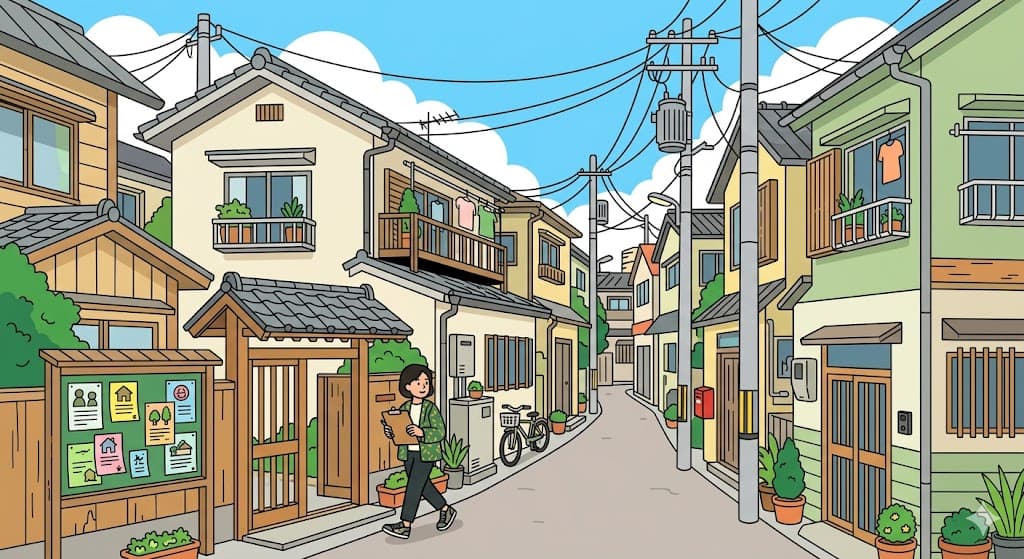 A modern Tokyo neighborhood where the quiet machinery of village society still circulates from house to house.
For years I lived in a place where the 町内会 (Chōnaikai: neighborhood association) collected a few hundred yen every month, sent a 回覧板 (Kairanban: a binder of notices passed house to house) around the block, and called residents out for cleanup mornings several times a year. Each house looked independent from the street. In practice, every household was tied to every other household by a fine mesh of small obligations. You could leave the association in theory. In practice, you could not — not without becoming the 家 (Ie: household) that "doesn't play along," which in a Japanese neighborhood is a quietly heavy label to carry.
That mesh of small obligations is the quiet engine of 村社会 (Mura Shakai). And the moment Eren raises his voice in the streets of シガンシナ区 (Shiganshina-ku: Shiganshina District), his neighbors are not really worried about Titans. They are worried about a child who is not playing along.
Related: The Apothecary Diaries and the Art of Playing Dumb: Why Maomao Hides Her Brilliance explains this in detail.
The Long Architecture of Walls in Japanese Life
Islands, Villages, and the Economics of Watching Each Other
Japan is an island country, and for most of its history the basic unit of life was not the city but the 集落 (Shūraku: village settlement). Rice cultivation in particular demanded coordinated water management, shared labor at planting and harvest, and collective festival observance to ensure the gods looked kindly on the fields. A villager who could not be relied on for any of these things was not just inconvenient. They were a threat to everyone's food supply.
Out of this economic reality came a deep cultural reflex: the group's continuity matters more than the individual's preferences. The villager who wanted to do things differently was not punished out of cruelty. They were corrected because the village's survival depended on predictable behavior.
Related: Kaiji and the Trap of the Japanese Guarantor: Why One Stamp Can Swallow a Life explains this in detail.
The Edo Government's Five-Household Net
The 徳川幕府 (Tokugawa Bakufu: Tokugawa shogunate) took this informal logic and made it law. The 五人組 (Gonin-Gumi) system bound five neighboring households into a single accountable unit. If one member committed a crime, did not pay taxes, or sheltered someone they should not have, the other four households shared the punishment. This was an exquisitely efficient surveillance mechanism — the neighbors did the watching for free, because their own livelihoods were tied to your behavior.
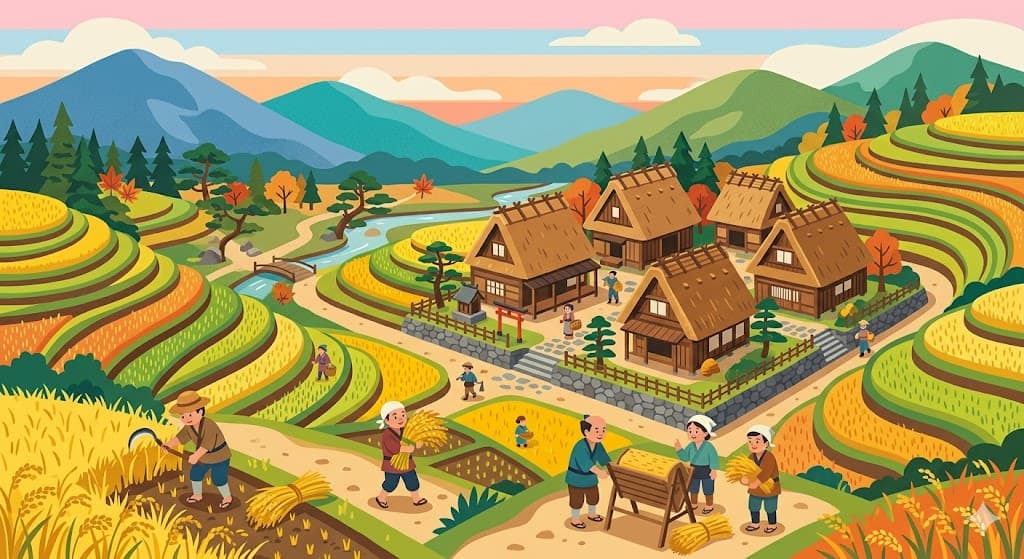 The Edo-era village was the original unit of mutual surveillance, where five households watched one another for the shogunate.
The 五人組 was formally abolished long ago, but its emotional architecture survives in the modern Japanese workplace ("the whole team gets scolded for one person's mistake"), in school discipline ("the whole class is punished"), and in the persistent custom of demanding a 連帯保証人 (Rentai Hoshōnin: joint guarantor) for rentals and loans. One person signs, but the whole web around them is implicated.
Walls as Comfort, Walls as Cage
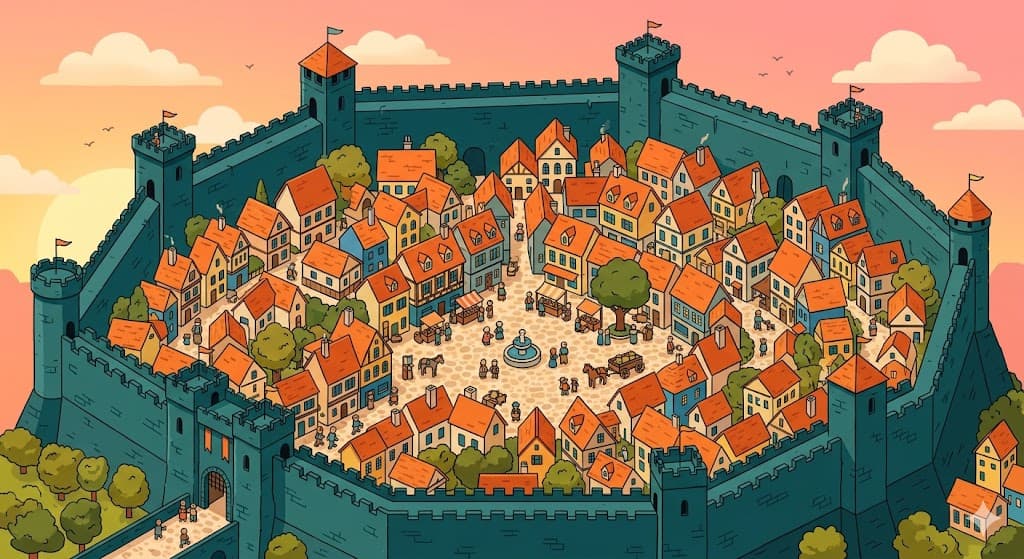
Pre-modern Japanese towns were often physically walled or gated as well — castle towns had clear boundaries, and even ordinary settlements were marked off with shrine gates and 鳥居 (Torii: shrine gateway) that distinguished the village's inside from the outside. The walls in the anime — 壁マリア (Kabe Maria: Wall Maria), 壁ローゼ (Kabe Rōze: Wall Rose), 壁シーナ (Kabe Shīna: Wall Sina) — read to a Japanese viewer not as exotic fantasy but as a heightened version of something familiar. Inside is order, predictability, and shared rules. Outside is danger, but also the unknown, the place where the rules dissolve.
What the anime captures sharply is that the wall is not only protective. It is also psychological. The townspeople in episode one are not held inside by force. They are held inside by a shared agreement that inside is the right place to be, and that anyone curious about outside is suspicious. That, more than any plot twist, is the part that lands hardest for a Japanese audience.
The Nail That Sticks Out
Eren's outburst — that staying inside the walls eating and sleeping makes humans into livestock — earns him an instant label. The adults call him 変わり者 (Kawarimono: an oddball, a nonconformist). His friends are pulled into fights to defend him. The local kids beat up his quiet companion Armin and call him a heretic for saying humanity should one day go outside.
This is 出る杭は打たれる (Deru Kui wa Utareru) operating in real time. The proverb is not abstract — it is the everyday mechanism by which 村社会 trains its members to lower themselves voluntarily, to anticipate disapproval before it arrives, to soften any opinion that might mark them as different. I felt this clearly in my own life when I chose 日本体育大学 (Nippon Taiiku Daigaku: Nippon Sport Science University) for my degree. The reaction from people around me was not anger. It was a puzzled, slightly worried "なぜそこを (Naze soko o: why there?)". In a country where the safe path is well-marked, choosing a different one is often read as a problem to be solved on your behalf, not a choice to be respected.
Heiwa-Boke and the Hundred-Year Wall
The Garrison soldiers in episode one are not lazy individuals. They are a portrait of a population. They drink on duty because nothing has happened in a hundred years. They reassure Eren that if anything ever does happen, they will handle it — though they have no plausible plan and no recent training under stress. Their commander even says, half-seriously, that them being called freeloaders is a sign of peaceful times for everyone.
This is 平和ボケ (Heiwa-Boke) almost too perfectly drawn. The term took root in postwar Japan as a piece of self-criticism: after decades of constitutional pacifism and astonishing economic recovery, a worry settled in that Japanese citizens had lost the capacity to imagine that anything could go badly wrong. The very stability of the country had become a liability, because no one was preparing for the day stability ended.
I encountered the corporate version of this repeatedly when I worked in companies in Japan. Whenever I proposed a new approach, the answer that came back most often was some variation of "we have always done it this way and it has worked." Long absence of failure was treated as proof of safety. Meanwhile, the world outside the company kept changing, and not changing was quietly becoming the largest risk of all. The drunk soldier's logic — "the wall has held for a hundred years, so the wall will hold tomorrow" — is not fantasy logic. It is the logic of every institution that mistakes the absence of recent disaster for the absence of underlying danger.
What the Walls Still Hold In, and What They No Longer Can
Living outside Japan for many years now, I have come to think of the opening scene of the anime as one of the most honest pieces of Japanese self-portraiture in modern popular culture. The show is often discussed in international circles as a story about freedom versus tyranny, or about the cost of revenge. From a domestic Japanese angle, the first episode is something quieter and more uncomfortable: a portrait of a society that has organized itself for safety so completely that safety itself has become the cage.
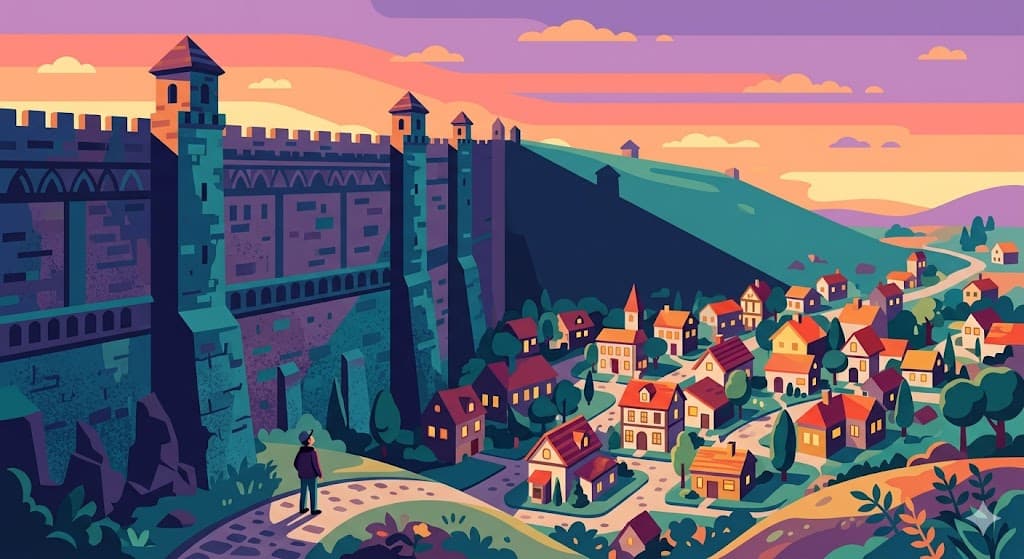 The most durable wall in Japan is not the one you can see, but the shared agreement about what lies safely inside it.
Some of the architecture I described above has softened. The 五人組 is long gone in name. Joint guarantors for rentals are increasingly being replaced by 家賃保証会社 (Yachin Hoshō-gaisha: rent guarantee companies), shifting risk from family relationships to a paid corporate service. Younger Japanese workers are noticeably less willing to absorb collective punishment for one colleague's error. These are real changes.
But the deeper reflexes remain. The 町内会 still circulates its 回覧板. The phrase 世間体が悪い (Seken-tei ga warui: it looks bad to the neighbors) still ends arguments inside families. And whenever I see a Japanese institution insist that its long track record is itself the proof that no preparation is needed, the drunk soldiers from episode one come back to mind, telling Eren that nothing has happened in a hundred years.
The decision to leave Japan, for me, was less a romantic adventure than a sober reading of the long-range numbers — public debt, demographic decline, the geological fact of major earthquakes that have not yet happened — and a sense that watching from outside the walls might be a more honest place to stand. Eren's line about not wanting to live an entire life in ignorance inside the walls reads differently when you have actually walked out of one of those walls yourself. It is not heroic. It is just a calculation that the inside is not as safe as it looks.
What 進撃の巨人 (Shingeki no Kyojin) gets exactly right is that the most dangerous thing inside the walls is never the walls themselves. It is the shared agreement to stop asking what is on the other side.
FAQ
Q: Is "village society" really still a meaningful concept in modern urban Japan?
A: Yes, in modified form. While 東京 (Tōkyō) and other large cities are not literal villages, the underlying mechanisms — neighborhood associations, mutual monitoring through workplace and school groups, the heavy weight of 世間体 — operate continuously even in apartment-block urban life. The village has become invisible, but the pressure to fit in has not.
Q: Did the creator of 進撃の巨人, Hajime Isayama, intend these Japanese cultural readings?
A: Isayama has spoken about growing up in a rural town surrounded by mountains, which gave him an early sense of being walled in by geography. Whether the village-society reading is fully intentional or partly emergent from the cultural water he was raised in, the resonance with 村社会 themes is unmistakable to a Japanese viewer.
Q: Why does Eren's "we are cattle" line hit so hard for Japanese audiences?
A: The livestock metaphor inverts a comforting Japanese self-image — that life inside the group is dignified, harmonious, and quietly noble. Calling the inhabitants of the walls cattle reframes that same life as domestication: fed, watered, kept safe, and ultimately consumed. For a society that prides itself on social order, that reframing is genuinely uncomfortable, which is exactly why the line lands.
Key Insights to Remember
- The walls in 進撃の巨人 operate on two levels at once. They are physical fortifications against giants, but they are also psychological structures — the shared belief that inside is correct and outside is forbidden. In the Japanese context, the second wall is the older and more durable one, and the show's most pointed cultural commentary is about that interior wall, not the masonry one.
- The townspeople's hostility toward Eren is not a side detail meant to make him seem isolated. It is a precise rendering of how 村社会 protects itself from change. The community does not need a king or an army to enforce conformity; it has neighbors, gossip, and the quiet threat of being talked about, which historically has been sufficient to keep most people inside the line.
- The Garrison soldiers' complacency is the most quietly tragic element of the opening episode, because their attitude is reasonable on its own terms. A hundred years of evidence does support relaxation. The trap of 平和ボケ is that it cannot be argued out of from the inside — only the wall actually breaking convinces everyone, and by then the cost of having been wrong is paid in full. This pattern is not unique to Japan, but Japan has named it more precisely than most cultures, which is why anime can dramatize it so cleanly.
Sources & References
- 村社会 (Mura Shakai) entry — Kotobank
- Gonin-gumi: Edo-Period Mutual Responsibility Group — Encyclopædia Britannica
- Japanese Proverbs and Their Cultural Background — Tofugu
- 平和ボケ entry — Kotobank
About the author

Spoiler-free cultural deep-dives into anime, manga & live-action Japanese drama
- ●Tokyo-born, 3rd-generation Edokko (江戸っ子)
- ●Lifelong manga reader & anime viewer since the kaiju era
- ●Writes from outside Japan — distance as a cultural lens
- ●Spoiler-free · sourced · Kanji + Romaji + English
A Tokyo-born, 3rd-generation Edokko writer who has spent years living outside Japan. I use the anime, manga, and live-action Japanese drama you already love as a doorway into the folklore, language, religion, and everyday history behind them — written so even first-time fans can follow along, with sources for every claim.
Enjoy this article?
Get the next spoiler-free cultural deep-dive straight to your inbox.
Related Articles

Crayon Shin-chan and Nagashi Somen: Why Japan Sends Its Summer Noodles Down a Bamboo Flume
How a Crayon Shin-chan episode turns nagashi somen into salaryman theatre — and the real 1955 origin of Japan's flowing noodles, from Takachiho Gorge to Kagoshima's rotating rival.
8/9/2026
Naruto and the Naruto Strait Whirlpools: The Real Uzushio Behind the Uzumaki Name
How the anime Naruto links to the real Uzushio whirlpools of Tokushima's Naruto Strait — a tidal wonder you can visit, and the spiral motif behind it.
7/17/2026
SPY x FAMILY and O-juken: The Real Exams Behind Eden Academy
How SPY x FAMILY dramatizes O-juken, Japan's high-stakes early-childhood entrance exams, and the parent-child interview that judges the whole family.
7/8/2026

Attack on Titan and On-Gaeshi: Why Hannes's Debt to the Jaeger Family Is More Than a Favor
How Attack on Titan dramatizes on-gaeshi — the lifelong Japanese debt of gratitude behind Hannes's vow, and why the English word favor can't carry its weight.
7/6/2026
Death Note and Hissatsu Shigotonin: Japan's Shadow Justice
How Death Note channels Japan's shadow-justice tradition — the TV drama Hissatsu Shigotonin, whose hidden killers punish evil the law itself cannot touch.
7/1/2026

Kaiju No. 8 and the Ritual of All Night Nippon: The Late-Night Radio Culture Behind Hoshi Night Nippon
How Kaiju No. 8's Hoshi Night Nippon bit recreates Japan's late-night radio ritual, from radio names to the postcard-artisan culture of listener submissions.
6/28/2026