Engawa: The Japanese Veranda Seen Through Summer Wars
What is an engawa? Learn what the Japanese wooden veranda is, how families used it, and why it vanished from city homes, via the old house in Summer Wars.

Tokyo-born, 3rd-generation Edokko · writing on Japanese culture from outside Japan
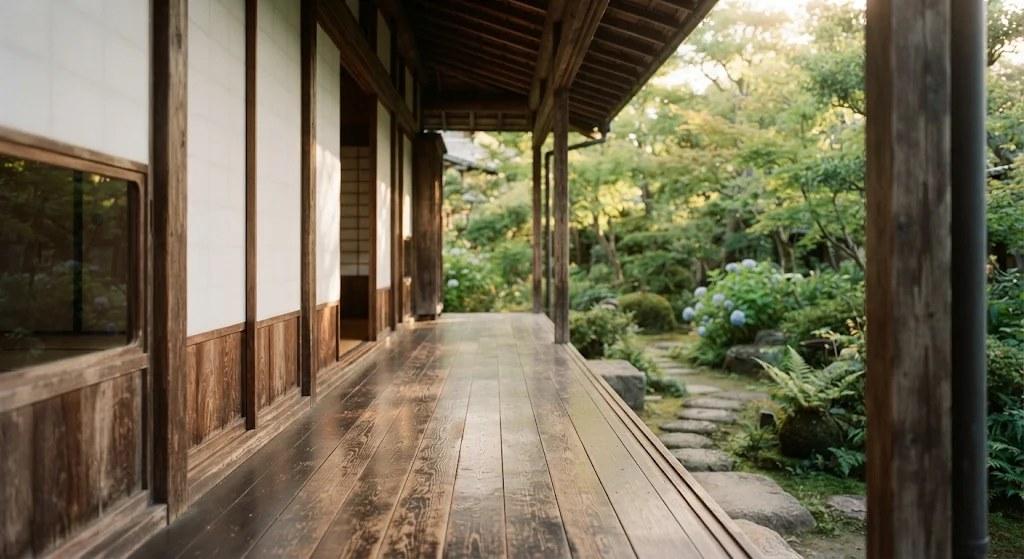
What is an engawa? It is the long strip of wooden flooring that runs along the outside of the rooms in a Japanese house, between the house and its garden. It is not quite indoors and not quite outdoors. In サマーウォーズ(Samā Wōzu: Summer Wars), a huge family gathers in an old house in the Japanese countryside, and the engawa belongs to exactly that kind of house. It is also a space that city homes in Japan have been losing.
Spoiler-Free Cultural Analysis
This article draws only on the opening premise of Summer Wars, as described in published summaries. It does not describe particular scenes or anything about how the story unfolds. The focus is the real engawa: what it is, how people used it, and why it disappeared from city homes.
Key Takeaways
- An engawa is a strip of board flooring along the outside of the rooms of a Japanese house. It sits between the main rooms and the outdoors, and it can also serve as a corridor and as a step up into the house.
- The engawa is said to go back to the eaves rooms around the houses of Heian-period aristocrats, but it became common in ordinary homes only about a century ago, around the Taishō period.
- Families used it to cool off on summer evenings, to air futons in the sun, and to chat with neighbours who came in from the garden. Its vague, in-between character, together with shrinking city houses, is the main reason it has become rare in urban Japan.
Key Terms Explained
- 縁側 (Engawa) / Veranda — A board-floored space on the outside of the rooms of a Japanese house, between the main rooms and the outdoors.
- 縁 (En) — The general word for a long, narrow area on the outside of a floored building. It can be part of a farmhouse, a traditional upper-class house, a temple, or a shrine.
- 濡れ縁 (Nure-en) / Open Veranda — An engawa with no rain doors, left open to the weather. The name literally means "wet edge."
- 雨戸 (Amado) / Rain Doors — Sliding doors set along the outer edge of an engawa to keep the rain out.
- 障子 (Shōji) / Sliding Screens — Light sliding screens that usually separate the engawa from the main room.
- 旧家 (Kyūka) / Old Family — A family with a long lineage, and by extension the old house it lives in.
A Downtown Childhood Without an Engawa
I grew up in a 平屋(hiraya: a single-storey house) in 足立区(Adachi-ku: Adachi Ward), 東京(Tōkyō: Japan's capital). It was a house in the 下町(shitamachi: Tokyo's old, crowded downtown neighbourhoods), and it had no engawa. I knew what an engawa was, but only from anime and television.
The houses around us stood close together, and there were few places where a child could run around with a bug net. Behind our house was a large house with a garden, and in summer that garden was loud with cicadas. It was someone else's garden, though, so I could not go in. I could only listen.
Summer in the shitamachi had its own small comforts. There were 打ち水(uchimizu: sprinkling water on the ground), すだれ(sudare: hanging blinds), and 風鈴(fūrin: wind chimes). There were 盆踊り(bon odori: summer festival dancing), local festivals, and 縁日(ennichi: festival stalls), and there were 線香花火(senkō hanabi: tiny hand-held sparklers) and other hand-held fireworks.
What I did not have was a long wooden edge to sit on between the house and a garden. As a city child, I got my real taste of a country summer from just a handful of family camping trips in 長野(Nagano: Nagano Prefecture). Most of my picture of a country summer, the boy in a straw hat and all, was built by the manga, anime, and television of the 昭和(Shōwa: the Shōwa era) years. I have read manga and watched anime since I was a child, and these days I rewatch old and new titles on Netflix. Summer Wars is set in Nagano, in exactly the kind of old house I only ever knew from the screen.
Related: Rurouni Kenshin and Uchimizu: Why Old Tokyo Cooled Its Streets explains this in detail.
The Engawa: Japan's In-Between Space
The Jinnouchi House as a Way In
Summer Wars is a 2009 animated film directed by 細田守(Hosoda Mamoru: the film's director) and produced by the studio マッドハウス(Maddohausu: Madhouse). It opened in Japan on 1 August 2009 and runs 115 minutes. Its theme is the bond of a large family, and Hosoda centres the film on marriage and relationships with relatives.
The premise is simple. Twenty-six relatives gather at the family home in 上田市(Ueda-shi: Ueda City), Nagano Prefecture, to celebrate the 90th birthday of 栄(Sakae), the great-grandmother of 夏希(Natsuki). Through a twist of circumstance, 健二(Kenji), the film's young hero, ends up pretending to be Natsuki's fiancé for Sakae's sake. Kenji lives almost alone at home, so at first he is overwhelmed by the sight of so many relatives around the dining table. One summary describes the film as the story of an old family in the provinces and a young hero who fight in a digital world to protect the world.
The family is the 陣内家(Jinnouchi-ke: the Jinnouchi family). An anime news site describes it as a distinguished family dating back to the 戦国時代(Sengoku jidai: Warring States period): a large, energetic household led by great-grandmother Sakae. According to the film's Japanese Wikipedia entry, Ueda is where Hosoda's wife's family lives, and he set out to capture the sense of 日本の原風景(Nihon no genfūkei: the nostalgic, timeless scenery of Japan) that he had felt on his visits there. His wife's relatives served as a model for the Jinnouchi family, and the film's family is also based on the 真田氏(Sanada-shi: the Sanada clan). Hosoda has said that he decided to set the film in Ueda, a place that had become familiar to him through marriage, and to make a new kind of film with relatives and family as its main characters.
The house is based on a real one. It is the main residence of 武重本家酒造(Takeshige Honke Shuzō: a sake brewery) in 佐久市(Saku-shi: Saku City), Nagano Prefecture, which belongs to relatives of the film's art director, 武重洋二(Takeshige Yōji). The news site ORICON reports that even the residence's nameplate appeared in the film, with the name changed, and that the place has become a pilgrimage spot for fans. The estate covers about 7,600 square metres and contains 30 buildings registered as Tangible Cultural Properties. Bamboo sliding doors, long brazier hearths, and matchlock guns still remain inside.
The Wikipedia entry describes the family gathering in "a fortress-like mansion of an old family." The film is my way in here, not my subject. What it gives me is a picture of the type of house. JAANUS, an English-language online dictionary of Japanese architecture and art terms, notes that an en may be part of a farmhouse, a traditional upper-class house, a temple, or a shrine. The engawa belongs to the world of large, old houses like the one the Jinnouchi family gathers in, not to the cramped downtown house where I grew up.
What an Engawa Is
Japanese dictionaries define the engawa as a board floor built on the outside of the rooms of a house. It can also work as a corridor and as a step up into the house, and it is described as something particular to Japanese homes. Some engawa have rain doors or glass doors along the boundary with the outside. Others, the nure-en, have none.
Another encyclopedia entry calls the engawa a secondary space, with either board or tatami flooring, between the main room and the outdoors. Usually 明障子(akari-shōji: sliding screens that let light through) separate it from the main room, and glass doors and rain doors separate it from the outside. It serves as extra space for the main room, and when it runs along several rooms it can double as a corridor.
JAANUS describes it in similar terms. Today, the word engawa usually means either a veranda partly inside the building, with sliding doors to protect it from rain, or a veranda left completely open.
A Japanese renovation glossary adds the point I find most telling. The engawa connects the inside of the house with the outside, and it gives Japanese architecture its particular ambiguity, in which spaces are only loosely divided. The engawa is not a wall, and it is not a garden. It is the place where inside gently becomes outside.
From Heian Eaves to Taishō Homes
The engawa is said to have begun as the ひさしの間(hisashi no ma: the room under the eaves) that ran around the 母屋(moya: the main building) of aristocrats' houses in the 平安時代(Heian jidai: Heian period).
The way it was closed off changed over time. At first, the outer side of the engawa had no doors at all. By the early 19th century, sliding rain doors along the outside had become the usual form. In 民家(minka: traditional folk houses), the style of an engawa with a row of white shōji behind it spread across the country. From the 明治時代(Meiji jidai: Meiji period) onwards, the shōji set between the pillars were replaced by glass shōji, sliding doors fitted with glass panes.
What surprised me is how recent the engawa is as an everyday feature. According to nippon.com, its history as a common feature in homes dates back only about a century. It seems to have spread to ordinary people's homes around the 大正時代(Taishō jidai: Taishō period). The idea is old, but the engawa in an ordinary family's house is a much younger thing.
How People Used the Engawa
nippon.com describes the engawa as a place to go in the heat of summer once the sun has set. After a bath, you could sit in the night breeze and look up at the sky, and feel cool without relying on an air conditioner.
It was also a place to air 布団(futon: bedding) and 座布団(zabuton: floor cushions) in the sun, which the writer calls the wisdom of earlier generations who made good use of the sun's energy. In autumn, you might set a 七輪(shichirin: a small charcoal grill) on the engawa, grill さんま(sanma: Pacific saury), and admire the 中秋の名月(chūshū no meigetsu: the mid-autumn full moon). The winter side of Japanese home life, centred on the heated table, is covered in Kotatsu in Crayon Shin-chan: Why the Noharas Won't Get Out.
A second nippon.com article describes the engawa as a board passage at the boundary between inside and outside. It brings natural light and seasonal breezes into the house and softens heat and cold, which makes it a comfortable place to relax. It was also social. Neighbours who dropped by did not bother walking round to the front door. They came in from the garden, sat down on the engawa, and fell into conversation. The engawa was once a place where a neighbourhood met.
That last picture is the one I never had. In my neighbourhood, the cool of summer came from uchimizu, sudare, and fūrin at the edge of the house. The engawa, with neighbours perched on it, was something I only saw on screen.
Why the Engawa Disappeared from City Homes
Sadly, houses with an engawa have become fewer in Japan's cities. nippon.com suggests that the biggest reason is the very vagueness that defines it. An engawa looks like a corridor but is not one, and it has no clearly fixed use. The English version of the article puts it plainly: it is this ambiguity that is largely behind the disappearance of engawa from Japanese homes.
Economics pushed in the same direction. During Japan's period of rapid economic growth, land prices rose in the cities, apartments and condominiums multiplied, and detached houses grew smaller. A Japanese encyclopedia notes that after the Second World War, houses had little floor space to spare, and many were built without an engawa.
I cannot say for certain why my own family's house had none. But a crowded downtown street, with houses pressed close together, fits the picture these sources describe. When every square metre has to earn its keep, a space without a clear purpose is the first thing to go.
The Edge Where the House Meets the Garden
The engawa is a strange thing to miss. It was never a room with a single job. It was a place to cool off, to dry the bedding, to watch the moon, and to talk with whoever came in from the garden. That loose, in-between quality was its value, and in the end it was also the reason city homes let it go.
Summer Wars is a film about a crowd of relatives in an old house, seen through the eyes of a boy who lives almost alone. For me, that contrast echoes the history of the engawa. The large old house had room for edges and in-between spaces. The smaller homes that came later had room only for what was clearly needed.
I grew up without an engawa, and my country summers came mostly from manga, anime, and television. I still meet the engawa where I always did, on the screen. But I no longer see it as just a wooden step outside a room. I see it as the place where a Japanese house once left its door half open to the garden and to the neighbours.
FAQ
Q: What is an engawa in a Japanese house? A: An engawa is a strip of board flooring along the outside of the rooms of a Japanese house, between the main rooms and the outdoors. It can also serve as a corridor and as a step up into the house. Usually, shōji screens separate it from the main room, and glass doors and rain doors separate it from the outside.
Q: What is the difference between an engawa and a nure-en? A: A nure-en is a type of engawa with no rain doors, so it is left open to the weather. Other engawa have rain doors or glass doors along the outside edge, which places them partly inside the house.
Q: Why do modern Japanese city homes rarely have an engawa? A: The main reason is that the engawa is an ambiguous space. It looks like a corridor but is not one, and it has no clearly fixed use. During Japan's period of rapid economic growth, land prices rose in the cities, apartments and condominiums multiplied, and detached houses grew smaller, so there was little room to spare for it.
Q: Is the Jinnouchi house in Summer Wars based on a real house? A: Yes. Its model is the main residence of Takeshige Honke Shuzō, a sake brewery in Saku City, Nagano Prefecture, which belongs to relatives of the film's art director. The estate covers about 7,600 square metres and contains 30 buildings registered as Tangible Cultural Properties.
Key Insights to Remember: Summary
- The engawa is defined by being in between. It is board flooring on the outside of the rooms, between the main rooms and the outdoors, and it gives Japanese architecture its particular vagueness about where inside ends and outside begins.
- The engawa is older as an idea than as a habit. Its roots are said to lie in the eaves rooms of Heian aristocrats' houses, yet it spread to ordinary homes only about a century ago, around the Taishō period.
- The same vagueness that made the engawa useful for cooling off, airing futons, and chatting with neighbours made it easy to give up. As city land prices rose and houses shrank, a space with no fixed purpose was the first to disappear.
Next time you watch Summer Wars, or any story set in an old Japanese house, think about the strip of boards between the rooms and the garden, and the kind of family life that once happened there.
Sources
- Summer Wars — Wikipedia (Japanese)
- Summer Wars News — Anime Hack (eiga.com)
- Summer Wars Article — Anime! Anime!
- Model for the Jinnouchi Family Home in Summer Wars — ORICON
- Engawa — JAANUS
- En — JAANUS
- Engawa — Kotobank
- The Engawa: A Space Between Indoors and Outdoors — nippon.com (English)
- The Engawa — nippon.com (Japanese)
- The Engawa as a Relaxing Space — nippon.com (Japanese)
About the author

Spoiler-free cultural deep-dives into anime, manga & live-action Japanese drama
- ●Tokyo-born, 3rd-generation Edokko (江戸っ子)
- ●Lifelong manga reader & anime viewer since the kaiju era
- ●Writes from outside Japan — distance as a cultural lens
- ●Spoiler-free · sourced · Kanji + Romaji + English
A Tokyo-born, 3rd-generation Edokko writer who has spent years living outside Japan. I use the anime, manga, and live-action Japanese drama you already love as a doorway into the folklore, language, religion, and everyday history behind them — written so even first-time fans can follow along, with sources for every claim.
Enjoy this article?
Get the next spoiler-free cultural deep-dive straight to your inbox.
Related Articles
Omamori Explained: Japan's Shrine Charms Through Lucky Star
What is an omamori? Learn what Japan's shrine charms are, the main types, how people keep them, and how old ones are returned, via Lucky Star's shrine family.
11/15/2026

Yakiimo: Why Japan's Roasted Sweet Potato Means Winter
What is yakiimo? See why Japan's roasted sweet potato, the seller's call and the warm paper-wrapped potato still mean winter, from Edo to Crayon Shin-chan.
11/12/2026
Kotatsu in Crayon Shin-chan: Why the Noharas Won't Get Out
What is a kotatsu? Through Crayon Shin-chan's Nohara family, see why Japan's heated table sits at the centre of winter home life and when it traditionally comes out for the season.
11/5/2026
Sazae-san Syndrome: The Anime Behind Japan's Sunday Gloom
Sazae-san syndrome is Japan's nickname for Sunday evening gloom. See how a family anime's fixed 6:30 slot and closing janken came to mark the end of Sunday.
10/31/2026

Totoro and Katori Senko: The Meiji Coil That Gave Summer Its Smell
For fans of My Neighbor Totoro: the story of the katori senko, the Meiji-era mosquito coil whose spiral was imagined in 1895 by the wife of Kincho's founder.
8/8/2026

Anohana and Kingyo-sukui: Why a Working Net Became Dissolving Paper
How Anohana's summer world explains kingyo-sukui, the festival goldfish-scooping stall game, and why Japan swapped a net that worked for a paper scoop designed to fail, a change that dates from the Taishō era.
8/2/2026