Spy × Family and the Hour of Twilight: Why Tasogare Is the Hour Demons Meet Us
How SPY x FAMILY's codename Twilight draws on tasogare and ōmagatoki — the Japanese hour between day and night when faces blur and spirits were once said to walk.

Tokyo-born, 3rd-generation Edokko · writing on Japanese culture from outside Japan
Spoiler-Free Cultural Analysis
This article looks only at the codename of SPY x FAMILY's lead spy — information that sits inside the official premise — and uses it as a doorway into the real Japanese folklore of dusk. There are no plot revelations here, only language, atmosphere, and the history behind a single word.
Key Takeaways
- The codename rendered in English as "Twilight" is 黄昏 (Tasogare) in the original, a word whose etymology is a literal question asked into the gloom — "who is that?" — which maps almost too neatly onto a man who survives by never being recognizable.
- Japanese folklore treats dusk not as a romantic hour but as a dangerous threshold called 逢魔時 (Ōmagatoki), "the hour of meeting demons," when the boundary between the human world and the world of spirits was believed to thin.
- The unease of twilight is rooted in something very practical and very old: when you cannot make out a face, you cannot tell friend from stranger, human from something else — a fear that a spy weaponizes rather than flees.
Key Terms Explained
- 黄昏 (Tasogare) / Twilight, Dusk — The dim stretch of evening when the sun has dropped and the sky is fading. The kanji 黄 (yellow, for the sun) and 昏 (darkening) are a phonetic fit applied later; the sound itself comes from elsewhere.
- 誰そ彼 (Ta-so-kare) / "Who Is That?" — The phrase behind the word tasogare. In the half-light you could not recognize an approaching figure, so you asked aloud, "who goes there?"
- 逢魔時 (Ōmagatoki) / The Hour of Meeting Demons — Twilight reframed as a supernatural danger zone, the window when 妖怪 (Yōkai: supernatural creatures and spirits of Japanese folklore) and uncanny things were said to stir.
- 大禍時 (Ōmagatoki, alternate writing) / The Hour of Great Calamity — A second way of writing the same hour, built on 禍 (calamity); the two readings drifted together through the shared "ma" sound.
- かわたれ時 (Kawatare-doki) / The Dawn's "Who Goes There" — The morning twin of tasogare, from 彼は誰 (kare wa tare, "who is he?"), used for the matching gray light just before sunrise.
The Embankment Where Faces Dissolved
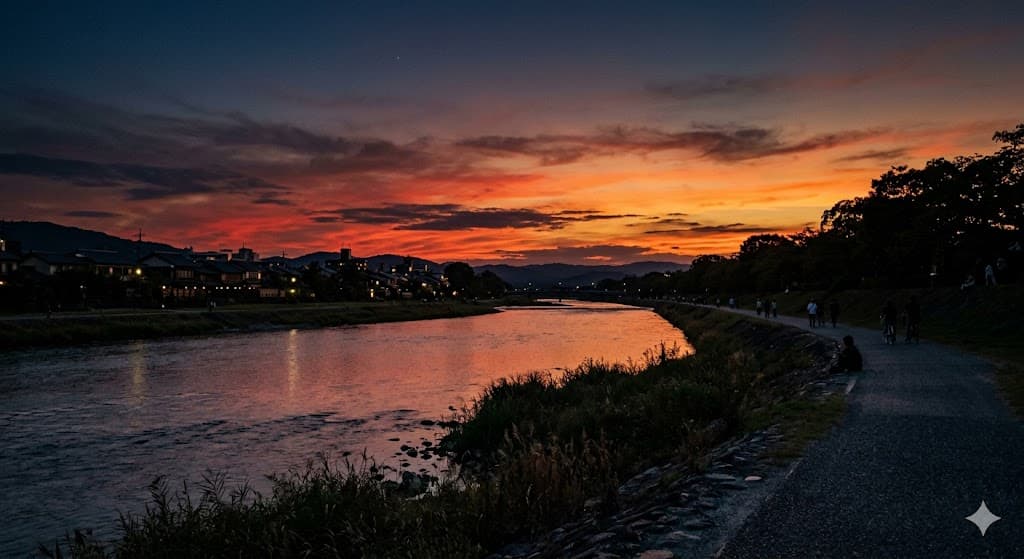
A two- or three-minute walk from my front door, there was an embankment along the 荒川 (Arakawa: a major river running through eastern Tokyo), and at dusk that is where I spent my evenings. The sky would start to redden, and from somewhere a recorded 夕焼けチャイム (yūyake chime: the evening chime broadcast over neighborhood loudspeakers) would drift across the water. That chime was the signal: time to head home. My family put it more bluntly — come back before it gets dark — so when the color of the sky thickened, my feet turned toward the house almost on their own. Spotting the first star from the embankment was the small daily reward.
 Dusk on a Tokyo river embankment — the hour when faces blur into silhouettes and the word tasogare was born.
But there was another side to that hour. The same riverside that had been an open, happy place all afternoon would, as the light drained, turn into somewhere faintly frightening. Once the gloom set in, I could no longer make out the faces or even the outlines of people nearby. A place I knew perfectly well became unsettled and strange, and a thin loneliness crept in that the bright hours never carried. I had no word for it then. I only knew that the in-between — neither day nor night — felt different.
Years later, when I learned that the word for that hour, 黄昏 (tasogare), is built from the question "who is that?", the memory snapped into place. The fear I felt as a child on the embankment was not invented by folklore. It was the folklore — the same fear, arriving the same way, through eyes that could no longer be trusted.
The Hour That Asks "Who Goes There"
From 誰そ彼 to 黄昏: A Question Frozen Into a Word
 In the gloom of evening an approaching figure could not be named, prompting the question ta-so-kare, "who is that?"
In an age before electric light, the end of the day was genuinely dark, and the moment the gloom set in, a human face stopped being readable. Out of that practical problem came a verbal habit: when a figure approached in the half-light, you asked 誰そ彼 (ta-so-kare) — roughly, "who is that there?" Repeated across centuries, the question itself collapsed into the name of the hour. Ta-so-kare became tasogare, and tasogare became the standard word for dusk.
The phrase is old enough to appear in the 万葉集 (Man'yōshū: Japan's oldest poetry anthology), where a speaker asks not to be questioned with "who is that?" while waiting in autumn dew. It survives into the 源氏物語 (Genji Monogatari: The Tale of Genji) as well, woven into the exchange around the lady 夕顔 (Yūgao: a Tale of Genji character whose name means "evening face," a moonflower), whose very name carries the dusk. The kanji 黄昏 came afterward as a phonetic dressing — 黄 for the yellowing sun, 昏 for the dark — which is why those characters are not read in any way that matches their usual sounds.
What strikes me about this, watching SPY x FAMILY as an adult, is how exact the overlap is. The lead spy's codename is precisely this word. He is a man who has built a life out of never letting anyone finish the sentence "who is that?" — the recurring greeting that opens his assignments leans on the codename itself, a small linguistic joke that only fully lands in the original. He does not fear the hour when identity dissolves. He lives inside it on purpose.
When Dusk Became 逢魔時: The Hour Demons Meet Us
The unease did not stay practical for long. "Someone is there, but I cannot tell who" curdles easily into "is that even a someone?" — and from that anxiety dusk acquired a second, darker name: 逢魔時 (ōmagatoki), the hour of meeting demons. There is a parallel spelling, 大禍時 (also ōmagatoki), the hour of great calamity, and the two slid into each other through the shared "ma" sound, so that the hour of misfortune and the hour of monsters became, in effect, the same hour.
This was the window when, in older belief, the membrane between the everyday world and the world of spirits grew thin enough to cross. The earliest such stories tended to come from people whose work pushed them outside the safety of the village after dark — woodsmen, travelers, those with reasons to move at night — who returned with accounts of eerie encounters after the light failed. Dusk took its place alongside other thresholds where the uncanny was said to gather: bridges, crossroads, doorways, mountain passes, riverbanks. Liminal places, all of them. The boundary in time had its echoes in the boundary in space.
There is a sober footnote to the superstition, too. Even now, the hour around sunset is when collisions between cars and pedestrians spike, as depth and distance become hard to judge in the failing light. The "demons" of the threshold were never entirely imaginary; they were the real hazards of a moment when human perception quietly stops working.
The Hundred Specters of the Evening
The Edo-period artist 鳥山石燕 (Toriyama Sekien: an 18th-century illustrator who cataloged yōkai) gave the hour its most famous visual gloss. In his 1779 collection, organized into volumes named for Rain, Dusk, and Dawn, he framed twilight as the stage on which a procession of specters rises — the hour, as he put it, when a hundred apparitions come out to walk. The folklorist 柳田國男 (Yanagita Kunio: the founder of Japanese folklore studies) later recorded regional variants of the word across the country, many of them tied to that same root problem of not being able to recognize a face at dusk.
 Edo-period art framed dusk as ōmagatoki, the hour when a hundred specters were said to come out and walk.
I want to be careful not to over-read a manga, but the resonance is hard to ignore. SPY x FAMILY's lead is described, within its own opening, as a man who survived the information war by wearing a hundred different faces. Sekien's dusk is the hour a hundred specters arise. Whether or not the echo was intended, both images point at the same instinct: that the failing light is when the count of who might be standing in front of you stops being one. The hour of a hundred faces and the hour of a hundred specters are, culturally, the same hour — the one where a single body could be anyone, or anything.
A Sky That No Longer Asks Me to Come Home
Living outside Japan for many years now, the thing I notice most about dusk is that it barely moves. Where I live, full dark arrives a little after six in the evening, and it does this with almost no seasonal drift — summer and winter land in nearly the same place. In Japan the evening slides around enormously: light until close to seven in high summer, dark by five in deep winter. A life where the sun sets at roughly the same hour all year is, for me, an easy one to live in.
And yet something is missing, and it took leaving to feel the shape of it. There is no chime here at dusk. No one says "come home before it gets dark," because the dark is not a moving target you have to beat. That sentence — and the recorded melody that carried it across the rooftops — was doing more than reporting the weather. It was cutting the day in two, marking the moment the safe world handed you over to a less certain one, and calling you back across the line before you crossed it. The hour the spy chose as his name was, where I grew up, the hour we were taught to fear in the gentlest possible way: a tune, a curfew, a parent's voice. I did not realize that "come home before dark" was a folk belief in disguise until I lived somewhere the belief had nothing to attach to.
FAQ
Q: Does "Twilight" in SPY x FAMILY actually mean something different in Japanese?
A: The codename is 黄昏 (Tasogare), the ordinary Japanese word for dusk. "Twilight" is an accurate translation, but the original carries an etymology English does not: the word is built from a question, "who is that?", asked when faces become unreadable at evening — a layer that quietly suits a spy who is never identifiable.
Q: What is the difference between tasogare and ōmagatoki?
A: They name the same stretch of time from different angles. Tasogare (黄昏) is the neutral, even wistful word for dusk. Ōmagatoki (逢魔時) is that same hour seen through folklore — "the hour of meeting demons," when the boundary to the spirit world was believed to thin and yōkai to stir.
Q: Why was dusk considered dangerous rather than just beautiful?
A: Before electric light, the half-light made it impossible to recognize people or judge distance. "Someone is there but I cannot tell who" became "is that even human," and the practical fear hardened into superstition. Sunset is still, in fact, when car-and-pedestrian accidents peak — the danger was never purely supernatural.
Key Insights to Remember
- A word can preserve a fear long after the conditions that caused it are gone. Tasogare is, etymologically, the frozen sound of a question asked into the dark — proof that the people who coined it were genuinely unsettled by not being able to see a face. The codename "Twilight" inherits that unease whether or not a reader knows the history.
- Japanese tradition is unusually comfortable treating boundaries — between day and night, human and spirit, here and elsewhere — as charged, dangerous places rather than neutral transitions. Dusk, crossroads, bridges, and doorways share a single logic, and a spy who lives permanently at the boundary of his own identity is, in that sense, a deeply native figure dressed in foreign clothes.
- The customs that once policed the dangerous hour did not vanish so much as soften into everyday life. A neighborhood chime and a parent's "come home before dark" are ōmagatoki with the teeth filed down — and you may only notice they were ever folklore once you live somewhere that has no use for them.
Sources
About the author

Spoiler-free cultural deep-dives into anime, manga & live-action Japanese drama
- ●Tokyo-born, 3rd-generation Edokko (江戸っ子)
- ●Lifelong manga reader & anime viewer since the kaiju era
- ●Writes from outside Japan — distance as a cultural lens
- ●Spoiler-free · sourced · Kanji + Romaji + English
A Tokyo-born, 3rd-generation Edokko writer who has spent years living outside Japan. I use the anime, manga, and live-action Japanese drama you already love as a doorway into the folklore, language, religion, and everyday history behind them — written so even first-time fans can follow along, with sources for every claim.
Enjoy this article?
Get the next spoiler-free cultural deep-dive straight to your inbox.
Related Articles
Spirited Away and Kamikakushi: The Folklore Behind the Title
Spirited Away's Japanese title ends in kamikakushi. Learn who villages said took children away, why dusk was the dangerous hour, and how they searched for them.
10/25/2026
Fruits Basket and the Zodiac Cat: The Real Japanese Folktale of the Cat Who Missed the Banquet
How Fruits Basket builds its outsider cat on the real Japanese folktale of the rat tricking the cat out of the zodiac, and what eto still means in Japan today.
10/20/2026

March Comes in Like a Lion and Tsukimi: Why Japan Watches the Moon With Rice Dumplings and Pampas Grass
How March Comes in Like a Lion opens onto tsukimi, Japan's moon-viewing harvest observance, and why dumplings, pampas grass and a shifting date belong to it.
8/17/2026

Summer Time Rendering and the Shoryo-uma: The Cucumber Horse That Carries the Dead Home
How Summer Time Rendering's Obon homecoming opens onto shoryo-uma, the cucumber horse for returning ancestors, and why it is only one of many regional forms.
8/16/2026

GeGeGe no Kitaro and Hyakumonogatari: Why Japan Saves Its Ghost Stories for Summer
How GeGeGe no Kitaro connects to hyakumonogatari, the hundred-candle ghost game, and the Edo custom of staging horror in summer to chill the audience.
8/11/2026

Demon Slayer Infinity Castle and the Biwa: Heike and Hōichi
How the biwa that opens Demon Slayer's Infinity Castle leads to blind Heike reciters and Hōichi, who played night after night for a court that was not there.
8/7/2026