Dandadan and the Rise of Toshi Densetsu: Why Postwar Japan Moved Its Ghosts Into the Tunnels
How Dandadan's Turbo Granny opens a door into toshi densetsu, postwar Japan's urban legends, and why modern dread took the shape of tunnels and schools.

Tokyo-born, 3rd-generation Edokko · writing on Japanese culture from outside Japan
Spoiler-Free Cultural Analysis
This article looks at the real folklore behind the first-episode antagonist of Dandadan — the road-haunting spirit known as Turbo Granny — and uses her to explore the genre of postwar Japanese urban legends. It discusses atmosphere, setting, and folkloric history only. There are no plot revelations beyond the opening premise.
Key Takeaways
- Turbo Granny is not an ancient monster but a modern legend, born in the age of cars and tunnels — a useful entry point into 都市伝説(Toshi Densetsu: urban legends), a genre distinct from Japan's classical spirits.
- Postwar Japan kept generating new uncanny figures on modern stages — the school toilet, the highway, the railway, the tunnel — rather than only inheriting the old creatures of mountains and rivers.
- These legends spread through a two-stage engine: schoolyard word of mouth first, then television amplification, which let a single rumor become a nationwide childhood fear with no internet involved.
Key Terms Explained
妖怪 (Yōkai) / Traditional Monster-Spirit — The classical creatures of premodern Japanese folklore, tied to specific natural or rural places like mountains, rivers, and old roads.
都市伝説 (Toshi Densetsu) / Urban Legend — A modern rumor-story treated as a possible real threat, set in contemporary spaces such as schools, tunnels, and highways.
ターボババア (Tābo Babā) / Turbo Granny — A road and tunnel spirit said to race cars and runners at impossible speed, cursing anyone she overtakes.
口裂け女 (Kuchisake-onna) / The Slit-Mouthed Woman — A masked figure from a 1979 nationwide panic who asks whether she is pretty before revealing a mutilated mouth.
学校の怪談 (Gakkō no Kaidan) / School Ghost Stories — The cluster of legends set inside schools, the most famous being トイレの花子さん(Toire no Hanako-san: Hanako of the school toilet).
The Summer a Masked Woman Joined Everyone's Walk to School
There was a stretch of my childhood when fear stopped being a thing that lived in old books and started walking the same route I did. In 1979, the 口裂け女(Kuchisake-onna: the slit-mouthed woman) swept across the country, and I was a kid on a daily school commute when it hit. The story was simple and merciless: a woman in a surgical mask stops you, asks if she is pretty, and if you answer wrong, the mask comes off and so does the rest. What unsettled me was not that it sounded old. It was that it sounded current — not a ghost from a temple, but something that might be standing at the next corner of my own neighborhood.
 The slit-mouthed woman of 1979 felt less like a folktale and more like a present-tense hazard on the walk home.
We learned about her the way kids learned everything then: somebody said she had appeared in the next town over, and the rumor crossed the classroom in an afternoon. Television did the rest, running the story as if sightings were real, until the whole country's children seemed to be bracing for the same masked figure at once. We invented defenses and traded them like currency. You could supposedly stop her by saying ポマード(Pomādo: a slick hair product) three times, or by throwing べっこう飴(Bekkō-ame: hard amber sugar candy) to distract her. Whether any of it was true mattered less than the comfort of sharing the countermeasure. And the places people said she haunted — tunnels, dark roads after dusk, the school toilets — we genuinely avoided, or hurried through with our shoulders up.
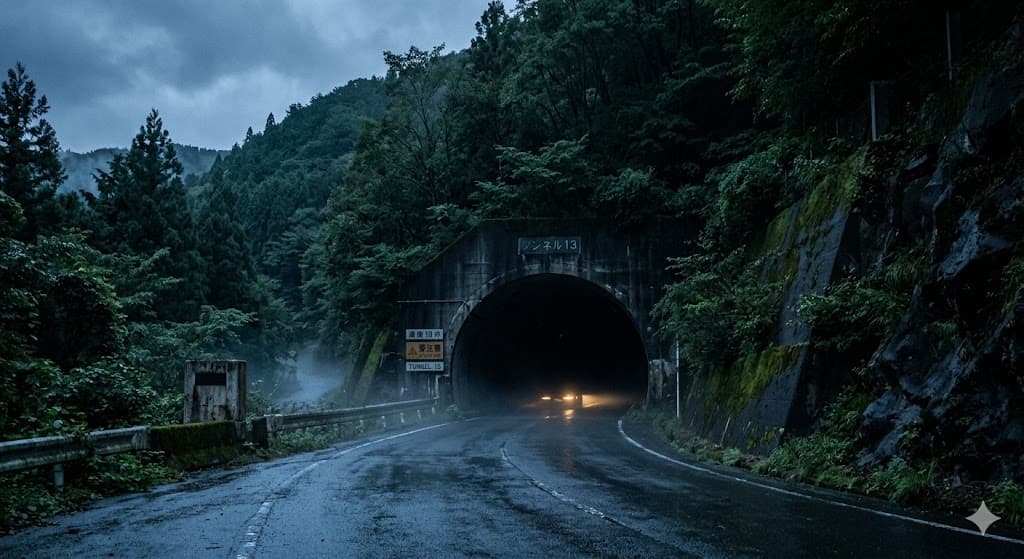
Watching Dandadan open on Turbo Granny, a hag who chases people through a tunnel and curses whoever outruns her, snapped me straight back to that feeling. She is built from the same material as the masked woman of my school days: a fear that does not haunt a ruined castle but a piece of ordinary modern infrastructure you pass every day.
From Mountain Spirits to Tunnel Curses: The Modernization of the Japanese Monster
The Old Map of the Yōkai
 For most of Japanese history the uncanny had a fixed address in the mountains, rivers, and forest paths between villages.
For most of Japanese history, the uncanny had a fixed address. The classical 妖怪(Yōkai: traditional monster-spirits) belonged to a premodern landscape: the river held the water-goblin, the deep mountain held the long-nosed mountain goblin and the 山姥(Yamamba: old mountain hag), the dark forest path held whatever waited there for travelers. These were creatures of a country that walked, that lived close to wilderness, and that read danger into the spaces between villages. The monster and the place were inseparable; you could draw a map of old Japan from its yōkai alone.
What is striking about the postwar period is that Japan did not simply keep telling those old stories. It kept building new ones — and it built them on a completely different map.
The New Stage: Car, Tunnel, School
The toshi densetsu of the 昭和(Shōwa: 1926–1989) and 平成(Heisei: 1989–2019) eras relocate the uncanny to wherever modern life concentrates people and unease. The single most common stage is the school, because that is where children spend their days and where they share their fears: the legend of トイレの花子さん(Toire no Hanako-san: Hanako of the school toilet) plants a ghost in the most institutional, fluorescent-lit room imaginable. Other legends migrate onto the transport network of a fast-motorizing nation. テケテケ(Teke-Teke: a half-bodied spirit), a figure cut off at the waist who drags herself with terrible speed, clings to railways and crossings. The 人面犬(Jinmen-ken: human-faced dog) is glimpsed from car windows along expressways, sometimes said to keep pace with speeding vehicles.
The pattern is consistent. The old uncanny haunted the seam between village and wilderness. The new uncanny haunts the seam between safety and the modern in-between: the school after hours, the highway at night, the mouth of an unlit tunnel. As the country urbanized and put families in cars during the high-growth decades, its ghosts simply followed the traffic.
Turbo Granny as a Case Study
Turbo Granny is almost a textbook of this shift. Strip away the asphalt and you can still see the 山姥(Yamamba: mountain hag) underneath — the fearsome old woman of the deep hills. But she has left the mountain hut and taken to the road, and her defining trait is no longer wilderness but speed. She races automobiles. She is associated with tunnels and mountain passes, the exact places where a driver feels most exposed. Her curse is triggered by being overtaken — a rule that only makes sense in a world of engines and lanes and the small private terror of something gaining on you in the dark.
In other words, she is what you get when you motorize a folk monster. The hag is ancient; the velocity is modern. That fusion is precisely why Dandadan can hand her a title-role moment in its first episode and let her stand shoulder to shoulder with aliens and the occult. The series treats a road-era legend with the same gravity classical folklore once received, which is itself a quietly accurate piece of cultural commentary.
How a Rumor Became a Nation Overnight
The mechanism behind these legends is as interesting as the legends themselves. They moved on two engines running in sequence. First came word of mouth — a child saying it happened somewhere nearby, and the schoolyard carrying it outward faster than any adult could track. Then came television, the wide-shows and the seasonal scare specials, which treated the rumor as something that had actually been witnessed and broadcast it to every region at once.
The result was a kind of national synchronization that, looking back, fascinates me more than any single ghost. With no internet, children separated by hundreds of kilometers came to fear the same figure in the same week, and to share the same homemade defenses against her. The truly modern thing about modern legends was never the monster. It was the speed and reach of belief.
What the Tunnel Keeps That the Mountain Lost
Having lived outside Japan for many years now, I have learned that the very phrase causes trouble in translation. In English, "urban legend" leans toward a widely circulated story that turns out to be false — something you debunk and smile about. That is not the texture of what we felt. The slit-mouthed woman and Hanako of the toilet were, for the children carrying them, half-believed and present-tense, less a tall tale than a hazard to route around. When I try to explain them abroad, I have to add the temperature back in: not "here is an old story," but "here is a thing kids genuinely braced for on the way home."
 When Japan paved itself over, its dread moved address — from the forest path to the late-night tunnel.
There is a loss folded into this modernization, and a strange preservation too. The old yōkai of mountain and river have faded as Japan paved itself over; few children today fear the forest path. But the function survived by changing address. The dread that once lived where village met wilderness simply moved to where the safe and the modern meet — the late tunnel, the empty corridor, the train platform after the last announcement. Turbo Granny is proof that the impulse to populate the dark did not die with the old map. It just bought a car.
What Dandadan understands, and what I keep turning over from a distance, is that a culture's monsters are a portrait of where it feels exposed. Premodern Japan was afraid of the spaces between settlements. Postwar Japan, racing through its tunnels and sitting its children in identical classrooms, grew afraid of the spaces inside the modern world it had just built. The hag on the highway is, in that sense, one of the most honest things the country ever dreamed up.
FAQ
Q: Is Turbo Granny a traditional yōkai or a modern urban legend?
A: She belongs to the modern urban-legend genre rather than classical folklore. She is best understood as a motorized descendant of the old mountain-hag figure, reborn for an age of cars, tunnels, and speed.
Q: What is the difference between yōkai and toshi densetsu?
A: Yōkai are the classical spirits tied to premodern places like mountains and rivers, while toshi densetsu relocate the uncanny to modern settings such as schools, toilets, highways, and tunnels, and spread through word of mouth and mass media.
Q: Do I need to know Japanese folklore to enjoy Dandadan's first episode?
A: No. It works as comedy-horror entirely on its own. But recognizing Turbo Granny as part of the postwar urban-legend tradition adds a layer, showing how the series places modern legends on the same footing as ancient ones.
Key Insights to Remember
- A culture's monsters map its anxieties. Japan's shift from mountain-and-river yōkai to tunnel-and-school urban legends tracks its own transformation from a walking, rural society into a motorized, mass-schooled, urban one. The ghost always moves to wherever people feel most exposed.
- Modernization did not abolish the supernatural; it relocated it. The same dread that once haunted the path between villages survives in the highway tunnel and the after-hours classroom. Turbo Granny is that continuity made vivid — an old hag who learned to keep pace with engines.
- The defining feature of postwar legends was the circulation, not the creature. Schoolyard rumor plus television produced a near-instant national fear long before the internet, which is why these stories carried a present-tense, half-believed weight that the English term "urban legend" does not fully capture.
Sources
- Kuchisake-onna — Wikipedia (https://en.wikipedia.org/wiki/Kuchisake-onna)
- Yōkai — Wikipedia (https://en.wikipedia.org/wiki/Y%C5%8Dkai)
- Hanako-san — Wikipedia (https://en.wikipedia.org/wiki/Hanako-san)
- Teke Teke — Wikipedia (https://en.wikipedia.org/wiki/Teke_Teke)
- Dandadan — Wikipedia (https://en.wikipedia.org/wiki/Dandadan)
About the author

Spoiler-free cultural deep-dives into anime, manga & live-action Japanese drama
- ●Tokyo-born, 3rd-generation Edokko (江戸っ子)
- ●Lifelong manga reader & anime viewer since the kaiju era
- ●Writes from outside Japan — distance as a cultural lens
- ●Spoiler-free · sourced · Kanji + Romaji + English
A Tokyo-born, 3rd-generation Edokko writer who has spent years living outside Japan. I use the anime, manga, and live-action Japanese drama you already love as a doorway into the folklore, language, religion, and everyday history behind them — written so even first-time fans can follow along, with sources for every claim.
Enjoy this article?
Get the next spoiler-free cultural deep-dive straight to your inbox.
Related Articles
Spirited Away and Kamikakushi: The Folklore Behind the Title
Spirited Away's Japanese title ends in kamikakushi. Learn who villages said took children away, why dusk was the dangerous hour, and how they searched for them.
10/25/2026
Fruits Basket and the Zodiac Cat: The Real Japanese Folktale of the Cat Who Missed the Banquet
How Fruits Basket builds its outsider cat on the real Japanese folktale of the rat tricking the cat out of the zodiac, and what eto still means in Japan today.
10/20/2026

March Comes in Like a Lion and Tsukimi: Why Japan Watches the Moon With Rice Dumplings and Pampas Grass
How March Comes in Like a Lion opens onto tsukimi, Japan's moon-viewing harvest observance, and why dumplings, pampas grass and a shifting date belong to it.
8/17/2026

Summer Time Rendering and the Shoryo-uma: The Cucumber Horse That Carries the Dead Home
How Summer Time Rendering's Obon homecoming opens onto shoryo-uma, the cucumber horse for returning ancestors, and why it is only one of many regional forms.
8/16/2026

GeGeGe no Kitaro and Hyakumonogatari: Why Japan Saves Its Ghost Stories for Summer
How GeGeGe no Kitaro connects to hyakumonogatari, the hundred-candle ghost game, and the Edo custom of staging horror in summer to chill the audience.
8/11/2026

Demon Slayer Infinity Castle and the Biwa: Heike and Hōichi
How the biwa that opens Demon Slayer's Infinity Castle leads to blind Heike reciters and Hōichi, who played night after night for a court that was not there.
8/7/2026